
Cooking for a group at a workshop
You want to make enough soup in one batch, with room for pearl barley as well as chicken and stock. The Netherlands Nutrition Centre classifies barley groats as a type of barley that contains gluten.


First, choose a pot with enough usable capacity for your recipe and group, then decide whether the soup can cook before the workshop. A slow cooker may not be quick enough for a short session; a multi-cooker with a separate pressure-cooking function offers another way to prepare it, but in either case the chicken must be thoroughly cooked before serving. Pearl barley is made from barley and contains gluten.
You want to make enough soup in one batch, with room for pearl barley as well as chicken and stock. The Netherlands Nutrition Centre classifies barley groats as a type of barley that contains gluten.
You need to choose between slow cooking in advance and using a different cooking method during the workshop. A cooking time given for another chicken dish is not a set cooking time for this soup.
You want participants to be able to serve themselves easily and help with the washing up, without mistaking the keep-warm setting for cooking chicken through. The Netherlands Food and Consumer Product Safety Authority advises checking chicken in professional kitchens with a digital probe thermometer.
A good fit if: you can cook the soup in advance and want straightforward controls.
Bear in mind: you’ll need to plan the cooking yourself. A chicken recipe from Crock-Pot takes several hours, but that isn’t a timetable for this soup.
A good fit if: you can cook the soup well before serving and want a timer or keep-warm setting.
Bear in mind: a timer or keep-warm setting doesn’t check whether the chicken is cooked through.
A good fit if: you want the option of a separate pressure-cooking method as well as slow cooking.
Bear in mind: pressure cooking is a different method, not a faster slow-cook setting. Check the usable capacity too.
| Consideration | What to look for | Who does this matter to? |
|---|---|---|
| Usable capacity | Calculate the recipe volume for your group and compare it with the filling instructions and, where stated, the usable capacity of the exact model. | If I’m making one batch for the group, I don’t want to look only at the largest litre figure: the stock, chicken, vegetables and pearl barley all need to fit. Around 31% of consumers put having enough room for the soup first. |
| Cooking time | Check the start time, planned serving time and instructions for the chosen cooking setting. Don’t leave raw chicken in a switched-off appliance before cooking. | If the group cooking session is short, I want to know in advance whether slow cooking will fit or whether I need another cooking method. Around 25% of consumers prioritise the time available for cooking. |
| Cooking through and serving | Cook the chicken thoroughly and check it separately; a keep-warm setting isn’t proof that the chicken is cooked through. | When participants are waiting for the soup, I want to plan the cooking and serving stages carefully. Around 25% of consumers put safe cooking and serving first. |
| Controls and cleaning | Check the controls, pot and cleaning instructions for the exact model; a removable pot isn’t automatically suitable for use on the hob. | If several participants are helping, I want the controls, serving and clearing up to be practical. Around 19% of consumers prioritise ease of use when cooking together. |
For the Tefal CY505E10, Tefal lists a 6 L bowl capacity and a usable capacity of 3,8 L. For a large batch, the usable space is what matters most.
First calculate the recipe volume, then follow the fill limit for the specific model.
A pot that’s too small may mean you need a second batch or another appliance.
A keep-warm setting doesn’t prove that raw chicken is fully cooked. The Netherlands Food and Consumer Product Safety Authority specifies a temperature of 75 °C or higher for chicken in the catering industry, checked with a digital probe thermometer.
Allow time for the full cooking stage before serving and check the chicken separately to make sure it’s cooked through.
Slow cooking and pressure cooking are separate methods. A time estimate for one setting doesn’t automatically apply to the other.
Choose your cooking method in advance and follow the instructions for that setting and recipe.
Instant says you can sauté in the Superior appliance, but its inner pot must not be used on a hob, induction hob or in an oven.
Check the instructions for the exact inner pot before browning ingredients.
The Superior 4-in-1 is designed for anyone who wants to sauté and slow cook in one appliance; Instant Pot Duo models are a different range that also offers pressure cooking.
The range includes different sizes; the CSC063x is a programmable slow cooker with a stated capacity of 7,5 L.
The models mentioned range from a compact 2 L slow cooker to the 6,5 L 25630-56 sous-vide slow cooker.
According to Tefal, the CY505E10 combines a slow-cook programme with a separate pressure-cooking function.
This selection includes slow cookers for soup that can be cooked in advance, and multi-cookers with a separate pressure-cooking function for a different approach to timing.
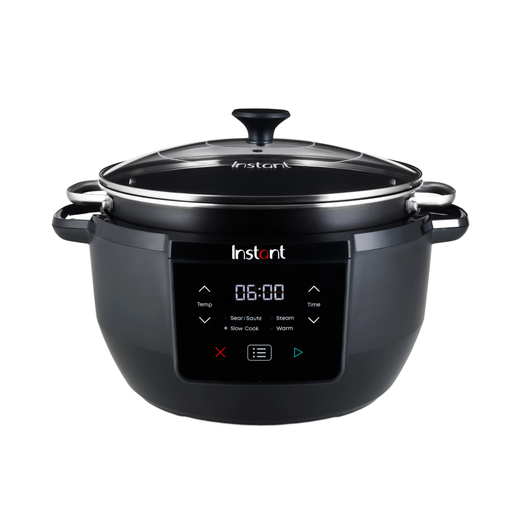 No image available
A good fit if you want to make a larger batch of soup and sauté ingredients in the appliance too.
The product title lists 7,1 L and up to 10 servings. The product information includes slow cooking, sautéing and keeping warm, as well as a dishwasher-safe inner pot. Don’t use the inner pot on a hob, induction hob or in an oven.
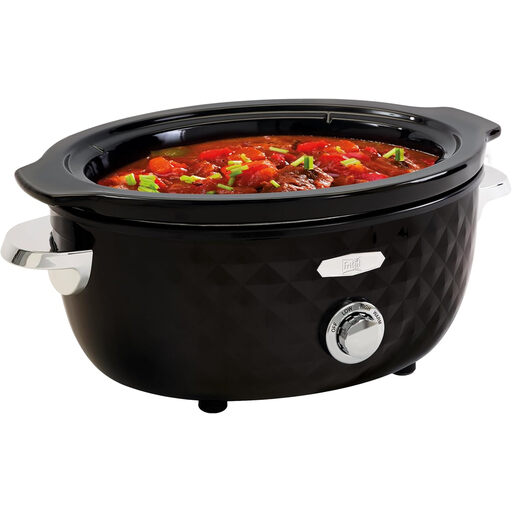 No image available
A good fit if you’re looking for a slow cooker for a group-sized batch and can cook the soup in advance.
The product title lists 210 W, a ceramic pot, four heat settings and a recommended group size of 4 to 8 people.
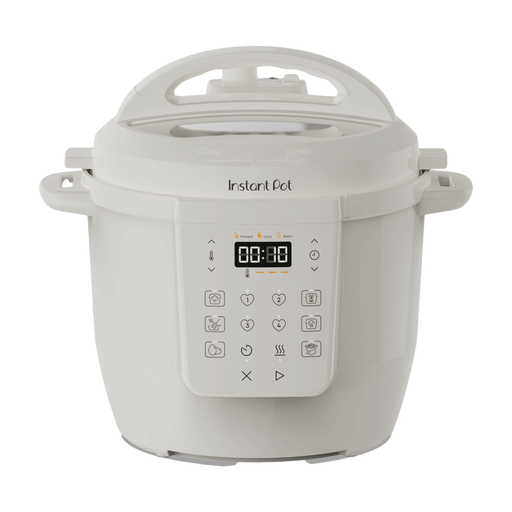 No image available
A good fit if you want the option of a separate pressure-cooking method as well as slow cooking.
The product title lists 5,7 L and pressure-cooking, slow-cooking and steaming functions. Pressure cooking and slow cooking are different methods; follow the instructions for the function you choose.
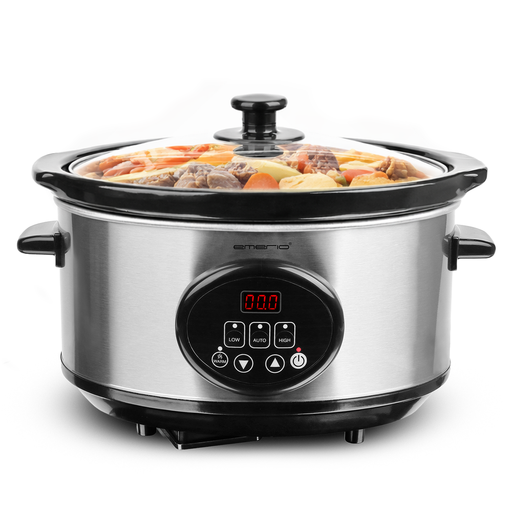 No image available
A good fit if you want a timer and keep-warm function and are happy with a smaller pot.
The product title lists a capacity of 3,5 L, a digital display and a keep-warm function. The product information says it’s for domestic use only; check whether that’s suitable for your workshop.
 No image available
A good fit if you want the option of a separate pressure-cooking method as well as slow cooking.
The product title lists 7,6 L and 12 programmes. For pressure cooking, the safety information specifies a maximum fill level of half full for ingredients that expand, such as grains; stick to this limit when adding pearl barley.
Thaw the chicken safely before putting it in the slow cooker. FoodSafety.gov advises thawing frozen poultry first; the Netherlands Nutrition Centre advises thawing chicken covered in the fridge and cooking it immediately once thawed.
No, not with pearl barley: barley groats come from barley and contain gluten. If you’re cooking for someone who needs to eat gluten-free, make a separate suitable dish and avoid cross-contamination.
It depends on the model. You can sauté in the Instant Superior appliance, but according to the product information, its inner pot must not be used on a hob, induction hob or in an oven.
Not automatically: the word ‘workshop’ alone doesn’t determine whether the activity counts as professional food preparation. If the workshop falls under the catering or small-scale food preparation activities described by the Netherlands Food and Consumer Product Safety Authority, the business must use an HACCP food safety plan or the applicable hygiene code. For this professional setting, the NVWA advises, among other things, heating chicken to at least 75 °C and keeping unpackaged perishable food hot at a minimum of 60 °C.