
Cooking for one
You mainly want to make a small lamb tagine without having to store a large pot. Compare the capacity and instructions for use with the quantity in your recipe. Tomado says its 1.5-litre TSC1501B is suitable for smaller portions.


If you usually make a small lamb tagine for one, compare compact slow cookers and check that your ingredients fit in the pot according to the instructions. Tomado says its 1.5-litre model is suitable for smaller portions. A multicooker could be a good option if you want to use other cooking methods too, while a larger slow cooker gives you room to cook ahead. Follow the Netherlands Nutrition Centre’s guidance for storing leftovers. Before buying, also check the CE marking on the specific appliance: the NVWA says this is compulsory for electrical products placed on the Dutch market.
You mainly want to make a small lamb tagine without having to store a large pot. Compare the capacity and instructions for use with the quantity in your recipe. Tomado says its 1.5-litre TSC1501B is suitable for smaller portions.
You’d like to do more than slow cook, such as cook rice or sauté ingredients, and don’t mind having a larger, more versatile pot. Instant Pot also describes a sauté function on its 2.8-litre rice cooker, slow cooker and steamer.
You eat alone but deliberately make several meals at once. Compare the pot capacity with your recipe and remember to cool and store any extra portions safely. Tristar lists the VS-3915 as having a capacity of 3.5 litres.
Start with how much tagine you want to make at a time. Then decide whether extra functions or space for leftovers matters more to you than a compact pot.
| What to consider | What to look for | Who is this important for? |
|---|---|---|
| Capacity for one tagine | Compare the inner pot’s capacity and the filling instructions for the exact model with all the ingredients in your recipe. | If I’m making one tagine, I want to be able to cook the meat, vegetables and liquid together without having to store a larger pot. Around 50% of consumers say that capacity for one portion is their top priority when choosing. |
| Controls and extra functions | Check which heat settings the model has, whether it includes a timer and whether you’ll actually use functions such as sautéing. | If I want to use the same pot for more than slow cooking, I compare its extra functions with the way I usually cook. Around 30% of consumers prioritise combined cooking functions. |
| Cooking ahead and leftovers | Choose a capacity that suits several portions and follow separate guidance on cooling and storing any leftovers. | If I’m deliberately cooking for several meals, I want enough room in the pot and a plan for the leftovers. Around 20% of consumers prioritise cooking ahead. |
The number of rice portions listed by Instant Pot doesn’t tell you how much tagine you can cook in the pot. Meat, vegetables and sauce add up to a different volume of ingredients.
Compare the inner pot and filling instructions with the full quantity in your recipe, rather than with the stated number of rice portions.
Keep warm is no substitute for cooling and refrigerating any extra tagine.
Spoon leftovers out of the pot and follow the Netherlands Nutrition Centre’s storage advice: cover and refrigerate them within two hours, and keep them for no more than two days.
Manufacturer pages for the Russell Hobbs Compact Home 25570-56 give conflicting capacity figures: 2 litres and 1.5 litres.
Before you decide, ask the seller to confirm the capacity of the specific version on offer.
Tomado describes the TSC1501B as a compact 1.5-litre slow cooker for smaller portions.
The Compact Home 25570-56 is a small slow cooker with a removable ceramic pot and three heat settings.
The Dutch manufacturer’s page describes a 2.8-litre rice cooker, slow cooker and steamer for anyone looking for several cooking methods.
Tristar describes the VS-3915 as a classic 3.5-litre slow cooker to consider if you make several portions at once.
This selection includes slow cookers and multicookers with a range of capacities and functions. Before buying, check the CE marking on the specific appliance: the NVWA says CE marking is compulsory for electrical products placed on the Dutch market.
 No image available
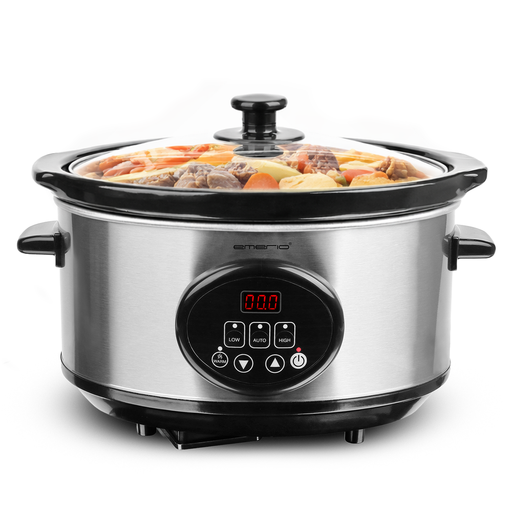
This could suit you if you’re looking for a slow cooker with manual heat control and a steaming function as well as a stewing function.
The product name lists 1000 W, a capacity of 2.6 L and three manual heat settings.
 No image available
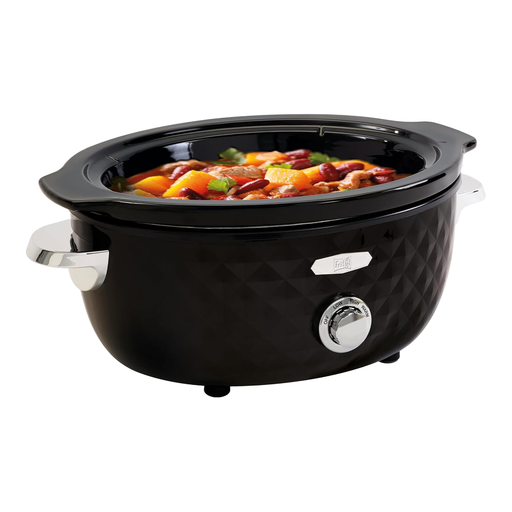
This could suit you if you want a larger slow cooker for your tagine than a compact pot designed for a small portion.
The product name lists digital controls and a keep-warm function. The stated capacity is 3.5 L; the product name doesn’t specify a number of portions.
 No image available
This could suit you if you want a slow cooker that the product name says is intended for one to four people, even though it has a larger capacity than a compact pot.
The product name lists 150 W, a ceramic pot and four heat settings.
 No image available
This could suit you if you want to sauté and steam as well as slow cook, and capacity for larger quantities matters more to you than a compact pot.
The product name lists a capacity of 7.1 L and 10 portions. According to the product information, the inner pot must not be used on a hob or in an oven.
 No image available
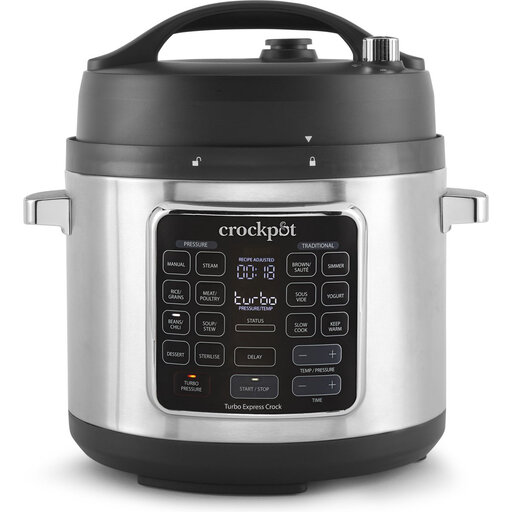
This could suit you if you plan to make several portions at once; it has plenty of capacity for one small tagine.
The product name lists a capacity of 5.6 L and three settings.
No. Simply switching on the slow cooker or waiting for a set time doesn’t prove that the meat is thoroughly cooked. The Netherlands Nutrition Centre advises cooking meat thoroughly, keeping raw meat separate from cooked food and observing the use-by date. Follow the instructions for your chosen slow cooker too, and check that the meat is thoroughly cooked at the end.
Cool leftovers quickly and cover and refrigerate them within two hours. The Netherlands Nutrition Centre advises keeping leftovers in the fridge for no more than two days; freeze them if you want to store them for longer. It recommends keeping your fridge at 4 °C.
The NVWA says CE marking is compulsory for electrical products placed on the Dutch market. Check the marking on the specific appliance; the general requirement doesn’t confirm that an individual product on sale complies with it.
Not automatically. According to the Dutch Government, you have a legal guarantee in the Netherlands, and the seller must provide a solution if a product is faulty. There is no fixed statutory guarantee period in the Netherlands. Compare any additional cover with the rights you already have.