
Workshop cook preparing one large batch
You want to make enough chicken stock in one go. Check how much food and liquid the chosen cooker can hold according to its filling instructions.


First, choose a model with a usable capacity that suits the amount of chicken, vegetables and liquid you’re allowed to prepare according to its instructions. Then plan the cooking time around your workshop schedule. A simple cooker may be enough for a small batch planned in advance, while a timer or multicooker could suit different scheduling needs or cooking demonstrations. Check the food temperature separately and plan how to cool any leftover stock quickly.
You want to make enough chicken stock in one go. Check how much food and liquid the chosen cooker can hold according to its filling instructions.
You want the cooking to fit in with the rest of your workshop. A timer can help with planning, but check the cooking time too, and make sure the model has a timer function.
You want to demonstrate another cooking method alongside slow cooking. Tefal lists a slow-cook programme and pressure-cooking function for the CY505E. When choosing a model for stock, compare its usable capacity, not just the bowl capacity.
First, compare the usable capacity with the amount of stock you plan to make and the model’s filling instructions. Then consider the schedule, controls and any additional cooking functions.
| What to consider | What to look for | Who is this important for? |
|---|---|---|
| Usable capacity | Compare the amount you plan to cook with the usable capacity and filling instructions. The stated bowl capacity does not always reflect the space available for cooking. | If I want to make one batch for the workshop, I need to know how much chicken and liquid will actually fit in the cooker. Around 28% of consumers prioritise usable capacity for their batch. |
| Cooking time | Check the cooking instructions and plan when to start in relation to the tasting session. A timer sets the cooking time, but it doesn’t determine how long the recipe needs. | If the stock is needed at a set time, I want to be able to fit the cooking into the workshop schedule. This is the top priority for around 22% of consumers. |
| Temperature and cooling | Plan who will check the temperature and how leftover stock will be portioned and cooled. A keep-warm setting alone doesn’t confirm the temperature the food reaches. | If I’m serving chicken stock and want to store any leftovers, I need to plan temperature checks and cooling in advance. This is the main concern for around 22% of consumers. |
| Controls and cleaning | Compare the controls, removable parts and cleaning instructions for the exact model. | For a clear demonstration and practical clean-up afterwards, I look for straightforward controls and parts that can be cleaned according to the instructions. Around 17% of consumers prioritise this. |
| Additional cooking functions | Check that the model supports the techniques you want to use and still has enough usable capacity for your batch of stock. | If I want to demonstrate other cooking techniques during the same workshop, I look for suitable functions without losing sight of the capacity needed for the stock. Around 11% of consumers value this versatility most. |
Tefal lists a 6-litre bowl capacity and a usable capacity of 3.8 litres for the CY505E. Ingredients and liquid must also stay within the filling instructions for your chosen model.
Write down your planned batch in advance and check the usable capacity and instructions for the exact model.
A cooker that’s too small may mean you need to prepare an extra batch or choose a different size.
A keep-warm function doesn’t tell you what temperature the stock reaches in practice. For relevant food businesses, the NVWA specifies temperature checks when keeping food warm. Follow the rules that apply to your situation.
Assign someone to check the temperature and make a plan in advance for portioning and cooling leftover stock.
You may need a suitable digital probe thermometer to check the temperature.
Model numbers can differ, even when the brand name is the same. For example, a reference to the Crock-Pot CSC062X isn’t proof that it’s the CSC063X.
Before buying, compare the full model number and check the capacity and functions of the specific version you plan to use.
The CSC063X is worth considering if you want to plan a larger batch using a timer.
The TSC3501B is a simple option for a smaller demonstration planned in advance.
The VS-3915 is another simple option for a smaller batch.
The CY505E is a multicooker to consider if you want to combine slow cooking with other cooking techniques.
This selection includes slow cookers and multicookers for a planned batch of stock, with options for a smaller pot, extra cooking functions or a larger capacity.
 No image available
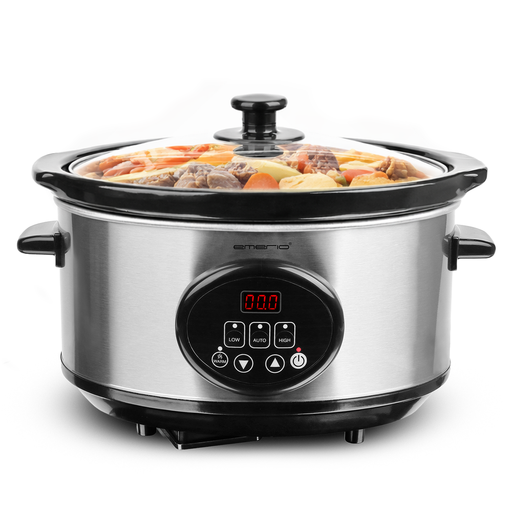
An option for a planned batch if you want to use a timer and keep-warm function.
The product information lists digital controls, Low and High settings, and a removable ceramic inner pot.
 No image available
The larger stated capacity and multiple cooking functions may suit a workshop with a bigger batch or several demonstrations.
The product information lists a 7.1-litre capacity, up to 10 portions, adjustable time and temperature, slow cooking, steaming, and baking or sautéing.
 No image available
The smaller stated capacity may suit a small batch. The product description says the appliance is for domestic use only and isn’t suitable for commercial use.
The title lists 1000 W. The description mentions three manual settings, a glass lid and a non-stick inner pot.
 No image available
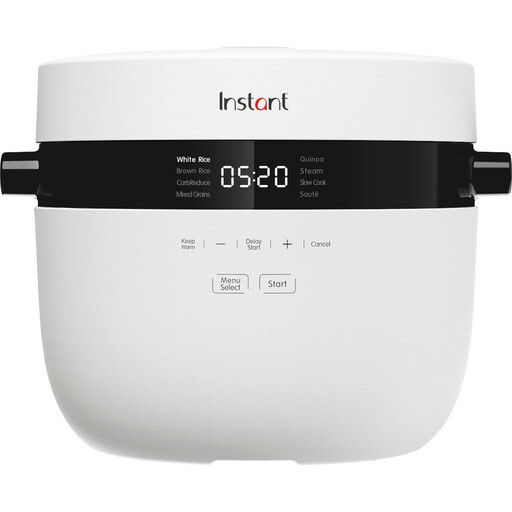
A multicooker option if you want to use other cooking techniques as well as slow cooking.
The product information lists a 5-litre capacity, a slow-cook programme, steaming and sautéing, and a stainless steel inner pot.
 No image available
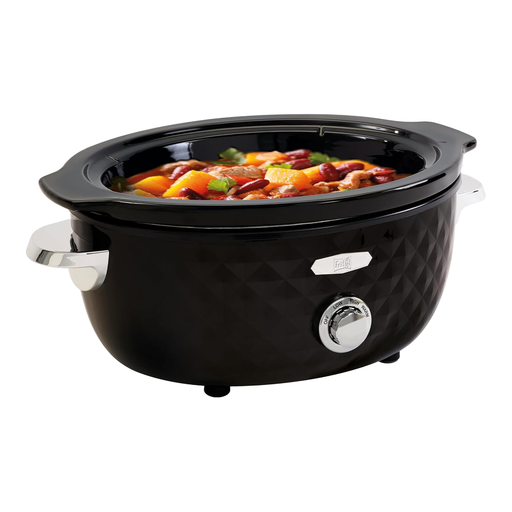
An option for a smaller planned meal, with a removable pot for serving and cleaning, according to the product information.
The title lists 150 W, a ceramic pot and four heat settings. The description mentions 1 to 4 people and a removable, dishwasher-safe pot.
A keep-warm setting doesn’t confirm the temperature the stock reaches, so check the food temperature. For relevant food businesses, the NVWA specifies that unpackaged perishable food must be kept at 60 °C or above.
Keep raw chicken separate from cooked food, wash your hands after handling it and don’t rinse the chicken, as advised by the Netherlands Nutrition Centre. For relevant food businesses, the NVWA specifies that chicken should be heated to 75 °C or above. Check this with a digital probe thermometer.
Divide leftover stock between suitable, airtight containers. According to the Netherlands Nutrition Centre, cover them and put them in a 4 °C fridge within two hours of cooking, once cooled. Food businesses may also need to follow applicable HACCP procedures for cooling food.
Not just because it’s a cooking workshop. The NVWA requires relevant food businesses, including restaurants and catering businesses, to have a food safety plan or hygiene code based on HACCP. Whether this applies to the organiser depends on the actual business activity; don’t automatically treat a private workshop as a catering business.
It depends on how much chicken, vegetables and liquid you want to cook, and on the filling instructions for the exact model. Compare your planned batch with the usable capacity; for some models, this differs from the stated bowl capacity.