If you have space next to the worktop or a suitable built-in recess, a slimline dishwasher keeps your worktop clear and usually offers more room than a tabletop model. The Consumentenbond gives a capacity of around 9 to 10 place settings for slimline models, compared with 6 for a mini dishwasher. Check that your bowls fit in the racks and that the dimensions and connections are right for your kitchen. A tabletop model is mainly an option if you’re happy to use some of your worktop for it.
Who might find a small dishwasher useful?
Keeping the worktop clear
You want to wash breakfast bowls in a machine without giving up permanent worktop space, and can check whether a slimline freestanding or built-in model will fit. The Consumentenbond describes slimline dishwashers as around 45 cm wide.
Loading bowls and crockery together
You want to fit several bowls, cups and cutlery in one load. The Consumentenbond, Inventum and Bosch describe capacity and rack layouts, but whether your own bowls fit also depends on their shape and height.
A tricky space for installation
Your choice depends on the available floor space or recess, as well as the connections available. Check the installation information for your chosen model; Bosch Nederland lists water, drainage and electrical connections among other requirements.
What should you look for when buying?
Slimline freestanding dishwasher
A good fit if: you have floor space next to the worktop and want to keep the worktop clear.
Bear in mind: the floor space needed, door clearance and connections.
Slimline built-in dishwasher
A good fit if: you have a suitable recess and your kitchen door and front panel are compatible with the model.
Bear in mind: the recess height and door system; measure these before choosing a model.
Compact tabletop dishwasher
A good fit if: you can place the appliance on the worktop and are happy to give up that space.
Bear in mind: the appliance takes up worktop space and usually offers less capacity than a slimline freestanding model.
Washing up by hand
A good fit if: you only have a few breakfast bowls and would rather not have an appliance taking up space.
Bear in mind: it takes your time. According to Milieu Centraal, washing up by hand is usually better for the environment if you use little hot water.
| What to consider |
What should you check? |
Who should pay particular attention? |
| Worktop space and external dimensions |
Measure the width, height and depth, as well as the space needed for the door. First decide whether you have room on the floor or worktop. |
I want to keep the worktop clear and can look for a space next to it; around 36% of consumers prioritise keeping their worktop space free. |
| Whether breakfast bowls will fit |
Measure your bowls and check the rack height, adjustability and cutlery space. A place-setting capacity doesn’t guarantee that your crockery will fit. |
If I want to load bowls, cups and cutlery together, I’ll focus on the usable rack space; around 29% of consumers prioritise whether their crockery will fit. |
| Positioning and connections |
For a built-in model, check the recess dimensions and door system. Check the installation manual and connection options for each model. |
If my recess, floor space or connections determine my choice, I want to check them before buying; around 21% of consumers prioritise installation and connections. |
| Consumption per usable load |
Compare kWh per 100 eco cycles, litres per eco cycle and capacity. Think about how much of your own washing-up will fit in one load. |
I want to weigh consumption against how much washing-up I can actually load; around 14% of consumers make consumption per usable load their main consideration. |
The European Commission says the energy label includes information such as the energy rating, consumption per 100 eco cycles, water consumption per eco cycle, capacity and noise level. These figures relate to the eco programme and don’t automatically show the consumption of other programmes.
Common buying mistakes
-
Confusing ‘compact’ with ‘slimline’
A slimline freestanding machine and a tabletop model solve different space problems: the first can leave your worktop clear, while the second sits on it.
Choose where you’ll put it first. Then compare the full product dimensions, door clearance and loading capacity.
-
Assuming the place-setting capacity means your bowls will fit
The stated place-setting capacity doesn’t tell you exactly whether your bowls will fit in the racks at the same time.
Measure your bowls and check the rack height, adjustability and cutlery holder on the exact model.
If your bowls don’t fit together, you may need to split your washing-up over more loads.
-
Assuming a smaller appliance will automatically use less energy
A small machine may take fewer dishes per load. The energy label shows consumption for the eco programme, but doesn’t automatically tell you how much energy you’ll use overall.
Compare the label information with the capacity and the amount of washing-up you can actually load each time.
A smaller usable load may mean running a programme more often.
-
Assuming a product listing confirms every specification
The Joybuy product listing for the Bosch SPS4EMI17E gives a capacity of 13 place settings, while Bosch Nederland states 10. This difference affects how much you can load.
Before buying, check which version and capacity apply to the model on offer; don’t rely on the place-setting capacity in the product title alone.
Brands to consider for this installation question
Bosch
Bosch has freestanding dishwashers around 45 cm wide, which may suit you if you want to keep your worktop clear.
- For the SPS4EMI17E, Bosch Nederland lists dimensions of 845 × 450 × 600 mm, energy rating B, an adjustable rack system and automatic door opening.
- This information applies to the model version listed. Also check that there’s enough room for the door to open in your kitchen.
ETNA
ETNA has a slimline freestanding model and a slimline built-in model; the right option depends on where you plan to install it.
- ETNA lists the freestanding VWV147SWIT as 44,8 cm wide, with a capacity of 9 place settings and energy rating E. For the built-in VW47SM, ETNA gives a capacity of 9 place settings.
- According to ETNA, the VW47SM requires a recess height of 820–880 mm. Freestanding and built-in models are designed for different types of installation, so compare them separately.
Inventum
The Inventum VVW5520 is a tabletop model for anyone who can make room for the appliance on their worktop.
- Inventum lists this model as 55 cm wide, with a capacity of 6 place settings and energy rating D.
- Inventum doesn’t list a half-load option. The stated capacity and dimensions are manufacturer specifications and don’t confirm whether your bowls will fit in the rack.
Product options at Joybuy
This selection includes slimline freestanding dishwashers that leave the worktop clear, plus a tabletop model for anyone with worktop space to spare.
 Image unavailable
Bosch SPS4HKW49E Series 4, freestanding, 45 cm, white
The freestanding model can leave your worktop clear if you have a suitable space on the floor next to it.
The product title gives a width of 45 cm. The product description mentions Slimline VarioFlex racks.
Check the available floor space, connections and whether your own crockery will fit.
View at Joybuy
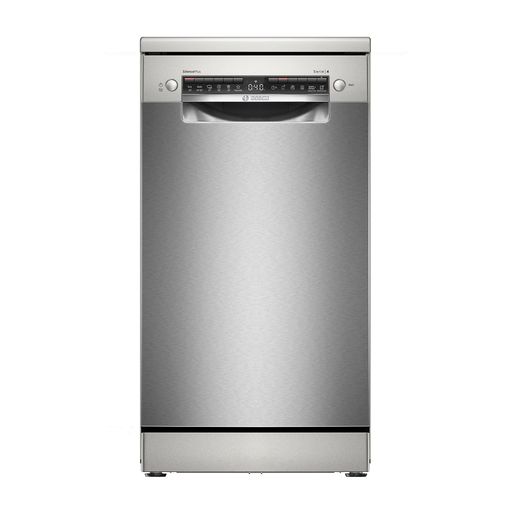 Image unavailable
Bosch SPS4EMI17E, freestanding, 45 cm
A slimline freestanding model to keep your worktop clear if you have space next to it.
The product title gives a width of 45 cm. The product description says the upper rack can be adjusted to three positions.
Check the capacity of the version on offer: the product listing and Bosch Nederland give different place-setting capacities.
View at Joybuy
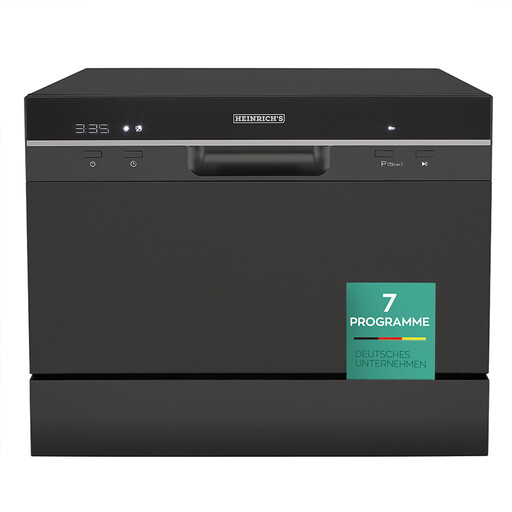 Image unavailable
Heinrich's HTG 8840, black tabletop model, 6 place settings
This tabletop model is an option if you’re happy to use some of your worktop for the appliance.
The product title gives a capacity of 6 place settings and 7 programmes.
Check that you’ll have enough worktop space left and that the rack will suit your bowls and other dishes.
View at Joybuy
Frequently asked questions
How much does the place-setting capacity tell me about space for my breakfast bowls?
The place-setting capacity gives a standard measure of how much a dishwasher can hold, but it doesn’t confirm that your bowls will all fit at once. Measure them and check the rack layout; Inventum gives a bowl as an example of crockery included in a place setting.
What should I check before installation?
Check the full installation dimensions, the model-specific manual and the available water, drainage and electrical connections. For built-in models, you’ll also need to check the recess dimensions and door system; Bosch Nederland refers you to the model’s installation information.
Should I rinse breakfast bowls before loading them?
No. According to Milieu Centraal, pre-rinsing isn’t necessary. Remove food scraps and, where possible, use the eco programme with a suitable load size.
What information is shown on the EU energy label for dishwashers?
According to the European Commission, the label includes information such as the energy rating, energy consumption per 100 eco cycles, water consumption per eco cycle, capacity and noise level. These figures apply to the eco programme; don’t assume they show the consumption of every other programme.
What can I do if my dishwasher breaks down too soon during normal use?
According to ACM ConsuWijzer, the retailer is responsible for the statutory guarantee. If the product doesn’t perform as you could reasonably expect during normal use, the retailer must offer a suitable solution at no extra cost, such as a repair or replacement.


