A slimline dishwasher around 45 cm wide is a practical option if you have a suitable space on the floor or a built-in recess. A tabletop model may be a better fit if you only have room on the worktop and usually have a small amount of washing-up. Measure more than just the width: check the height, depth, door clearance and connection points too, and make sure your lunchboxes fit securely in the upper basket. Plastic items won’t dry automatically, so follow the care instructions for your lunchboxes and allow for some hand-drying.
Who is a slimline dishwasher suitable for?
Shopper with a narrow kitchen
You’re looking for a permanent place for a dishwasher but don’t have room for a standard-width model. First, measure the available space or recess and compare it with the appliance dimensions. The Consumentenbond recommends comparing the recess dimensions with those of the appliance.
Everyday lunchbox washer
You want to wash lunchboxes and separate lids regularly with your usual washing-up. The Consumentenbond recommends placing plastic and delicate items in the upper basket. Mepal advises storing the lid and lunchbox separately so they can dry properly.
Household with little washing-up
You often have a small load and want to match the capacity to the programme you use. Milieu Centraal recommends running the dishwasher when it’s full and choosing the eco programme, so consider how often you expect to be able to fill the machine too.
What should you look for when choosing?
Freestanding slimline model
Choose this if: you have a suitable floor space around 45 cm wide and can access the water inlet and outlet.
Bear in mind: you’ll need room for the appliance on the floor and for the door to open; the number of place settings doesn’t tell you how many large lunchboxes will fit.
Slimline integrated dishwasher
Choose this if: you have a suitable built-in recess and want to conceal the appliance behind a kitchen cabinet door.
Bear in mind: the recess, appliance dimensions, plinth and door construction all need to work together.
Compact tabletop model
Choose this if: you don’t have a suitable raised space, but do have room on the worktop and a suitable way to connect it.
Bear in mind: the model takes up worktop space and usually has less capacity than a tall slimline model.
Standard model around 60 cm wide
Choose this if: you have room for the extra width and regularly have enough washing-up to fill the machine.
Bear in mind: this model needs more width. According to the Consumentenbond, a slimline model washes a smaller amount of dishes and is less efficient than a larger machine when that machine is full.
| What to consider |
What to look for when buying |
Who is this important for? |
| Will the appliance fit in the space? |
Measure the width, height, depth and door clearance; check the water inlet and outlet too. |
If space is limited, I want to know in advance that both the appliance and its open door will fit. Around 33% of consumers put placement first. |
| Will the lunchboxes fit in the baskets? |
Compare the dimensions of your lunchboxes with the upper basket and check whether separate lids can sit securely. |
If I want to wash lunchboxes and lids with my usual washing-up, I look at how usable the basket layout is and how well things dry. Around 27% of consumers prioritise the layout for lunchboxes. |
| How much will it use? |
Compare energy and water consumption for the same eco programme, and think about the load you realistically expect to wash. |
If I use the machine regularly, I want to know how much it uses for my usual load. Around 20% of consumers consider consumption first. |
| Are installation and aftercare manageable? |
Check the connection points and, for an integrated model, the installation instructions and the dimensions of the recess and cabinet door. |
If I’m having a model installed or connected, I want to know in advance what’s involved and who to contact if there’s a fault. Around 20% of consumers make installation and aftercare their main priority. |
Which buying mistakes can you avoid?
-
Measuring only the 45 cm width
The height, depth, door clearance and connections also determine whether the appliance will fit. For an integrated model, the recess and cabinet door also need to match the installation specifications.
Measure the full space available and compare it with the specifications for the exact model before you order.
-
Assuming ten place settings means ten lunchboxes
Place settings describe a standard load. Large lunchboxes and separate lids take up basket space differently, leaving less room for other dishes.
Compare the dimensions of your own lunchboxes with the basket layout and follow the lunchbox manufacturer’s instructions.
-
Assuming a smaller machine is always more efficient
Consumption depends on the amount of washing-up and the programme you choose. A larger machine filled properly may use less per amount of washing-up than a smaller one.
Compare consumption figures on the same basis and choose a capacity that suits how you use it.
Which brands are worth considering?
Beko
The BDFS26046XQ is a freestanding slimline model with space for 10 place settings and a cutlery drawer.
- According to Beko’s model specifications, this model has an adjustable upper basket and the door opens automatically at the end of the programme.
- These features don’t guarantee that every plastic lunchbox will dry; check how you load it and follow the instructions for your lunchboxes.
Inventum
The VVW4530AW is a freestanding model, 45 cm wide, with space for 10 place settings.
- Inventum lists an adjustable upper basket, a cutlery basket, a half-load option and energy class D.
- A half-load option doesn’t replace comparing consumption across the programmes you use.
Siemens
The SR61HX17KE is a fully integrated slimline model for a suitable built-in recess.
- Siemens specifies appliance dimensions of 815 × 448 × 550 mm and energy class D.
- These appliance dimensions alone don’t confirm that an existing recess, plinth and cabinet door will fit.
ETNA
The VWV147SWIT is a freestanding slimline model for anyone looking for an adjustable upper basket.
- The product specification sheet lists appliance dimensions of 845 × 448 × 600 mm, a noise level of 47 dB(A) and residual-heat drying.
- Check the full space available; these specifications don’t guarantee that plastic lids will dry.
Dishwashers for smaller spaces
This selection includes freestanding slimline models measuring 45 cm and compact tabletop models. The right type for you depends on the floor or worktop space available.
 No image available
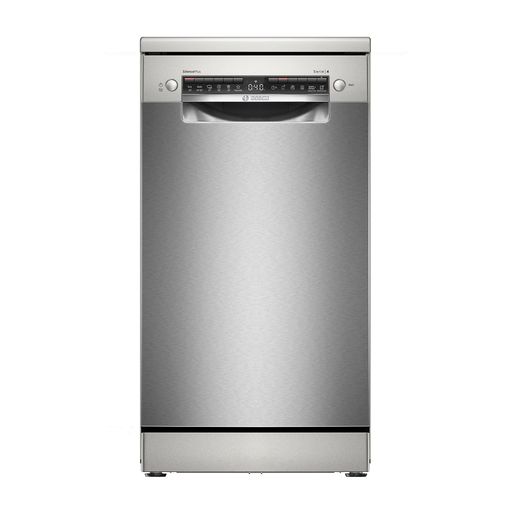
Bosch SPS4EMI17E
A freestanding model to consider if you’re looking for a slimline dishwasher and the space available can accommodate this type.
45 cm wide; 13 place settings; EcoSilence Drive; AquaStop.
Joybuy
 No image available
Bosch SPS4HKW49E Series 4
A freestanding slimline model to consider if a width of 45 cm suits the space you have available.
45 cm; white.
Joybuy
 No image available
AIRMSEN Portable Countertop Dishwasher
A tabletop model to consider if you have room on the worktop and don’t want to use a fixed water connection.
Built-in 5-litre water tank; 5+1 wash cycles; no water connection required according to the product title.
Joybuy
 No image available
AIRMSEN Tabletop Dishwasher
A tabletop model to consider if a compact appliance on the worktop better suits the space you have available.
37 × 50 cm; built-in 5-litre water tank; 9 wash programmes; energy class D.
Joybuy
 No image available
Heinrich's HTG 8855
A mini tabletop model to consider if you have little washing-up and are looking for a small appliance to sit on a table.
3 place settings; 7 programmes; noise level 56,3 dB.
Joybuy
Frequently asked questions
Is a tabletop model the same as a slimline dishwasher?
No. A tabletop model is shorter and usually holds around 6 place settings, while a slimline model is about 45 cm wide and roughly the same height as a standard dishwasher. Measure your lunchboxes and the space where you plan to put the appliance too.
Can dishwasher-safe lunchboxes go in the bottom basket?
Check the instructions for the specific lunchbox model. The Consumentenbond recommends placing plastic and delicate items in the upper basket because it’s hotter at the bottom. Arrange the items so water can drain away.
How do I maintain my dishwasher with daily use?
Scrape large food scraps off the dishes and clean the filter regularly. Follow the manual’s instructions for salt and rinse aid, and adjust the salt to suit your local water hardness.
How do I compare the consumption of different models?
Compare the energy and water figures for the same eco programme, and take into account how many cycles you run yourself. Milieu Centraal recommends running the machine as full as possible and choosing the eco programme.
What about warranties and the EU energy label in the Netherlands?
If a product develops a fault, the seller must provide a solution according to the Dutch government; there’s no fixed statutory warranty period covering all products in the Netherlands. EU rules on energy labels and ecodesign apply to dishwashers. Use the label and product information sheet to compare models on the same basis.


