
Small kitchen with floor space
You’re looking for a dishwasher that fits into a narrow gap without taking up worktop space. The Consumentenbond advises checking the available width, height and depth against the appliance’s dimensions.


If you have floor space and suitable connections, a slimline dishwasher is a sensible choice if you want to wash breakfast bowls alongside your other everyday dishes. If you don’t have the space, compare tabletop models by their actual external dimensions and smaller capacity: a tabletop model isn’t automatically narrower than a freestanding one. The Consumentenbond generally describes slimline dishwashers as 45 cm wide; the Inventum VVW5520 tabletop model is 55 cm wide.
You’re looking for a dishwasher that fits into a narrow gap without taking up worktop space. The Consumentenbond advises checking the available width, height and depth against the appliance’s dimensions.
You’d like to fit bowls, glasses and cutlery in the same load. So don’t just look at the number of place settings: check the rack layout and the dimensions of your own tableware too. For example, Inventum lists an adjustable upper rack for the VVW4530AW.
You’re considering a tabletop model and need to assess both the available worktop space and its smaller capacity, as well as the connection options. Inventum lists the VVW5520 as 55 cm wide, with a capacity of six place settings.
A good fit if: you have around 45 cm of floor width, can use the available connections and want to wash breakfast dishes alongside your other everyday dishes.
The trade-off: the appliance still takes up floor space. The number of place settings doesn’t guarantee that your bowls will fit in the racks.
A good fit if: there’s no floor or alcove space, but you have a suitable spot on the worktop or in a cupboard and usually have a small amount of washing-up.
The trade-off: capacity and width vary by model. The Inventum VVW5520, for example, is 55 cm wide and holds six place settings; Milieu Centraal generally advises against mini dishwashers on the grounds of energy use and ease of use.
| What to consider | What should you check? | Who is this important for? |
|---|---|---|
| Space and external dimensions | Measure the width, height and depth, and allow for the door to open and the hose route. Compare the dimensions of the exact model with the space available. | I first need to know whether an appliance will fit on the floor or worktop and whether the door can open properly; around 36% of consumers make space their top priority. |
| Capacity and racks | Check the rack layout and whether it can be adjusted. Compare the interior space with your own bowls, glasses and cutlery. | I’d like to wash my breakfast dishes alongside the rest of my everyday dishes; around 29% of consumers prioritise capacity and layout. |
| Connections and installation | Check the model’s manual and the required water supply, drainage and electrical connection. Have any unclear alterations assessed before you order. | I first need to know whether the machine can be installed and connected safely; around 21% of consumers make connection requirements their first deciding factor. |
| Energy use and noise | For the exact models, compare energy use per eco cycle, programme duration and noise level. The energy label is based on the eco programme. | Once space and connections are sorted, I mainly want to weigh up running costs and noise; around 14% of consumers give these points top priority. |
A tabletop model isn’t necessarily narrower than a slimline freestanding dishwasher. The Inventum VVW5520, for example, is 55 cm wide, while slimline dishwashers are generally 45 cm wide.
Measure the space and compare all the external dimensions of the exact model, including the room needed to open the door.
An appliance that doesn’t fit in the chosen spot could take up valuable worktop space.
A place setting is the standard set of tableware for one person. The shape of your bowls and the rack layout may not match those standard dimensions.
Check the racks and measure larger items of tableware before choosing based on the stated number of place settings.
The energy label is based on eco mode. Energy use can vary if you choose another programme or load the machine differently.
Check that the appliance can be connected, then compare the exact models’ energy use per 100 eco cycles, water use per eco cycle and the capacity you usually need.
If the existing connections aren’t suitable, installation may require extra work.
In the Netherlands, Inventum offers both a slimline freestanding dishwasher and a compact tabletop model.
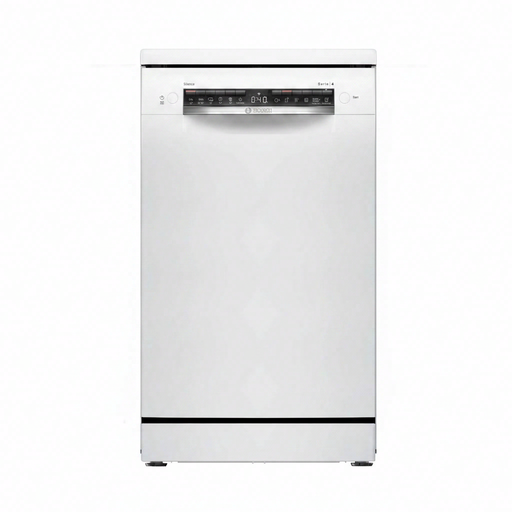
The SPS4HKW49E is a 45 cm-wide slimline freestanding model.
Beko describes the BDFS26046XQ as a slimline freestanding dishwasher for ten standard place settings.
The VW47SM is a fully integrated 45 cm-wide built-in model, designed for a suitably sized niche and kitchen door panel.
These product options include compact tabletop models and a slimline freestanding dishwasher for small kitchens. Compare the stated capacity with your breakfast bowls and the space you have available.
 No image available
Worth considering if you’re looking for a tabletop model for smaller everyday loads.
The product information lists a capacity of up to four place settings, a built-in 5 l water tank, two water supply options, nine programmes and energy class D. The stated width and depth are 37 × 50 cm.
 No image available
This tabletop model is worth comparing if you want to wash a small load and a water tank is a useful connection option for you.
The product information lists three place settings, seven programmes, a 5 l water tank and 4,2 l of water per wash. It also gives a noise level of 56,3 dB and energy class C.
 No image available
A slimline freestanding option to compare if you have enough floor space and want to wash breakfast dishes in the same load.
Bosch lists an adjustable upper rack and a noise level of 44 dB for the SPS4HKW49E. Check that the rack layout and external dimensions suit your tableware and kitchen.
No. Slimline freestanding dishwashers are generally 45 cm wide, while the Inventum VVW5520 tabletop model is 55 cm wide. Measure the available space and check the dimensions of the exact model.
Check the model’s manual and make sure the water tap, drain and electrical connection are suitable. For a standard connection, the Consumentenbond specifies an earthed wall socket on a separate 16 A circuit; make sure any necessary alterations are carried out safely.
Milieu Centraal advises removing food scraps and generally skipping a hot pre-rinse. For normally soiled dishes, it’s best to run a full machine on eco and check the model’s manual for exceptions.
No. According to ACM ConsuWijzer, the statutory guarantee is separate from the seller’s guarantee and depends on what you could reasonably expect from the product with normal use. Report any fault to the seller.
The Dutch government states that dishwashers must have an energy label. You can take an old appliance to the shop or online retailer where you buy a new, similar appliance, to a collection point or to your local council’s recycling centre.