For small daily loads, first choose a slimline dishwasher whose type and full dimensions fit your kitchen, then check that its racks suit your crockery. The Consumentenbond describes slimline dishwashers as around 45 cm wide, with space for 9 to 10 place settings, but the exact model’s dimensions will determine whether it really fits. A half-load option can be useful if you often have only a few items to wash. Milieu Centraal advises running a full load on the eco programme if you can wait, while Energielabel.nl explains that energy-label values do not automatically apply to other settings.
Who is a slimline dishwasher suitable for?
Cook with limited kitchen space
You want to wash plates and cups in the machine every day and check whether a freestanding or integrated model will fit the space available. The Consumentenbond describes slimline dishwashers as around 45 cm wide and notes that a freestanding model can, for example, go next to the worktop, provided water and drainage connections are available.
If you often wash small loads
You don’t want to keep waiting until you have lots of dirty crockery, so you compare the rack layout, programmes and half-load option for the specific model. Manufacturers list this option by model, so check the product specifications.
If you are energy-conscious
You may be able to save up your washing and want to weigh the convenience of running the machine more often against its electricity and water use. Milieu Centraal advises only switching the dishwasher on when it’s full and using the eco programme.
What should you look for when washing small loads?
Slimline freestanding dishwasher
Suitable for: a kitchen without a suitable space for an integrated model, but with room and connections for a freestanding one.
Things to consider: check the appliance’s full dimensions and the space needed for the door. A slimline machine is narrower, but doesn’t automatically use less energy or water.
Slimline integrated dishwasher
Suitable for: a kitchen with a suitable space and matching door front.
Things to consider: check the installation dimensions, kitchen door front and door clearance for the exact model. The number of place settings doesn’t tell you whether your pans will fit.
Wait for a full load
Suitable for: anyone with enough crockery to wait until the next wash.
Things to consider: you’ll have to wait longer for clean crockery. Milieu Centraal advises running a full load on the eco programme.
| What to consider |
What to look for when buying |
Who is this important for? |
| Will it fit in the space? |
Check the type, full appliance or niche dimensions, connections and door clearance against the manual for the exact model. |
If space is limited, I want to know in advance whether the appliance will really fit. Around 31% of consumers say installation is their main concern when buying. |
| Practical for small loads? |
Look at the racks and cutlery system, check the capacity and confirm whether the model has a half-load option. |
If I only have a few plates and cups each day, I want to wash them without waiting ages for a full load. Around 31% of consumers prioritise small loads. |
| Electricity and water use |
Compare kWh per 100 eco cycles, litres per eco cycle, capacity and programme duration on the same label basis. Ask for model-specific figures if half-load consumption is a deciding factor. |
I can save up my washing if that helps reduce electricity and water use, and I want to compare consumption on a like-for-like basis. Around 25% of consumers say energy and water use is their main concern when buying. |
| Noise and drying performance |
Compare the stated noise level and check the drying function and programme conditions for the exact model. |
In an open-plan kitchen, I want to take noise into account. If I want to put crockery away quickly, I’ll also look at the drying function. Around 13% of consumers prioritise quiet operation or dry crockery. |
Common buying mistakes
-
Assuming ‘45 cm wide’ is the full installation size
The niche, depth, door and kitchen front must also fit the exact model.
Measure the available space and compare all installation requirements with the manual before choosing between a freestanding and an integrated model.
Getting the measurements wrong could mean extra installation or modification work.
-
Assuming half a load uses half the energy and water
A manufacturer may offer a half-load option without the energy-label values showing its consumption in that setting.
Use label values for the stated comparison basis, and check model-specific consumption figures if you plan to use that setting often.
-
Choosing based only on place settings or energy class
Place settings describe standard crockery, not how your pans will fit in the racks. The energy label also gives separate figures for electricity, water, noise and programme duration.
Consider the rack layout with your own crockery in mind, and compare label figures on the same basis.
Brands and models to compare
Inventum
The VVW4530AW is a slimline freestanding dishwasher for anyone looking for a freestanding model with room for standard crockery.
- Inventum says this model has 10 place settings, a height-adjustable upper rack and a half-load option.
- Inventum mentions savings when using the half-load option, but this is information from the manufacturer. Don’t assume the stated 11 litres is the consumption for that setting.
ETNA
The VW47SM is a slimline integrated option for a kitchen with a suitable niche and door front.
- ETNA says this model holds nine place settings and has a half-load option, several programmes and a delay-start function.
- Check that the niche, kitchen door front and door clearance suit the exact model. A small load isn’t automatically more efficient than waiting for a full one.
Beko
The BDFS26046XQ is a slimline freestanding dishwasher with published capacity and consumption figures.
- Beko lists 10 place settings, energy class C, 8.9 litres of water per cycle and a noise level of 44 dB(A) for this model.
- These specifications apply to this model. The product information about SelfDry is a manufacturer’s claim, not the result of an independent test.
Bosch
The SPS4HKW49E is a slimline freestanding model with stated eco-cycle consumption and noise figures.
- Bosch lists 10 place settings, 44 dB(A), energy class E and 76 kWh per 100 eco cycles for this model.
- Extra Dry is a separate setting; the eco-cycle consumption figure shouldn’t automatically be applied to it.
Joybuy products
These Joybuy products are slimline freestanding dishwashers. Compare their capacity and rack layout with the crockery you use every day.
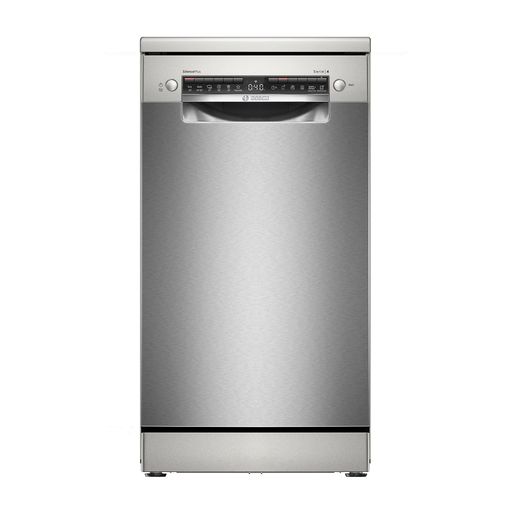 No image available
Bosch SPS4EMI17E, 45 cm, 13 place settings
A slimline freestanding model to compare if you’re looking for a dishwasher for everyday crockery.
The product title lists a width of 45 cm and 13 place settings. The product description mentions six programmes, AquaSensor, automatic door opening, an adjustable upper rack and VarioDrawer.
View at Joybuy
 No image available
Bosch SPS4HKW49E Serie 4, 45 cm, white
A slimline freestanding model to compare if you want to consider stated consumption and noise as well as capacity.
Bosch lists 10 place settings, 44 dB(A), energy class E and 76 kWh per 100 eco cycles for this model. The product description mentions Extra Dry; this setting is different from the eco cycle to which the consumption figure applies.
View at Joybuy
Frequently asked questions
Is a half load the same as an efficient full eco cycle?
No. The label values provide a basis for comparing eco cycles and don’t automatically show consumption for a half load. Milieu Centraal advises running a full load on the eco programme if you can wait. Check model-specific figures before assuming there will be a difference in consumption.
What should I check before installing a slimline integrated dishwasher?
Compare the niche dimensions, door fitting and kitchen front with the installation manual for the exact model. Also check the available connections, and don’t rely solely on the ‘45 cm’ measurement.
What maintenance does a dishwasher need with daily use?
Remove food scraps and clean the machine and filters according to the manual. Follow the model’s instructions for salt and rinse aid, and take your local water hardness into account. An all-in-one tablet isn’t sufficient in every situation.
Which Dutch labelling and guarantee rules are relevant?
Energy labels are compulsory for household appliances and also show water consumption for dishwashers. According to ACM ConsuWijzer, the seller must offer an appropriate solution if a product is faulty under normal use; a shorter manufacturer’s guarantee doesn’t replace this legal right. For a typical online purchase, you generally have a statutory 14-day cooling-off period after delivery.


