If you have room for a slimline dishwasher, first compare freestanding and integrated models by their external dimensions, connections and basket layout. The place-setting capacity won’t tell you how many of your mugs will fit. A tabletop model saves floor space, but takes up worktop room and usually offers less loading capacity.
Who should consider a slimline dishwasher?
If you have limited kitchen space
First decide whether a freestanding, integrated or tabletop appliance is right for you. Measure the available space and allow for the connections and the door opening. The Consumentenbond describes slimline dishwashers as 45 cm wide.
If you often wash dishwasher-safe mugs
The dimensions of your own mugs and the usable space in the basket matter more than the stated place-setting capacity. ETNA Service recommends placing cups in the upper basket.
Small households keeping an eye on consumption
Compare energy and water consumption using the eco programme, and check that the machine suits the amount of washing-up you usually have. Milieu Centraal recommends loading a dishwasher fully; the EU label includes information such as energy consumption per 100 eco cycles.
What should you consider when choosing?
Slimline freestanding model
Choose this if: you have floor or under-worktop space and the water, waste and electrical connections are accessible.
The trade-off: a slimline model takes up less width than a standard model, but still uses floor space. Also measure the height, depth and space needed to open the door.
Slimline integrated dishwasher
Choose this if: you have a suitable niche and want to conceal the dishwasher behind a kitchen door.
The trade-off: your worktop stays clear, but the niche, door system and installation must all be suitable for the exact model.
Compact tabletop model
Choose this if: you don’t have suitable floor space or a niche, but do have a stable spot on the worktop and a workable connection.
The trade-off: you’ll save floor space, but lose worktop space and loading capacity. Milieu Centraal advises against mini dishwashers because of their relatively high consumption and often disappointing test results.
| What to consider |
What to look for when buying |
Who should pay particular attention? |
| Space and positioning |
Measure the height, width, depth, door opening and connections; for an integrated model, also check that it will fit the niche. |
I want to make sure the appliance won’t block my workspace and that there’s a suitable place to connect it safely. Around 36% of consumers give physical fit the highest priority. |
| Space for mugs |
Compare the height and width of your mugs with the upper basket, and check that the spray arms can rotate freely. |
I want to position my own mugs securely without them getting in the way of other items or the spray arms. Around 29% of consumers put space for their own mugs first. |
| Loading capacity |
Check both the stated place-setting capacity and the basket layout; place settings don’t indicate how many mugs will fit. |
I want the baskets to suit the amount of washing-up I have each time, without needing to run the dishwasher unnecessarily often. Around 21% of consumers consider suitable loading capacity the most important factor. |
| Consumption |
Compare energy and water consumption using the same eco programme, and check the programme duration too. |
I want to know how much a suitable machine uses on the programme I choose, and whether I can load it sufficiently. Around 14% of consumers prioritise consumption over the other factors listed. |
Avoid common buying mistakes
-
Checking the width only
The height, depth, door opening and distance to the connections also determine whether the appliance will work in the space you’ve chosen.
Measure the full space and consult the installation instructions for the exact model before deciding where to put it.
Brands to compare
Bosch
Bosch offers, among other options, 45 cm freestanding dishwashers. The SPS4EMI17E is one specific model to look at when comparing dimensions and basket layout.
- Bosch lists dimensions of 845 × 450 × 600 mm, energy class B and Vario Flex baskets for the SPS4EMI17E.
- These details apply to this model and don’t prove how well it cleans mugs or what all Bosch models offer.
Beko
The BDFS26046XQ is a freestanding slimline model with a stated capacity of 10 place settings.
- Beko lists energy class C, 8.9 litres of water per cycle, 44 dBA and an adjustable upper basket for this model.
- Check whether your own mugs fit in the basket; a claim about an intensive zone doesn’t, by itself, prove better mug cleaning.
ETNA
ETNA’s Dutch product information includes both a slimline freestanding model and a slimline integrated model.
- For the freestanding VWV147SWIT, ETNA lists a width of 44.8 cm, nine place settings, energy class E and an adjustable upper basket.
- The VW47SM is a separate integrated model with its own installation requirements and specifications; don’t assume that features of one model apply to the other.
Joybuy products for a small kitchen
This selection includes slimline freestanding dishwashers and compact tabletop models for a small kitchen. Check that each model’s position and basket layout suit your space and mugs.
 No image available
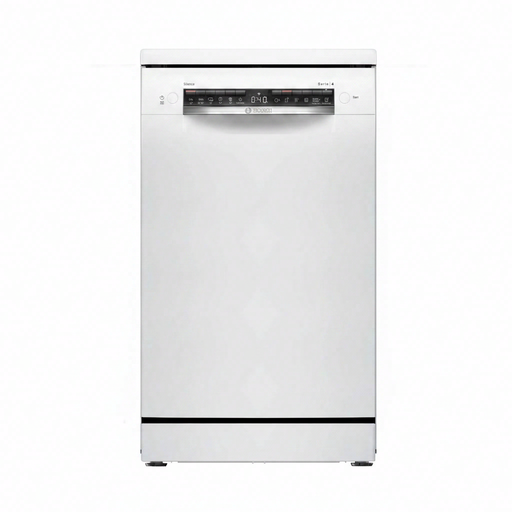
Bosch SPS4EMI17E, freestanding, 45 cm, 13 place settings
A slimline freestanding model to compare if you have floor or under-worktop space and suitable connections.
Joybuy lists energy class B, 51 kWh per 100 cycles and 8.7 litres of water per cycle. The product information gives a capacity of 13 place settings, dimensions of 45 × 84.5 × 60 cm and an upper basket adjustable to three positions.
View at Joybuy
 No image available
Bosch SPS4HKW49E Series 4, freestanding, 45 cm, white
A slimline freestanding model to consider if you’re looking for an upper basket that, according to the product information, can accommodate different types of crockery.
Joybuy lists 44 dB and Slimline VarioFlex baskets; the product information recommends placing cups in the upper basket.
View at Joybuy
 No image available
AIRMSEN tabletop dishwasher with 5-litre tank
A tabletop model to consider if you don’t have a suitable space for a floor-standing model but can clear a stable, level worktop.
Joybuy lists a capacity of up to four place settings, dimensions of 45.8 × 42.8 × 42.5 cm, five wash programmes and a drying mode. The product information specifies a 5-litre tank and two water supply options. The appliance is intended for indoor use; the safety information requires earthing and a dedicated electrical circuit, and prohibits the use of extension leads.
View at Joybuy
 No image available
AIRMSEN tabletop dishwasher, 5-litre tank, energy class D
A compact tabletop model to compare if a tank and a worktop setup suit your kitchen.
Joybuy lists energy class D. The product information gives a capacity of up to four place settings, dimensions of 420 × 435 × 435 mm and a 5-litre tank. The safety information requires an earthed 220–240 V socket and prohibits the use of extension leads.
View at Joybuy
 No image available
Heinrich's HTG 8855 tabletop dishwasher, 3 place settings
A tabletop model with a stated capacity of three place settings to compare if you have only a small amount of washing-up each time.
Joybuy lists energy class C, 4.2 litres of water per wash, seven programmes and a 5-litre tank or connection to a tap. The instructions require a stable, level worktop and indoor use.
View at Joybuy
Frequently asked questions
Where should I put dishwasher-safe mugs?
ETNA Service recommends placing mugs in the upper basket, with the dirty surfaces facing inwards and downwards. Leave space between the mugs, follow your appliance’s loading instructions and check that the spray arms can rotate freely.
What space and connections should I check before installation?
Check the dimensions of the space, the water supply, waste outlet and electrical connection against the manual for your chosen model. Bosch’s installation advice also recommends levelling the appliance and ensuring the earthed connection is installed correctly; check the requirements for other brands separately.
Should I rinse mugs before putting them in the dishwasher?
Milieu Centraal says pre-rinsing is generally unnecessary when using a dishwasher. Remove food scraps to prevent the filter from clogging, and follow your appliance’s instructions.
How do I compare electricity and water consumption?
Compare models using the EU label for the same eco programme: it includes information such as kWh per 100 cycles and water consumption per cycle. Your actual costs depend on how you use the appliance and your tariffs.
What does the EU energy label tell me about a dishwasher?
The EU energy label provides information including the energy class, energy consumption per 100 eco cycles, water consumption and programme duration. The European Commission says the current scale for household dishwashers runs from A to G and has applied since 1 March 2021.


