What should you look for when choosing?
First measure the available space, then check whether your everyday dishes will fit in the machine. Next, compare consumption and the features that make a difference to your kitchen and routine.
| What to consider |
What should you check? |
Who is this important for? |
| Space and installation |
Measure the width, height and depth. Also check the water supply and waste connections, and, for a built-in model, the niche dimensions and installation requirements. |
If I’m looking for an appliance that will fit in my kitchen, I want to know in advance that the space and connections are suitable. Installation is the main concern for around 36% of consumers. |
| Suitable load capacity |
Compare the number of place settings with the rack layout, and measure any large plates and pans you use often. |
If I cook regularly, I want to fit my own cookware in as well as standard dishes. Suitable load capacity is the main buying concern for around 29% of consumers. |
| Consumption and routine |
Compare electricity use per 100 eco cycles and water use per eco cycle on the same labelling basis. Also consider how often you’ll be able to fill the machine. |
If I have only a small amount of washing-up, I want to weigh consumption against how often I wash and how much is in the machine. This is the main consideration for around 21% of consumers. |
| Noise, drying and layout |
Check the noise rating on the energy label and look at the drying method and the layout of the cutlery and dish racks for each model. |
If my kitchen is close to my living space, or I want to load the dishwasher easily, noise and layout matter. These preferences are the main buying concern for around 14% of consumers. |
Tabletop dishwashers on Joybuy
These tabletop dishwashers are worth considering if a taller slimline model won’t fit in your kitchen. They aren’t a substitute for a freestanding slimline dishwasher or a built-in model measuring around 45 cm.
 No image available
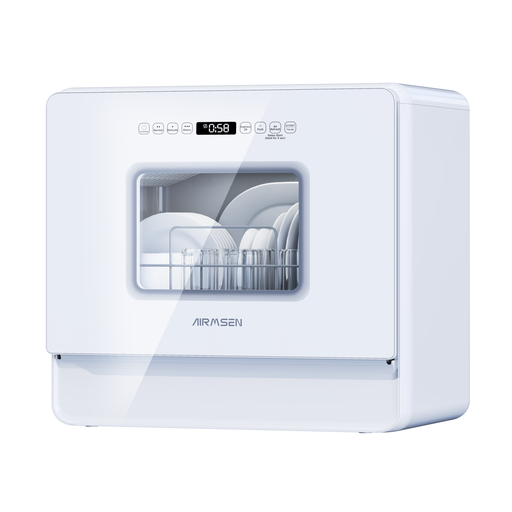
AIRMSEN A01 tabletop dishwasher
An option if you can’t fit a taller model and have space on your worktop.
The description lists five place settings, a two-tier rack and room for plates up to 300 mm when the upper rack is removed.
The model has a built-in 5-litre water tank and, according to the product description, can also be connected to a tap.
View on Joybuy
 No image available
AIRMSEN tabletop dishwasher, 5 litres
A compact option if you’re looking for a tabletop model for a small amount of everyday washing-up.
The description lists four place settings and room for plates up to 26 cm.
The model has a built-in 5-litre tank; the product description also mentions a mains water connection and automatic drying.
View on Joybuy
 No image available
Heinrich’s HTG 8855 mini tabletop dishwasher
A tabletop model to consider if there isn’t room for a larger dishwasher.
The title lists three place settings and seven programmes.
The product description lists a 5-litre tank, a tap connection and water consumption of 4.2 litres per wash.
View on Joybuy
Frequently asked questions
Is a 45 cm dishwasher automatically the right size for one person?
No. Width alone doesn’t determine whether the appliance will suit your kitchen and your dishes. The Consumentenbond says a slimline model typically holds 9 to 10 place settings. Also measure the available space and check that your own dishes and pans will fit in the racks.
Should I rinse my plates first, and when should I use the eco programme?
Milieu Centraal recommends scraping off food scraps without rinsing the dishes by hand first, and using the eco programme with a well-loaded machine wherever possible. Check the manual for your chosen model for instructions on how to use it.
Which consumption figures can I compare fairly?
On the EU energy label, compare figures such as electricity use per 100 eco cycles and water use per eco cycle, using the same labelling basis for both models. How often you wash and how much you load each time also play a part in your decision.
What are my rights if my dishwasher is faulty or I replace an old appliance?
If a product has been used normally but turns out to be faulty, the seller is responsible for providing an appropriate remedy free of charge, such as a repair, replacement or refund, according to ACM ConsuWijzer. If you’re buying a new, similar appliance as a private customer, the Dutch government says the seller must take back the old appliance free of charge, subject to the stated return conditions.


