Who is a slimline dishwasher suitable for?

People living alone with a narrow kitchen

If you don't have room for a standard-width model, weigh up the space and connection you need, and whether to choose a freestanding or integrated model. The Consumentenbond describes slimline dishwashers as models around 45 cm wide.

People who use mugs every day

If you mainly wash mugs, compare the rack layout with your own mugs and consider how much other washing-up builds up in between. The Consumentenbond advises against stacking cups and recommends keeping the spray arms clear.

People comparing machine washing with washing up by hand

If you keep an eye on electricity and water use, compare the eco-cycle consumption with how often you do the washing-up. Milieu Centraal also points out that washing up by hand with a small amount of hot water is an alternative.

What should you consider when choosing?

Slimline freestanding model

Suitable for: a spot outside a built-in space, with room for the appliance and a suitable water supply and drain.

Bear in mind: a slim width doesn't guarantee that the height, depth or door clearance will fit.

Slimline integrated dishwasher

Suitable for: a kitchen with a suitable space and the right installation for the model you've chosen.

Bear in mind: the dimensions of the built-in space and the furniture door configuration must suit your kitchen.

Washing up by hand for a small amount of washing-up

Suitable for: situations where you usually only wash a few mugs or don't have a suitable space and connection.

Bear in mind: washing up by hand takes time; Milieu Centraal suggests using a washing-up bowl rather than leaving the hot tap running to keep hot water use low.

What to consider What should you look for? Who will find this important?
Positioning and connection Measure the width, height, depth and door clearance. For an integrated model, also check the space and installation requirements, and check the location of the water supply and drain. I want to be sure the appliance will fit in my kitchen and can be connected. Around 29% of consumers put positioning first.
Mugs in the rack Compare the height and shape of your mugs with the rack. Place them without stacking and keep the spray arms clear. I want to load my own mugs without them getting in each other's way. Around 29% of consumers prioritise whether their mugs will fit.
How often you run it Estimate how much washing-up you collect between cycles and compare it with the model's capacity and programmes. I don't want to run a cycle for just a few mugs every time or wait ages for a full load. Around 24% of consumers prioritise how often they can fill the machine.
Energy and water use, and washing up by hand Compare kWh per 100 eco-cycles and litres per eco-cycle on the same label basis, and factor in how often you do the washing-up. I want to weigh up the expected electricity and water use against washing up by hand. Around 18% of consumers put this first.

Common buying mistakes

  • Assuming a width of 45 cm tells you all you need to know about the fit

    The height, depth, door clearance and connections also determine whether the appliance will fit in your chosen spot. For an integrated model, the space and installation requirements matter too.

    Measure the entire space available and check the installation instructions for the exact model before choosing.

  • Assuming the place-setting capacity guarantees your mugs will fit

    The place-setting capacity alone doesn't tell you whether tall or wide mugs will sit comfortably in the rack.

    Compare the rack with your own mugs and keep the spray arms clear.

  • Assuming a half-load option means a small load is economical to wash

    A programme option doesn't prove that a small load is as economical as a full eco-load or washing up by hand.

    Compare the label figures on the same eco basis and think about how much washing-up you actually collect. Running small loads regularly means repeated electricity and water use; this also depends on the programme and how often you wash.

Brands and models to consider

Beko

The Dutch product page describes the freestanding slimline BDFS26046XQ.

  • The stated capacity is 10 place settings.
  • Check whether the rack suits your mugs and washing-up routine; capacity alone says nothing about the cleaning results.

ETNA

The Dutch product page describes the fully integrated VW47SM as a slimline dishwasher.

  • ETNA lists nine place settings, an eco programme and a half-load option for this model.
  • A half-load option doesn't show that a small load is as economical as a full one; check the built-in space too.

Bosch

The Dutch manufacturer pages describe both freestanding and fully integrated 45 cm models.

  • For each model, the pages list dimensions and label details, including energy class and eco-cycle water use.
  • Installation type and product specifications vary by model; check the details for the exact version you're considering.

Siemens

The Dutch manufacturer page describes the SR65EX09ME as a fully integrated 45 cm iQ500 model.

  • The manufacturer lists the dimensions, energy class and eco-cycle water use for this model.
  • Check that the built-in dimensions suit your kitchen and compare the figures with other models on the same label basis.

Joybuy products for a slimline freestanding setup

These Joybuy products are 45 cm freestanding dishwashers for anyone looking for a slimline setup. Check the dimensions, rack layout and connection requirements for the exact model before choosing.

Bosch SPS4HKW49E Series 4 freestanding dishwasher, 45 cm, white

Bosch SPS4HKW49E Series 4 freestanding dishwasher, 45 cm, white

This 45 cm freestanding model could suit you if you don't want to use a built-in space; measure the available area and check the connections.

Type: freestanding. Width: 45 cm. Colour: white.

Compare the rack layout with the height and shape of your own mugs.

View at Joybuy
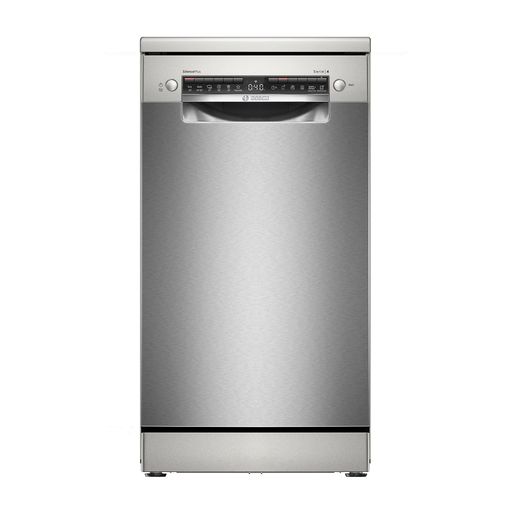
Bosch SPS4EMI17E freestanding dishwasher, 45 cm, 13 place settings

Bosch SPS4EMI17E freestanding dishwasher, 45 cm, 13 place settings

This 45 cm freestanding model could suit you if you don't want to use a built-in space; consider its capacity if you don't collect much washing-up.

Type: freestanding. Width: 45 cm. Capacity: 13 place settings.

In a one-person household, it may take longer to collect enough washing-up for a full load.

View at Joybuy

Frequently asked questions

Is a slimline dishwasher automatically the most economical choice for one person?

No. It depends, among other things, on how much washing-up you collect and how often you use the machine. Milieu Centraal also suggests washing up by hand with a small amount of hot water if you don't have much to wash. Consider how often you can fill the machine and the model's eco-cycle consumption.

How should I load dishwasher-safe mugs?

Place mugs upside down and don't stack them, so water can drain away and the spray arms stay clear. If necessary, angle mugs with a rim, and check the care instructions for mugs with decorations.

What should I check before installation?

Measure the space available for the exact model and, for an integrated dishwasher, check the built-in space and installation requirements. A freestanding model needs a suitable water supply and drain where you plan to put it; follow the model's installation instructions when connecting it.

What maintenance helps with everyday use?

Scrape food debris off your dishes, generally avoid rinsing them under the tap first and clean the filter regularly. Follow the manual's instructions for salt and rinse aid, and take your local water hardness into account.

What information is shown on a dishwasher energy label?

According to the European Commission, the label includes details such as energy use per 100 eco-cycles, water use per eco-cycle, capacity and noise. Compare models on the same label basis, bearing in mind that your choice of programmes and washing habits may differ from the figures shown.
