
Washing up after class
You want your used lunchboxes clean in time after an evening class, so you compare programme duration with drying performance. Consumentenbond points out that short programmes often have a shortened or omitted drying phase.


Start by choosing between a freestanding and an integrated model: measure the available space and check the connections before picking a dishwasher. Then check whether your lunchboxes and lids fit securely in the racks without stacking. A short programme can be useful if you want to get the washing up done quickly after class, but short programmes often have a limited drying phase and are usually less energy-efficient than Eco. For plastic items, always follow the care instructions for each individual part.
You want your used lunchboxes clean in time after an evening class, so you compare programme duration with drying performance. Consumentenbond points out that short programmes often have a shortened or omitted drying phase.
You have room for a slimline appliance, but first need to decide whether a freestanding or integrated model will fit and whether the racks can accommodate your lunchboxes. Consumentenbond recommends choosing the type and size to suit your kitchen.
You wash dishwasher-safe lunchboxes with separate lids and want to avoid warping or water being left behind. Consumentenbond recommends placing plastic items in the top rack.
First, measure the space and decide whether you want a freestanding or integrated model. Then compare the rack layout and programmes with your lunchboxes, the time you have available and the amount of washing up you usually have.
| What to consider | What to look for | Who is this most relevant to? |
|---|---|---|
| Positioning and loading space | Measure the width, height and depth, as well as the door clearance; check the appliance type and whether the top rack is adjustable. | I want to know whether the appliance will really fit and whether my lunchboxes can go in the rack without stacking. Around 25% of consumers prioritise positioning and loading space. |
| Plastic items and lids | Check the dishwasher instructions for the lunchbox, lid and seal; see whether the parts can stand securely in the top rack. | If I wash plastic lunchboxes and separate lids, I want to know how to position them in line with their care instructions. Around 25% of consumers prioritise suitable care for plastic items. |
| Programme duration | Compare the actual programmes and timings for the exact model, not just the ‘quick’ label. | After an evening class, I want to know whether a programme will finish in time for the next use. Around 20% of consumers prioritise a practical programme duration. |
| Consumption with a small load | Compare energy use per 100 Eco cycles and water use per Eco cycle; take your usual load size into account. | If I often wash just a few items, I want to know whether waiting until I have more washing up is practical for me. Around 15% of consumers prioritise ongoing energy and water consumption. |
| Noise in the evening | Compare the stated noise levels and check whether the model has a quiet programme. | If I want to use the machine late in the day, I need to consider noise in my living space. Around 15% of consumers prioritise noise when using their dishwasher late. |
A short cycle can save time, but often dries items less effectively and is usually less energy-efficient than Eco. According to Consumentenbond, a half-load programme uses only slightly less than a full cycle; that does not automatically mean lower consumption per lunchbox washed.
Freestanding and integrated models have different installation requirements, and external dimensions vary from model to model.
Measure the available space, the depth and the clearance needed for an open door. For an integrated model, also check the niche dimensions and installation details for the exact appliance.
An unsuitable space may require changes to the layout or connections.
According to Consumentenbond, short programmes often have a shortened or omitted drying phase and are usually not energy-efficient.
Choose a short cycle when time matters and the dishes are not very dirty. If you are not in a hurry, compare the Eco programme duration and load size.
Consumentenbond says that a half-load programme uses only slightly less than a full cycle, while washing fewer dishes.
Consider whether waiting until you have more washing up fits your routine. A half-load option alone does not prove lower consumption per item washed.
ETNA describes the VWV147SWIT as a slimline freestanding dishwasher with nine place settings.
Inventum describes the freestanding VVW4530AW as a slimline model with ten place settings and an adjustable top rack.
Bosch describes both a freestanding model, the SPS4EMI17E, and a fully integrated model, the SPV4EMX17E.
Beko describes the DVS05024W as a freestanding slimline dishwasher with ten place settings.
This selection includes slimline freestanding dishwashers and compact countertop models for anyone short on kitchen space who wants to wash lunchboxes after an evening class.
 No image available
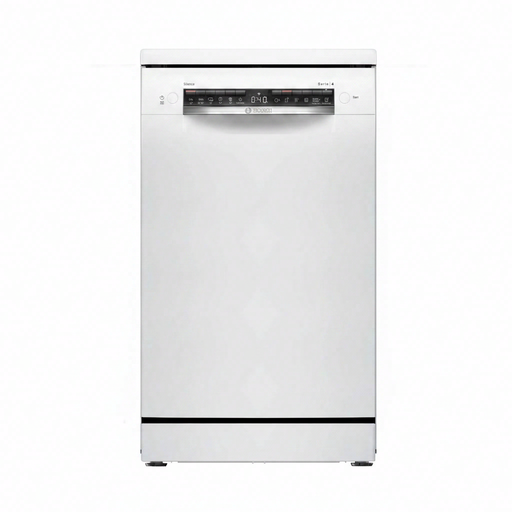
A freestanding model to consider if you do not have a suitable built-in niche. Bosch lists an energy rating of B, adjustable racks and automatic door opening during drying for this model.
 No image available
A freestanding Series 4 model for anyone looking for an appliance that can be installed on its own. The product title states that it is 45 cm wide and white; check the space and connections for this specific model.
 No image available
A countertop model to consider if a compact design suits your kitchen better than a slimline freestanding machine. The product title lists five wash cycles plus an extra cycle, as well as a built-in 5-litre water tank. According to the product information, the drain hose must run into a sink or container during use.
 No image available
A compact countertop model for anyone short on kitchen space. The product title lists dimensions of 37 × 50 cm and a built-in 5-litre water tank; the product information also mentions a tap connection. Check which connection suits your set-up.
 No image available
A countertop model for anyone looking for a smaller appliance rather than a slimline dishwasher that sits on the floor. The product title lists three place settings, seven programmes, a delayed start of up to 24 hours and a noise level of 56,3 dB. The product information mentions both a water tank and a direct tap connection.
No. Follow the instructions for each lunchbox, lid and any seal. Consumentenbond recommends placing plastic items in the top rack; instructions for one product do not automatically apply to other parts.
Follow the dishwasher manual and the lunchbox care instructions. Position lunchboxes and lids so they stand securely, and check that they are suitable for the programme you have chosen.
Yes. According to ACM ConsuWijzer, if a product is faulty during normal use, the seller must resolve the issue free of charge through repair, replacement or, where applicable, a refund. A manufacturer's guarantee does not replace this statutory right.
Yes. The Dutch government says that energy labels are compulsory for products including dishwashers. The EU label runs from A to G and includes information such as energy use per 100 Eco cycles, water use per Eco cycle, programme duration and noise.