First, choose between a freestanding and an integrated model based on the space and connections available in your work area. Then match the layout and programme duration to your lunchboxes and workshop schedule. Place settings don’t guarantee a particular number of boxes will fit, and a short cycle is no substitute for an appropriate food-safety procedure.
Who is this relevant to?
Workshop organiser with lots of lunchboxes
You want to know whether your boxes and lids will fit in the baskets, and whether successive washes can be completed within your workshop schedule. Place settings and programme duration help you compare models, but you’ll still need to test the fit with your own items.
Organiser with a small kitchen
You have limited width to work with and need to decide whether a freestanding appliance will fit, or whether there’s already a suitable slimline built-in space.
Organiser with groups of varying sizes
You want to plan for both small and full loads and compare the consumption of Eco programmes.
What should you look for?
Freestanding slimline dishwasher
Choose this when: there’s no suitable built-in space, but there is room and the right connections for a freestanding model.
Consider: check the external dimensions and basket layout. The stated number of place settings won’t tell you how many lunchboxes and loose lids will fit at once.
Slimline integrated dishwasher
Choose this when: a suitable slimline space and a compatible kitchen door are available.
Consider: check the dimensions of the space and kitchen door for the exact model before making your decision based on width alone.
Another option for quick turnaround
Consider this when: you need to wash lots of boxes again during short breaks, or your workshop requires a commercial food-safety procedure.
Consider: first work out the throughput and procedure you need. Don’t assume a domestic slimline model will automatically meet those requirements.
The Consumentenbond describes slimline dishwashers as 45 cm wide, with room for 9 to 10 place settings. This figure isn’t a measure of how many lunchboxes will fit.
| What to consider |
What should you check? |
Who is this important for? |
| Fit and throughput |
Measure representative boxes and lids; check the basket height and layout, and ensure there’s enough clearance for the spray arms. |
I want to know how many of my own lunchboxes will fit at once and whether I’ll have them back in time. Around 40% of consumers prioritise fit and throughput. |
| Installation |
Measure the height, width, depth and door clearance; check the connections and, for an integrated model, the dimensions of the space and kitchen door. |
If my kitchen has limited space, I want to know in advance which type of appliance will actually fit. Installation is the most important consideration for around 30% of consumers. |
| Flexible washing |
Compare the programmes available and check the load requirements and instructions for each one. |
When group sizes vary, I want to be able to plan for both small and full loads. Around 20% of consumers prioritise this flexibility. |
| Water and energy consumption |
Compare consumption per Eco cycle and programme duration on the same basis; don’t apply label figures to other programmes. |
If I use the dishwasher repeatedly, I want to weigh up its consumption against the time available. This is the top priority for around 10% of consumers. |
The European Commission says the energy label includes information such as energy consumption per 100 Eco cycles, water consumption per cycle and the duration of the Eco programme. Milieu Centraal recommends running a full load and using the Eco programme when your schedule allows.
Common buying mistakes
-
Assuming place settings equal a fixed number of lunchboxes
The number of place settings doesn’t tell you how many of your boxes and loose lids will fit. Their height and shape, along with the basket layout, also affect how much you can load at once.
Before buying, measure a representative load and compare the programme duration with your workshop schedule.
-
Choosing an integrated model based on width alone
The space, kitchen door and clearance for the door all need to be suitable for the exact model.
Check all installation and kitchen-door dimensions before choosing an integrated model.
If the space or kitchen door needs adapting, installation will involve extra work.
-
Using energy-label figures for every programme
The EU label figures for energy, water and duration apply to the Eco programme. They don’t automatically tell you what another cycle will use.
Compare models using the same Eco-cycle figures, and separately plan which programmes you’ll need during the workshop.
-
Treating a conflicting product listing as confirmed capacity
A Joybuy product title lists the Bosch SPS4EMI17E as having 13 place settings, while Bosch states 10 for the same model.
If information conflicts, check the full model number and manufacturer’s specifications before treating the capacity as confirmed.
Brands to consider
Bosch
The freestanding SPS4EMI17E is a 45 cm model with adjustable baskets. It’s worth considering if layout and installation are key priorities.
- Bosch lists the SPS4EMI17E as measuring 845 × 450 × 600 mm and having energy class B.
- Bosch states 10 place settings, while a Joybuy listing gives 13 for the same model. Don’t treat the capacity as confirmed; check whether your own lunchboxes fit.
Beko
The freestanding BDFS26046XQ is a slimline model you can compare for its basket layout and stated consumption when space is limited.
- Beko lists this model as having 10 place settings, energy class C, using 8,9 litres per cycle and producing 44 dBA of noise.
- Beko’s claims about the cleaning performance of the intensive zone are manufacturer claims, not the result of an independent test with lunchboxes.
Inventum
The freestanding VVW4530AW is a 45 cm model with an adjustable upper basket and a half-load option.
- Inventum lists this model as having 10 place settings, energy class D and a Hygiene programme.
- The programme name alone doesn’t prove that the procedure meets the food-safety requirements for a commercial workshop.
ETNA
The fully integrated VW47SM is worth considering if you already have a suitable slimline space for a built-in model.
- ETNA lists nine place settings, a half-load option and programmes ranging from rinse to intensive.
- Check the space, kitchen door and fit of your boxes. The place-setting specification isn’t a measure of lunchbox capacity.
Freestanding slimline dishwashers at Joybuy
These freestanding 45 cm dishwashers are for anyone looking for a slimline model without built-in installation.
 No image available
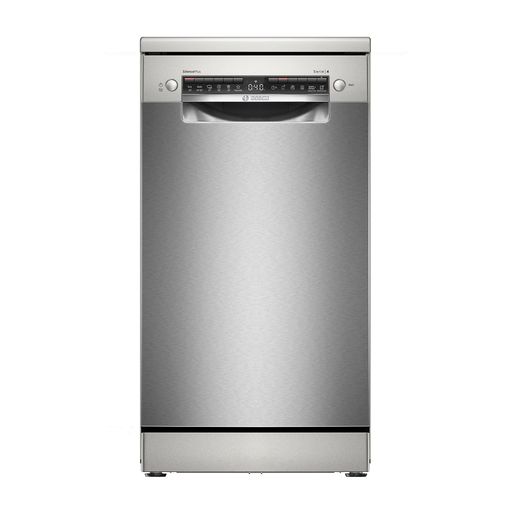
Bosch SPS4EMI17E freestanding dishwasher, 45 cm
A good fit if you’re looking for a freestanding slimline model and want to explore different basket layouts. Check how much usable space there is with your own boxes.
The product description lists six programmes, including Eco, Intensive and Quick, energy class B, a height-adjustable upper basket and a VarioDrawer. The stated capacity is inconsistent: Bosch gives 10 place settings, while the product title says 13.
View at Joybuy
 No image available
Bosch SPS4HKW49E Series 4 freestanding dishwasher, 45 cm, white
A good fit if you’re looking for a freestanding 45 cm model. Check the basket layout with the lunchboxes and lids you want to wash.
The product description lists Slimline VarioFlex baskets, Auto and Eco programmes, Extra Dry and AquaStop.
View at Joybuy
Frequently asked questions
Can every dishwasher-safe lunchbox be washed in the same cycle as its lid?
Not without checking the box and lid separately. The Voedingscentrum says that symbols and packaging information can help, but may vary between manufacturers. Also check that both parts fit without obstructing the spray arms.
Is the Eco programme suitable if you need the boxes back during a short break?
That depends on how much time you have and the stated programme duration. The EU energy label gives the duration of the Eco programme. A shorter cycle doesn’t automatically mean the same consumption or cleaning results.
Which installation and running costs should you check in advance?
Check whether a freestanding or integrated model is suitable for your space, water connection and drainage. Compare consumption on the same basis with the label figures for kWh per 100 Eco cycles and litres per Eco cycle. Ask your chosen retailer about installation requirements and any service charges.
Does a domestic dishwasher automatically make your cooking workshop food-safe under Dutch regulations?
No. Choosing a dishwasher doesn’t replace a food-safety procedure. The NVWA states that registering and following a food-safety plan or hygiene code are requirements if you sell food to consumers several times a year. Whether these requirements apply to your workshop depends on the activity.


