First, choose between a freestanding model and an integrated one, based on the space, cabinet recess and connections in your kitchen. Then compare the layout with your own plates and cookware. If you use it regularly, energy and water consumption, eco-programme duration and noise levels are also worth considering. A full-size dishwasher may be an alternative if you have the space and can usually fill it.
Who is a slimline dishwasher suitable for?
For cooks with a small kitchen
You’re looking for a machine for everyday plates and cutlery, but the available space and connections determine which type will fit. The Consumers’ Association (Consumentenbond) describes slimline dishwashers as models for freestanding or integrated installation.
For homes with an existing integrated recess
You want to conceal the dishwasher behind a kitchen door panel. As well as the appliance dimensions, you’ll need to check the recess, door system and panel fittings. The Consumers’ Association also lists the connection as part of the installation.
Regular eco-programme user
You expect to run a full load regularly and want to compare consumption, programme duration and noise levels. The energy label gives separate figures for these; a slimline size isn’t automatically more economical.
What should you consider when choosing one?
Freestanding slimline model
When it’s a good fit: if you have a suitable space outside an integrated recess, with accessible water supply, drainage and power.
Consider: the appliance will be visible; also check its full dimensions, door clearance and room for the hoses.
Integrated slimline model
When it’s a good fit: if you have a suitable narrow recess and want to conceal the dishwasher behind a kitchen door panel.
Consider: measurements and fitting need extra attention; check that the recess, door panel and door system are compatible with your chosen model.
Full-width dishwasher
When it’s a good fit: if your kitchen has enough room and you regularly want to wash cookware in a full machine.
Consider: this option takes up more kitchen width; if you don’t generate much washing-up each day, it may take longer to fill.
| What to consider |
What to check before buying |
Who is this most important for? |
| Type and dimensions |
Measure the space or recess and check the appliance dimensions, door clearance, door panel and reach of the connections. |
If I want to know whether the appliance will really fit where I intend to put it, I start with the recess and connections; around 31% of consumers prioritise the right type and dimensions. |
| Room for your own dishes |
Compare your largest plates and cookware with the rack layout, and check whether the upper rack is adjustable. |
If you want to fit everyday plates, glasses and cookware into a useful load, look beyond the place-setting capacity; around 31% of consumers prioritise space for their own dishes. |
| Consumption, duration and noise |
Compare kWh per 100 eco cycles, litres per eco cycle, programme duration and noise level using the same label basis. |
If I run a programme often or use the dishwasher in an open-plan kitchen, consumption, running time and noise all matter; around 23% of consumers prioritise these considerations. |
| Connections and aftercare |
Check the water supply, drainage and power supply, and follow the model manual for installation and maintenance. |
If you want to know in advance whether installation is practical and who to contact with questions after purchase, check the connection points and terms; around 15% of consumers prioritise installation and aftercare. |
Common pitfalls
-
Assuming place settings mean there’s room for all your cookware
The place-setting capacity refers to standard tableware; it doesn’t necessarily tell you whether your largest plates or pans will fit in the racks.
Compare the rack layout with the dishes you use most often and check there’s room for your largest items.
-
Assuming a slimline model is automatically more economical
A smaller machine won’t necessarily use less energy and water for the amount of washing-up you do. The Consumers’ Association and Milieu Centraal highlight the importance of size and usage; the energy label gives consumption figures for the eco programme.
Compare energy consumption per 100 eco cycles and water consumption per eco cycle, and consider whether you’ll usually fill the machine.
-
Measuring only the appliance width
Height, depth, door clearance and space for connections also determine whether the machine will fit where you want to put it. For an integrated model, the recess and kitchen door panel must fit too.
Measure the entire installation and check the connection points and door system before buying; the recess, door panel or connections may need adapting.
-
Assuming the manufacturer’s warranty covers all your statutory rights
According to the Dutch Government, there is no fixed statutory warranty period in the Netherlands. If there’s a problem with the product, the retailer is your point of contact; a manufacturer’s warranty and any extended warranty are separate from this.
Read the terms of any extended warranty and compare them with the rights you already have.
Brands to compare
Bosch
The freestanding slimline Serie 2 SPS2HKW55E is worth considering if you’re looking for a freestanding model.
- Bosch lists dimensions of 845 × 450 × 600 mm, energy class D and 8.9 litres of water per eco cycle for the SPS2HKW55E.
- These figures apply to this model; they aren’t an independent washing-performance test and don’t necessarily apply to all Bosch models.
Inventum
The freestanding VVW4530AW is a slimline model with room for 10 standard place settings.
- Inventum lists an adjustable upper rack, energy class D and 45 dB for this model.
- The manufacturer lists 11 litres per wash; compare consumption using the same programme and label basis, and treat any claims about savings with a half load as manufacturer information.
Beko
The DVS05024W is a freestanding slimline model with space for 10 standard place settings.
- Beko lists energy class E, 11.9 litres of water per cycle and 49 dBA for this model.
- According to the manufacturer, the upper rack isn’t height-adjustable, so check whether tall glasses and other high-sided dishes will fit.
AEG
The 45 cm-wide integrated models FSE74507P and FSE73407P are worth considering if you have a suitable integrated recess.
- AEG lists 10 place settings and energy class C for the FSE74507P, and 9 place settings and energy class D for the FSE73407P.
- Check the recess, kitchen door panel and installation requirements for each model; the label classes listed don’t in themselves indicate which model washes better.
Siemens
The fully integrated SR65EX09ME is a 45 cm-wide model for a suitably fitted kitchen.
- Siemens lists dimensions of 815 × 448 × 550 mm, energy class B and 8.7 litres per eco cycle for this model.
- Check the recess and fitting requirements for your chosen model; these specifications aren’t a comparative washing-performance test.
Joybuy products for a small kitchen
This selection focuses on freestanding slimline dishwashers for everyday washing-up.
 No image available
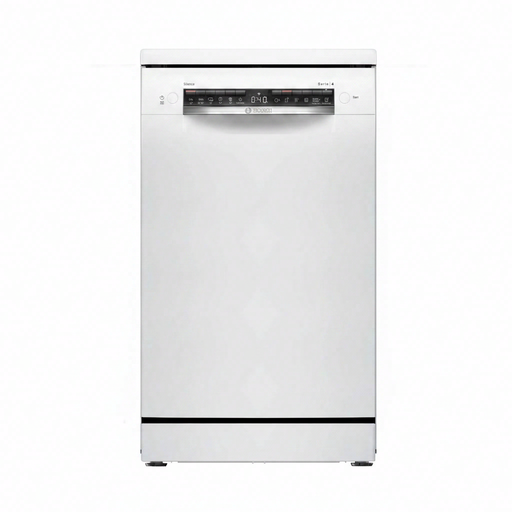
Bosch SPS4HKW49E Series 4 freestanding dishwasher, 45 cm, white
The freestanding slimline design suits a narrow space outside an integrated recess; compare the rack layout with the dishes you use every day.
The product information mentions VarioFlex racks for different types of dishes. Check that the layout works for your largest plates and cookware.
View at Joybuy
Frequently asked questions
Is a slimline dishwasher the same as a mini dishwasher?
No. According to the Consumers’ Association, a slimline dishwasher is around 45 cm wide and the same height as a standard dishwasher. A mini dishwasher is shorter and usually has less capacity.
What should I check before connecting the dishwasher?
Check the water tap, drainage and earthed power supply, and follow your model’s manual. For an integrated model, you’ll also need to check the recess and kitchen door panel fittings; not every kitchen is suitable without modifications.
Should I pre-rinse the dishes and always use extra salt?
No, rinsing by hand beforehand is generally unnecessary; Milieu Centraal recommends scraping off food scraps. Follow your model’s manual for salt and rinse aid, and adjust the amount of salt to your water hardness.
Am I entitled to exactly two years’ statutory warranty in the Netherlands?
No. According to the Dutch Government, there is no fixed statutory warranty period in the Netherlands: you’re entitled to a product that works as it should, and the retailer is your point of contact if there’s a problem. A manufacturer’s warranty or an extended warranty is separate from this.
Which details can I compare on a dishwasher’s energy label?
The energy label includes the energy class on the A–G scale, energy consumption per 100 wash cycles, standard place settings, water consumption, noise and the duration of the eco programme. Energielabel.nl explains these figures; compare models using the same label basis and don’t treat the old A+++ scale as directly equivalent to the current one.


