What should you look for when choosing one?
Slimline freestanding dishwasher
Suitable for: a suitable spot outside a kitchen recess, with accessible water, drainage and electrical connections.
Bear in mind: the appliance will be visible and needs space for its hoses and an open door.
Slimline integrated dishwasher
Suitable for: a suitable recess and matching kitchen door if you want the appliance out of sight.
Bear in mind: the recess, door and hinge system must be compatible with the exact model; checking the width alone isn’t enough.
Standard 60 cm size
Suitable for: a kitchen with enough space and enough regular washing up to fill the larger machine properly.
Bear in mind: a larger machine isn’t automatically the right choice if you often run it with only a small load.
Washing up by hand or a compact mini dishwasher
Suitable for: washing a few bowls by hand in a bowl may be enough; a mini dishwasher is an alternative if a machine of around 45 cm won’t fit.
Bear in mind: washing up by hand takes time and, according to Milieu Centraal, is only an energy-saving alternative if you use little hot water. Milieu Centraal considers a mini dishwasher relatively inefficient.
| Consideration |
What should you look for? |
Who is this important for? |
| Positioning and connections |
Measure the space or recess, depth and door clearance; check the water supply, drainage, electricity and the model’s manual. |
If I have a small kitchen, I want to know in advance whether the appliance can actually be installed and connected. Around 31% of consumers say installation is their main consideration. |
| Space for bowls and other dishes |
Measure your bowls and check the rack layout, adjustable upper rack and cutlery storage. |
If my breakfast bowls need to fit in the machine alongside plates and glasses, I want to know whether the combination will fit comfortably. Around 25% of consumers give loading the highest priority. |
| Consumption for your usual load |
Compare kWh per 100 eco cycles, water per eco cycle and programme duration; consider how much washing up you usually accumulate. |
If I use the machine often, I want to weigh the figures on the label against my usual amount of washing up. Around 25% of consumers prioritise consumption. |
| Noise and programme |
Compare the stated noise level in dB and check the programme information for the exact model. |
If my kitchen is close to my living space, I want to take noise into account and know when a programme will finish. Around 19% of consumers consider quiet operation and timing the most important factors. |
The European Commission lists details on the EU energy label such as energy consumption per 100 eco cycles, water consumption per eco cycle, eco programme duration, capacity and noise. Compare figures for the same programme: they won’t necessarily predict the consumption of a different programme.
Slimline freestanding dishwashers at Joybuy
These product picks are 45 cm-wide freestanding dishwashers for anyone looking for a dishwasher that fits a slimline space.
 No image available
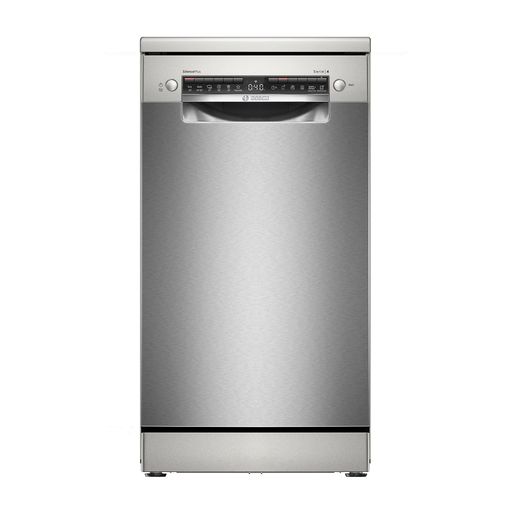
Bosch SPS4EMI17E freestanding dishwasher, 45 cm
The stated width and freestanding design make this a suitable option if you don’t have a slimline integrated recess. Check in advance that the space has the right connections and enough room for the door to open.
The capacity differs between the product specifications from Bosch Netherlands and the Joybuy product page. Check the version and capacity with the retailer before making your choice.
Purchase link unavailable
 No image available
Bosch SPS4HKW49E Series 4 freestanding dishwasher, 45 cm, white
A 45 cm freestanding model to consider if you have a slimline space outside a kitchen recess. Check the connections and door clearance at your chosen location.
The product information lists 44 dB, Slimline VarioFlex racks and a height-adjustable upper rack. Check how the rack works with your own bowls and other dishes.
View at Joybuy
Frequently asked questions
How can I check whether my breakfast bowls will fit?
Measure your bowls and assess the rack layout of the specific model. The number of place settings refers to standard tableware and doesn’t guarantee that your combination of bowls and other dishes will fit.
What should I check before connecting the dishwasher?
Check the installation manual for the exact model, the space required, water supply, drainage and a suitable electrical connection. For an integrated model, you’ll also need to check the kitchen door and hinge system; have any changes to an installation carried out by a professional.
Should I rinse breakfast bowls first, and how do I maintain the dishwasher?
According to Milieu Centraal, pre-rinsing usually isn’t necessary, but you should remove food scraps. Clean the filters regularly and follow the manual for any other cleaning.
What do the consumption and noise figures on the energy label mean?
The EU dishwasher label shows details such as energy class A–G, energy consumption per 100 eco cycles, water consumption per eco cycle, capacity, eco programme duration and noise. Compare figures for the same programme: they won’t necessarily predict the consumption of a different programme.
Am I automatically entitled to only two years of legal protection in the Netherlands?
No. According to the Dutch Government, the Netherlands has no fixed statutory guarantee period; what you can expect from a product depends on the circumstances. If a product is faulty, the retailer is your point of contact, alongside any manufacturer’s guarantee.


