
Families with lots of washing-up at every meal
Want to know whether lunch boxes, lids and the tableware from a family meal will all fit in the racks together.


Choose a slimline dishwasher if space is limited and your usual load will genuinely fit in the racks. Consider a standard 60 cm model if you often want to wash a full family load in one go. For every lunch box and component, check the permitted temperature and rack position: dishwasher-safe does not automatically mean suitable for every programme. The Consumentenbond and Milieu Centraal offer different perspectives on slimline and standard sizes.
Want to know whether lunch boxes, lids and the tableware from a family meal will all fit in the racks together.
Need to weigh up whether a freestanding appliance will fit or whether a slimline model is better suited to the existing built-in space.
Need to check the temperature limit and any rack-position instructions for each container, lid and other component.
First measure the available space, then check whether a realistic family load will fit in the racks. The Consumentenbond describes slimline dishwashers as around 45 cm wide, usually with room for 9–10 standard place settings. That figure doesn’t tell you how many lunch boxes and lids will fit.
| What to consider | What should you check? | Who is this important for? |
|---|---|---|
| Temperature and rack position | Check the instructions for each component and make sure the full cycle and specified rack position are suitable. | I want to clean containers, lids and inserts according to their individual instructions. Consumers with temperature or positioning requirements account for around 25% of those for whom this is the main concern when choosing. |
| Usable loading space | Try a typical combination of lunch boxes, lids, plates and cutlery; also check whether the racks can be adjusted. | I want to fit the lunch boxes and tableware from a family meal in together. For consumers who are mainly concerned about fitting that combined load, this accounts for around 25% of primary concerns when choosing. |
| Dimensions and appliance type | For freestanding use, measure the height and depth too. For built-in models, also check the cavity, door front and plinth. | I need to allow for a narrow space or built-in cavity. Consumers who prioritise a good fit in their kitchen account for around 20% of those with one main concern when choosing. |
| Drying plastics | Compare the drying option and check that it is suitable for the instructions for your lunch box components. | I want to put plastic containers away after the cycle without choosing an unsuitable drying option. Consumers who prioritise drying plastics account for around 15% of primary concerns when choosing. |
| Consumption per load | Compare kWh per 100 eco cycles and litres per eco cycle on the same label; consider how often you can fill the machine. | I want to weigh ongoing consumption against the amount of washing-up that will actually fit in one cycle. For consumers who are mainly concerned about this, it accounts for around 15% of primary concerns when choosing. |
The permitted temperature and rack position can vary from one component to another. Choosing the wrong programme may go against the instructions for use.
Check the instructions for the container, inserts and lid separately, then compare them with the full cycle of the model you’re considering.
The Consumentenbond points out that freestanding models are often taller and deeper than built-in or under-counter models. A built-in appliance must also fit the cavity and kitchen door front.
Compare the appliance, cavity and door-front measurements with the installation instructions for the exact model.
A poor fit could mean modifying your kitchen or exchanging the appliance.
The letters on the energy label have changed. Energielabel.nl and Milieu Centraal state that the current A–G scale has been in use since 1 March 2021, so an old A+++ label cannot be compared directly.
Compare current labels and check the kWh per 100 eco cycles and litres per eco cycle.
According to Beko, the freestanding slimline BDFS26046XQ holds 10 place settings and has an adjustable upper rack.
The freestanding SPS4EMI17E is a slimline model with flexible racks and a cutlery drawer.
The freestanding VWV147SWIT is 44,8 cm wide, holds nine place settings and has a half-load function.
The fully integrated FSE74507P is a 45 cm model with 10 place settings and a height-adjustable upper rack.
The products below include freestanding slimline dishwashers and one smaller tabletop model. Consider the tabletop model only if a smaller load is enough.
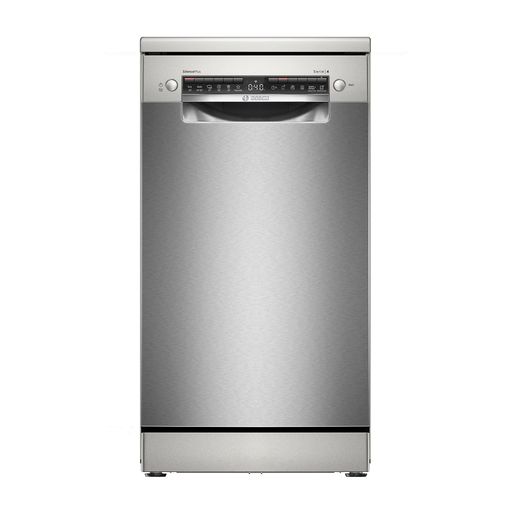 Image unavailable
A freestanding slimline model to compare if your kitchen space is around 45 cm wide.
Bosch lists energy class B and 8,7 litres per cycle on Eco 50 °C. The product information mentions an adjustable upper rack and VarioDrawer. Eco 50 °C is not suitable for a lunch box with a maximum temperature of 40 °C.
 Image unavailable
A freestanding slimline model to consider if you want to compare flexible arrangements for tableware and cutlery.
The product information mentions VarioFlex racks and Extra Dry. Bosch describes Extra Dry as using a hotter final rinse; check whether this option meets the temperature requirements for each lunch box component.
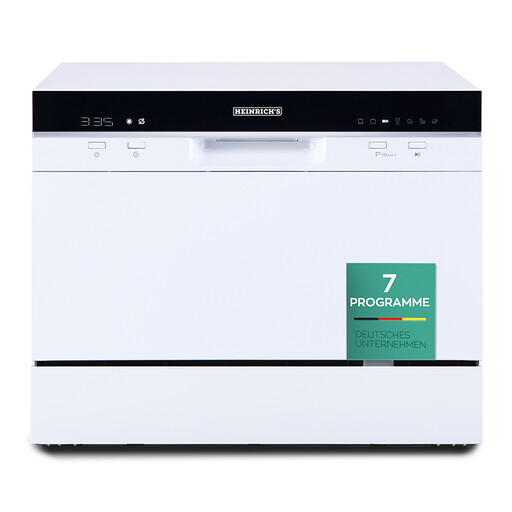 Image unavailable
A tabletop model to consider if a smaller load is enough; six place settings may be limiting if you also need to fit the washing-up from a full family meal.
The product name lists six place settings and seven programmes.
No, the symbol alone doesn’t tell you that. The Voedingscentrum says that sometimes only the upper rack or a low temperature is permitted. Check the instructions for each component; for example, Mepal recommends a maximum of 40 °C for a Lunchbox Campus.
Not without checking the full model documentation. ETNA lists 40 °C as one of the cleaning temperatures for the VWV147SWIT, but that information alone does not confirm the maximum temperature during every stage of the cycle.
Remove food debris and check the filter according to the appliance manual. Bosch advises removing the filter from its dishwashers, rinsing it and refitting it correctly; for other brands, follow their own instructions.
Compare kWh per 100 eco cycles and litres per eco cycle on the energy label. Actual running costs also depend on the number of cycles and the programmes you choose; the label values describe the eco programme.
According to ACM ConsuWijzer, for a standard online product purchase the cancellation period ends 14 days after delivery; legal exceptions may apply. The seller must also resolve, free of charge, any failure of a product to meet what you could reasonably expect under normal use, in line with the statutory guarantee. This could mean a repair, replacement or refund.