What should you look for when choosing?
First decide which type of installation suits your kitchen. Then check whether your usual combination of mugs and dinnerware will fit in the racks without blocking the spray arms.
| What to consider |
What should you check? |
Who is this most important for? |
| Usable space for mugs and family dishes |
Check the rack layout, space for mug handles and whether the spray arms can move freely. An adjustable upper rack can change the layout, so check whether there’s enough room for your own dishes. |
If I want to wash mugs, plates and cutlery together after a meal, I look beyond the number of place settings. Shoppers who mainly want one practical load make up around 36% of the group with this purchase need. |
| Space, connections and installation |
Measure the height, width and depth, and check the installation instructions and connections. The Consumers’ Association notes that freestanding models are often taller and deeper than integrated models. |
If there’s very little room to spare in my kitchen, I want to know whether the appliance can stand freestanding or needs to fit into a recess with a door. Shoppers who prioritise installation above all else make up around 29%. |
| Mugs that drain well |
Check whether the rack gives you room to place mugs upside down and, if needed, at an angle if they have a rim. Treat a drying feature as a model specification, not a guarantee for every mug shape. |
If I want to put mugs away after a cycle without water left in the bottom, I check how they can be loaded and what drying features the model has. Shoppers who prioritise the result on mugs make up around 21%. |
| Energy and water consumption |
Compare the energy label, kWh per 100 eco cycles and water per eco cycle on a like-for-like basis. Milieu Centraal and the Dutch government explain that dishwasher energy-label values are based on the eco programme. |
If I use the dishwasher regularly, I want to compare consumption without applying eco figures to other programmes. Shoppers who prioritise running costs make up around 14%. |
Brands to consider
The features mentioned below apply to the specific models and product ranges listed; they don’t necessarily apply to every model from the same brand.
Bosch
Dutch product information lists slimline freestanding models such as the SPS4EMI17E and SPS4HKW49E, with different rack and drying features.
- Bosch lists Slimline VarioFlex racks and an Extra Dry option for the SPS4HKW49E, and energy class B for the SPS4EMI17E.
- These are model specifications, not proof of a particular drying result for every mug or of features found on all Bosch dishwashers.
Beko
Beko describes the BDFS26046XQ as a slimline freestanding dishwasher with 10 stated place settings.
- The stated capacity gives you a useful starting point for comparing loads with other slimline models.
- Ten place settings don’t tell you whether a particular combination of large mugs and bowls will fit at the same time.
ETNA
ETNA describes the VWV147SW as a freestanding slimline model with nine place settings.
- According to ETNA, this model has a height-adjustable upper rack and a half-load option.
- The number of place settings isn’t a direct measure of how much room your mugs will take up alongside plates.
Siemens
Siemens describes the SR65EX09ME as a fully integrated 45 cm dishwasher for a suitable kitchen recess.
- For this model, Siemens lists energy class B, autoOpen Dry and flexible racks.
- Check the measurements of the recess and kitchen door; these features don’t automatically apply to freestanding Siemens models.
Miele
Miele describes the G 5740 SC SL as a 45 cm freestanding model.
- For this model, Miele lists features including a cutlery drawer, QuickPowerWash and AutoOpen.
- This product information doesn’t substantiate an independently verified cleaning or drying advantage for mugs.
Slimline freestanding dishwashers at Joybuy
These models are slimline freestanding dishwashers for anyone looking for a compact set-up and wanting to load mugs alongside the rest of the dinnerware.
 No image available
Bosch SPS4EMI17E, freestanding, 45 cm
A slimline freestanding model to consider if space is limited and you need a practical layout for mugs and dinnerware.
The product title lists 13 place settings; this doesn’t tell you how many large mugs will fit at once. Bosch lists dimensions of 845 × 450 × 600 mm, energy class B and water consumption of 8,7 litres per eco cycle for this model.
View at Joybuy
 No image available
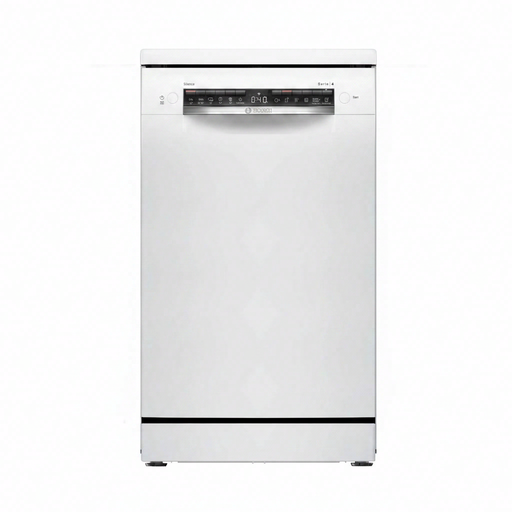
Bosch SPS4HKW49E Series 4, freestanding, 45 cm, white
This model is worth considering if you’re also weighing up the rack layout and a separate drying option in a slimline freestanding dishwasher.
Bosch lists Slimline VarioFlex racks and an Extra Dry option. These specifications don’t independently demonstrate a drying result for every mug shape.
View at Joybuy
Frequently asked questions
How should I load a slimline dishwasher with mugs after a family meal?
Place dishwasher-safe mugs upside down and, where possible, angle mugs with a rim so less water collects inside. Make sure the other dishes don’t block the spray arms; the Consumers’ Association recommends loading cups, glasses and bowls this way.
Will a 45 cm freestanding dishwasher automatically fit into a 45 cm recess?
No, comparing the width alone isn’t enough. Measure the full height, width and depth of both the appliance and the recess, and follow the installation instructions for the exact model. Also check the water inlet and drain. The Consumers’ Association notes that freestanding appliances are often taller and deeper than integrated models.
How do I compare dishwasher consumption?
Compare the energy label, kWh per 100 eco cycles and water consumption per eco cycle on a like-for-like basis. According to Milieu Centraal, energy-label values are based on the eco programme; they don’t automatically describe the consumption of other programmes. Actual costs also depend on how you use the appliance and the rates you pay.
What are my rights in the Netherlands if my dishwasher is faulty?
Consumer purchases are covered by the statutory guarantee: if the product doesn’t meet the required standard, the seller must offer a solution. The Dutch government also describes the old-for-new scheme: when you buy a new, similar appliance, the seller must take back your old one free of charge, including for online purchases subject to the stated take-back conditions.


