Who is a slimline dishwasher suitable for?

Workshop host with limited kitchen space

You’re looking for a machine that fits the space available and need to choose between a freestanding position and an existing built-in space. The Consumentenbond recommends first deciding which installation type suits your kitchen.

Organiser with lots of crockery to wash after each session

You want to fit in plates, glasses and cutlery, and find out whether larger workshop items will fit in the racks. The Consumentenbond gives a capacity of 9 to 10 place settings for slimline dishwashers; check the rack layout with your own crockery too.

Organiser with short breaks

You want to know whether the crockery will be ready to use again in time. You can compare programme duration and drying performance with the break between sessions. For example, Bosch lists an eco-programme duration of 3:40 hours for the SPS4HKW49E. If you prepare food commercially, you should also assess your dishwashing procedure against the applicable food safety plan or hygiene code.

What should you look for when choosing?

Freestanding

Suitable when: there’s no suitable built-in space, but there is a suitable position with water supply and drainage.

Trade-off: you don’t need a kitchen door panel, but the machine will be visible and take up space.

Integrated

Suitable when: the niche, door panel and hinge system are compatible with the model you choose.

Trade-off: as well as the width, you’ll need to check the niche dimensions and how the door panel attaches.

What to consider What to check before buying Consumer priority
Space and connections Measure the space and check the installation type and connections. For an integrated model, check the specified niche dimensions too. I want to know whether the machine will fit in the available space and can be connected. Around 26% of consumers prioritise fitting it into their space.
Amount and size of crockery Count the crockery for one session and check that your own plates and bowls fit in the racks, with enough clearance. What matters to me is whether the racks can hold the plates, glasses and bowls from one session; the number of place settings doesn’t tell the whole story. Around 26% of consumers prioritise loading capacity.
Wash time and reuse Compare the duration and conditions of the programmes you plan to use, including drying performance, with the break between sessions. If crockery needs to be ready for the next session, I want to know whether the cycle will finish in time and the crockery will be ready to use. Around 21% of consumers prioritise a quick turnaround.
Energy and water consumption Compare consumption figures for the same programme; EU label data relates to the eco programme. I want to assess consumption based on the programme I expect to use. Around 16% of consumers prioritise energy and water consumption.
Noise in the workshop Compare the stated dB(A) rating and consider whether the machine will be running while participants are cooking or talking. If the machine runs during the workshop, I want to take the noise in the room into account. Around 11% of consumers prioritise noise levels.

Pitfalls to avoid

  • Assuming 10 place settings means there’s room for all your workshop crockery

    A place setting refers to the tableware for one person. It doesn’t mean there’s room for pans or serving bowls.

    Before buying, make a list of the crockery you use for each session and check the rack layout with your largest plates and bowls.

    If the layout isn’t suitable, you may need to wash large items separately or run extra cycles.

  • Assuming a quick programme performs like the eco programme shown on the label

    The European Commission explains that the energy and water figures on the EU energy label relate to the eco programme. They don’t automatically tell you how much a shorter cycle uses or how dry the crockery will be.

    Check the programme duration, drying performance and consumption figures for the programme you actually plan to use.

  • Measuring only the width for an integrated model

    The niche height and hinge system also need to suit your kitchen layout.

    Check the exact measurements, door panel and hinge system against the model’s installation details.

    If the niche or door panel doesn’t fit, you may need to adapt your kitchen.

  • Assuming a household hygiene programme meets commercial food safety requirements

    A programme name alone doesn’t prove that a food business’s entire dishwashing procedure meets the applicable requirements.

    If you prepare food commercially, assess the procedure against the applicable food safety plan or hygiene code, and check the appliance’s conditions of use.

Brands as a point of reference

These model examples can help you compare installation, capacity and programmes. The details apply to the models listed and are not a general assessment of any brand.

Beko

The freestanding BDFS26046XQ is a slimline model with 10 place settings and an adjustable upper rack.

  • Beko lists energy class C, 8.9 litres of water per stated cycle and 44 dBA for this model.
  • Check that the rack layout suits your crockery and the larger items you use in your workshop.

Bosch

The freestanding SPS4HKW49E is a 10-place-setting model with several programmes, including a quick programme.

  • Bosch lists energy class E, 8.9 litres per eco cycle, 44 dB(A) and an eco-programme duration of 3:40 hours.
  • The stated eco duration doesn’t automatically apply to the quick programme; choose a cycle that fits the break between sessions.

Inventum

The freestanding VVW4530AW is a 45 cm model with 10 place settings, an adjustable upper basket and a half-load option.

  • Inventum lists energy class D, 45 dB and 11 litres of water per wash for this model.
  • The manual limits use to the purposes described; check the conditions for your intended workshop use.

ETNA

The integrated VW47SM is an example of a built-in model with nine place settings, plus quick and intensive programmes.

  • ETNA lists energy class E, 47 dB(A) and a niche height of 820–880 mm.
  • As well as the niche width, check the niche height, door panel and door-on-door system.

Freestanding slimline dishwashers at Joybuy

This Joybuy selection features freestanding slimline dishwashers for a suitable position where there’s no suitable built-in space. Compare the stated dimensions and capacity with the space available and the crockery you use for your workshop.
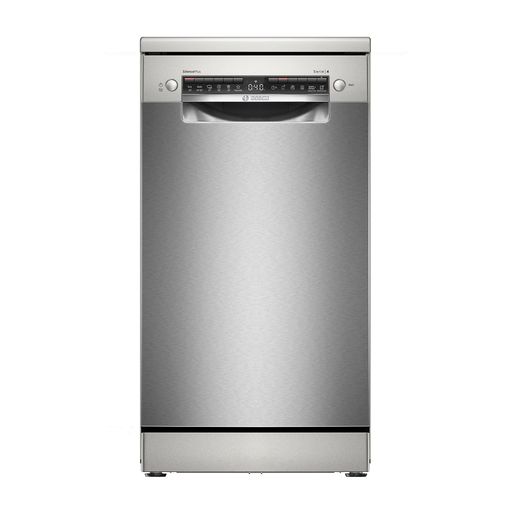
Bosch SPS4EMI17E freestanding dishwasher, 45 cm, 13 place settings

Bosch SPS4EMI17E freestanding dishwasher, 45 cm, 13 place settings

A freestanding model for a workshop kitchen with a suitable space for it.

The product name lists a width of 45 cm and a capacity of 13 place settings.

Joybuy

Bosch SPS4HKW49E Series 4 freestanding dishwasher, 45 cm, white

Bosch SPS4HKW49E Series 4 freestanding dishwasher, 45 cm, white

A freestanding model for anyone looking for a slimline machine and wanting to check how their own crockery fits in the racks.

Bosch lists 10 place settings, energy class E, 8.9 litres per eco cycle and 44 dB(A). The eco programme takes 3:40 hours; this duration doesn’t automatically apply to the quick programme.

Joybuy

Frequently asked questions

Are nine or 10 place settings enough for a cookery workshop?

That depends on the crockery you use for each session. A place setting means standard tableware for one person. Count glasses, bowls and pans separately, and check that the largest items fit in the racks.

Will a 45 cm integrated dishwasher fit in any slimline niche?

No, width alone isn’t enough to determine whether it will fit. Check the stated niche dimensions, door panel and hinge system too. For example, ETNA lists a niche height of 820–880 mm and a door-on-door system for the VW47SM.

Can you read a quick programme’s consumption figures from the energy label?

Not directly: the European Commission states that the EU label’s energy and water figures are for the eco programme. Compare those figures on the same basis, and check the model-specific details for other programmes.

Is a household dishwasher with a hygiene programme automatically suitable for a commercial cookery workshop?

No, a programme name doesn’t prove that it is. According to the Netherlands Food and Consumer Product Safety Authority, a business that prepares, processes or sells food must follow an HACCP food safety plan or an applicable hygiene code. Assess your dishwashing procedure as part of that process, and check the appliance’s conditions of use too.

How do you maintain a dishwasher that’s used frequently?

Follow the manual for your chosen model. Bosch recommends removing the filter from its dishwashers, rinsing it and putting it back correctly.
