Who is a slimline dishwasher suitable for?

Households who eat dinner together

You want to fit the dinner plates, cutlery and, ideally, serving dishes from a shared meal into one load. The Consumers’ Association describes standard place settings as a guideline; the rack layout also affects whether your crockery will fit.

Buyers with a narrow space in the kitchen

You have limited width or an existing narrow space for an integrated appliance, so you first need to work out which installation type and dimensions will fit. The Consumers’ Association recommends comparing the space with the appliance’s full width, height and depth.

Regular users of the eco programme

You run the dishwasher often and want to compare energy and water use per eco cycle, without considering lower consumption separately from capacity and how full you can load the machine. Milieu Centraal and Energielabel.nl identify consumption per programme as useful information for comparing models.

What should you look for when choosing?

First check whether your usual after-dinner washing-up fits in the racks. Then measure the available space and compare consumption and ease of use.

What to consider What should you check? Who is this important for?
Space for the after-dinner washing-up Check the dimensions of your largest plates and serving dishes, the rack height and the space for cutlery on the exact model. If I want to wash plates, cutlery and serving dishes together after a shared meal, I’ll check that they really do fit at the same time. Around 36% of consumers make this their main consideration.
Fit in your kitchen Measure the width, height and depth. For an integrated model, also check the door front, plinth and door system. For a freestanding model, make sure the water supply and drain are accessible. If my kitchen only has room for a narrow appliance or an integrated space, I want to know in advance which installation type will fit. Around 29% of consumers say available kitchen space is their main concern.
Electricity and water consumption Compare kWh per 100 eco cycles and litres per eco cycle on the current energy label. Also consider programme duration and how often you can run the machine full. If I use the dishwasher regularly, I’ll compare eco consumption and consider whether I can usually run it full. Around 21% of consumers prioritise running costs.
Noise and drying convenience Compare the decibel rating, noise class, eco programme duration and drying technology of the exact model. Don’t treat a manufacturer’s drying claims as independent test results. In an open-plan kitchen, I want to know how much noise the machine makes and when I’ll be able to unload it. Around 14% of consumers prioritise quiet operation and drying convenience.

Common buying mistakes

  • Assuming place settings guarantee your crockery will fit

    The number of standard place settings describes a standard load; it doesn’t tell you whether your dinner plates will fit or how much room there is for serving dishes. If your usual combination won’t fit, you may need to run an extra cycle.

    Measure your largest plates and serving dishes, then check the rack height, adjustability and cutlery space on the exact model.

  • Choosing an integrated model based on width alone

    The height, depth and combination of the installation space, door front and door system also determine whether the dishwasher will fit.

    Compare the full installation dimensions with your kitchen, and check the door front, plinth and door system before choosing.

  • Automatically treating a mini or 60 cm model as an alternative

    According to the Consumers’ Association, a mini dishwasher holds around 6 place settings, compared with about 9 to 10 for a slimline model. Milieu Centraal points out that a standard-size model is most suitable when you can load it efficiently. The right choice therefore depends on both the available space and the amount of washing-up you usually have.

    Choose a size that suits both your available space and the washing-up from a typical evening meal.

  • Confusing old and current energy labels

    The current label uses a scale from A to G. The consumption figures on a dishwasher’s energy label relate to the eco programme, so compare like with like.

    Compare kWh per 100 eco cycles and litres per eco cycle on the current label. Energielabel.nl lists these figures as part of the dishwasher energy label.

Brands to compare

Beko

Beko offers freestanding slimline models. The Dutch product page for the BDFS26046XQ lists 10 standard place settings, energy class C and a cutlery tray.

  • Beko lists a noise level of 44 dBA and water consumption of 8,9 litres per cycle for the BDFS26046XQ.
  • Claims about the intensive zone and SelfDry come from the manufacturer. Check that the racks suit your plates and serving dishes.

Inventum

According to Inventum, the freestanding VVW4530AW, which is 45 cm wide, holds 10 place settings and has an adjustable upper rack and a removable cutlery basket.

  • Inventum lists energy class D for this model and says the upper rack is height-adjustable.
  • The manufacturer lists a noise level of 45 dB and water consumption of 11 litres per wash. Any savings from a half load depend on the programme and load; this is not an independent comparative test result.

Bosch

According to Bosch, the freestanding slimline Serie 4 SPS4EMI17E measures 845 × 450 × 600 mm and has energy class B.

  • Bosch lists an adjustable rack system and an automatically opening door as a drying feature.
  • Check the capacity of the exact version: a Joybuy listing states 13 place settings, but this capacity is not confirmed on the Bosch product page.

Siemens

According to Siemens, the fully integrated slimline SR65EX09ME measures 815 × 448 × 550 mm and has energy class B.

  • Siemens lists adjustable racks and autoOpen Dry.
  • Whether it fits depends on the exact installation space and door front. The appliance dimensions alone don’t confirm that the model will fit your kitchen.

ETNA

According to ETNA, the VW47SM is a 45 cm-wide integrated slimline dishwasher with space for nine place settings.

  • ETNA lists nine programmes and a half-load setting for this model.
  • Check the exact installation and door-front dimensions, and make sure there’s enough room for serving dishes as well as your dinner plates.

Joybuy products for a narrow space

This selection focuses on freestanding 45 cm dishwashers for narrow kitchen spaces. For each model, check whether the racks can accommodate your dinner plates, cutlery and serving dishes.

Bosch SPS4EMI17E freestanding dishwasher, 45 cm wide

Bosch SPS4EMI17E, freestanding, 45 cm

Suitable if you’re looking for a narrow freestanding model. Check whether its racks can accommodate your dinner plates and serving dishes at the same time.

The Joybuy product title lists 13 place settings, but Bosch doesn’t confirm this capacity on its Dutch product page. Check the capacity and rack layout of the exact version before buying.

Bosch lists dimensions of 845 × 450 × 600 mm and energy class B for the SPS4EMI17E.

Joybuy
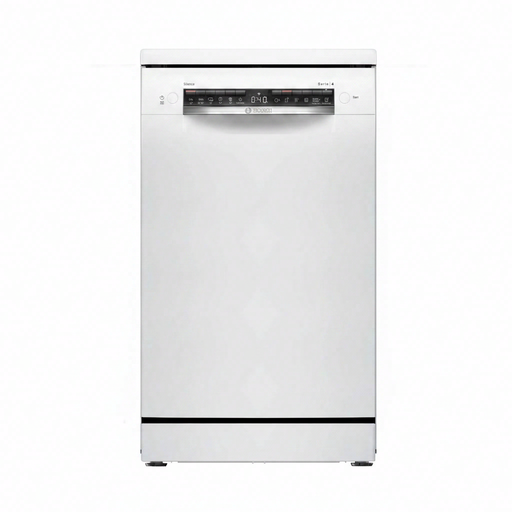
Bosch SPS4HKW49E Series 4 freestanding dishwasher, 45 cm, white

Bosch SPS4HKW49E Series 4, freestanding, 45 cm, white

An option if you’re looking for a 45 cm freestanding dishwasher. Measure the available space and check that your plates and serving dishes will fit in the racks.

Base your choice on the appliance’s full dimensions and the space your crockery needs, not just its width category.

Joybuy

Frequently asked questions

Are 10 place settings enough for the plates from a shared dinner?

Not necessarily: the number of place settings describes a standard load, not the dimensions of your plates or serving dishes. The Consumers’ Association says slimline dishwashers typically hold around 9 to 10 place settings. Check that your own crockery fits in the racks.

What should I measure for a slimline integrated dishwasher?

Measure the width, height and depth of the installation space, then compare them with the appliance specifications. Also check the door front, plinth and door system. A 45 cm measurement only indicates the width category; it doesn’t confirm that the appliance will fit the space properly.

Do I need to pre-rinse dishes by hand?

According to Milieu Centraal, pre-rinsing by hand is rarely necessary, especially with hot water. Scrape off food scraps first, and follow the instructions for your chosen dishwasher when loading and maintaining it.

How do I compare electricity and water consumption?

On the current energy label, compare the number of kWh per 100 eco cycles and the water consumption per eco cycle. Milieu Centraal recommends running a full load and using the eco programme. Your actual consumption also depends on how often you wash and how you use the machine.

Is the eco programme always the most convenient option for the after-dinner washing-up?

Not if you want to unload the dishes quickly: according to the Consumers’ Association, the eco programme takes longer than the automatic programme, but uses less energy and water. Weigh the longer programme time against when you use the dishwasher, and compare the figures for the exact model.
