What should you look for when choosing one?
Freestanding slimline model
A good fit if: you have space for a visible appliance and don’t need it to match your kitchen units.
Bear in mind: the racks have limited space. Check the external dimensions, connections and door clearance too.
Built-in slimline model
A good fit if: the dishwasher needs to sit behind a kitchen door and the housing, door and hinge system are compatible with the model.
Bear in mind: installation requirements are more involved than for a freestanding model. Check the full housing dimensions and door system.
Consider a standard-width model
A good fit if: your kitchen has the space and a slimline machine repeatedly doesn’t have enough room for your usual load.
Bear in mind: a standard-width model takes up more space. Consider your everyday load before choosing a larger machine for occasional meals.
The Dutch Consumers’ Association describes slimline dishwashers as around 45 cm wide and suitable for 9 to 10 place settings. This is a useful starting point for comparison, but your own crockery and available space will determine whether the machine is practical for you.
| What to consider |
What should you check? |
Who is this important for? |
| Space for meal-time crockery |
Compare the place-setting capacity with your usual load, measure large plates and check the rack layout. |
If you want to wash serving dishes, glasses and plates from a neighbourhood meal as well as your everyday dishes, you may need to plan more than one load. Around 36% of consumers rank space for meal-time crockery as their main buying concern. |
| Fitting the available space |
Measure the width, height and depth. For a built-in model, check the kitchen door and hinges too. |
If you have a narrow space or an existing built-in housing, you’ll want to know whether the appliance and installation will fit. Around 29% of consumers say fitting the dishwasher is their main buying concern. |
| Consumption for everyday use |
Compare the EU label figures for the eco programme and consider whether you can usually wait until the machine is full. |
If you use the dishwasher often and want to compare consumption, look at the label figures as well as your own routine. Around 21% of consumers put everyday consumption at the top of their list. |
| Programme and noise |
Check the programme duration and noise rating for the exact model. For a quick programme, look at the details for that cycle. |
If you need clean dishes during or soon after a meal, consider the time available and the noise level. Around 14% of consumers say wash planning and noise are their main buying concerns. |
Dishwashers at Joybuy
This selection includes slimline freestanding and built-in dishwashers, plus some standard-width built-in models for kitchens with room for a wider machine.
 No image available
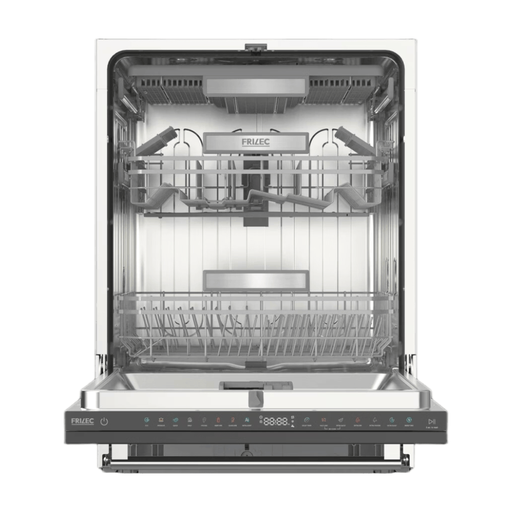
Frilec FRANKFURT8818-E-450A built-in dishwasher
A fully integrated model for a kitchen with compatible units.
The product name states energy class A and 16 place settings.
View at Joybuy
 No image available
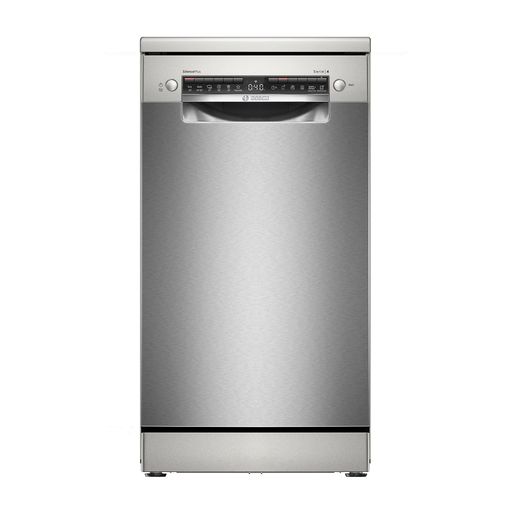
Bosch SPS4EMI17E freestanding dishwasher, 45 cm
A freestanding 45 cm model for anyone who doesn’t need a built-in door panel.
The Joybuy product title states 13 place settings; Bosch lists a maximum of 10 for the SPS4EMI17E. Check this discrepancy before taking capacity into account.
View at Joybuy
 No image available
Bosch SPS4HKW49E Series 4 freestanding dishwasher, 45 cm, white
A freestanding 45 cm model for a narrow space without a kitchen door panel.
The product name specifies the white finish.
View at Joybuy
 No image available
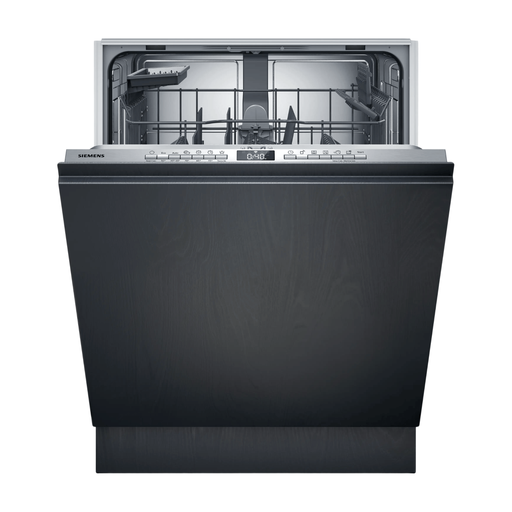
Bosch iQ300 SN73HX04TE fully integrated dishwasher, 60 cm
A standard-width built-in alternative for a kitchen with a compatible housing and door panel.
The product name specifies a varioHinge model. The product details state a housing width of 600–608 mm and a door-panel weight of 4.5–11 kg.
View at Joybuy
 No image available
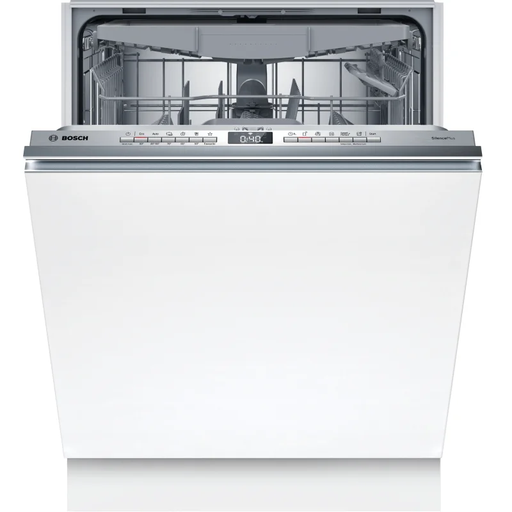
Bosch SMV4EVX08E Series 4 fully integrated dishwasher, 60 cm
A standard-width built-in model for a kitchen with a compatible cabinet housing and door panel.
The product name specifies a width of 60 cm.
View at Joybuy
Frequently asked questions
Are nine or ten place settings enough for a neighbourhood meal?
Not necessarily. A place setting is the tableware for one person at one meal. Check the size of your plates and allow for glasses, serving dishes and pans too. If everything won’t fit, plan to run more than one load.
What should I check before having a slimline built-in dishwasher installed?
Measure the width, height and depth of the housing, then compare the space for pipework, the door panel and hinge system with the installation drawing for the exact model. The description ‘45 cm wide’ alone doesn’t confirm that the machine will fit.
How should I use my dishwasher for everyday washing?
Milieu Centraal recommends running the machine when full, selecting the eco programme and wiping away food scraps instead of routinely rinsing dishes with hot water first. Follow your model’s manual for detergent, salt, rinse aid and operation.
What costs and rights should I consider when choosing?
Ask in advance what delivery, installation and any removal of your old appliance include, and compare consumption using the EU label. When you buy as a consumer in the Netherlands, your statutory guarantee applies alongside any manufacturer’s guarantee. If a product used normally breaks down sooner than you could reasonably expect, the seller is responsible for providing an appropriate solution at no extra cost.
Does a new dishwasher sold in the Netherlands have to carry an energy label?
Yes. The Dutch Government says energy labels are compulsory for dishwashers. Since 1 March 2021, the EU label has used a scale from A to G. For dishwashers, it includes information such as energy consumption per 100 eco cycles and water consumption per eco cycle.


