First, choose between a freestanding model and an integrated model that will fit the space you have; then check whether the racks can accommodate your plates, glasses and any serving dishes. A slimline dishwasher of around 45 cm takes up less width, but if a standard 60 cm model will fit and you can usually fill it properly, that’s also worth considering.
Who is a slimline dishwasher suitable for?
Cook with a small kitchen
You want to machine-wash the dishes after lunch, but the available width and any built-in space will determine which type fits. The Consumentenbond and Milieu Centraal describe slimline dishwashers as an option when a standard-width model won’t fit.
Host with lots of crockery
You want room for glasses, cutlery and perhaps serving dishes after lunch, too. So check the rack layout and compare it with your own crockery; the stated number of place settings doesn’t necessarily tell you whether large serving dishes will fit.
Regular eco programme user
You use the machine outside the weekend too and want to compare electricity and water consumption. The European Commission says the dishwasher energy label includes details such as electricity consumption per 100 eco cycles and water consumption per eco cycle.
What should you look for when choosing?
Measure the space first, then work out which capacity, running costs and programmes suit your everyday washing-up.
| What to consider |
What should you check? |
Who should give this more weight? |
| Suitable type and size |
Check the external dimensions or niche dimensions, the hinge system and the clearance needed for the open door. Also check that water, drainage and a suitable electrical connection are available. |
If the available space or existing kitchen determines your choice, you’ll want to make sure the appliance fits first. Around 36% of consumers put fit and installation at the top of their list when buying. |
| Room for your lunch dishes |
Check the number of place settings, whether the racks are adjustable and how the cutlery is arranged. Compare the layout with your largest plates, glasses and serving dishes. |
If you want to wash plates, glasses and perhaps serving dishes in one load, practical rack space matters more than the capacity figure alone. Around 29% of consumers prioritise capacity. |
| Electricity and water consumption |
Compare the kWh per 100 eco cycles and litres per eco cycle shown on the labels of the exact models. Don’t compare these figures with consumption for a different programme. |
If you use the dishwasher regularly outside the weekend too, you’ll want to compare consumption on a like-for-like basis. Around 21% of consumers put ongoing electricity and water consumption first. |
| Noise and programme duration |
Check the noise level on the label and consult the manual for the duration and conditions of the programmes you want to use. |
If your kitchen is open-plan or you need your crockery again quickly, noise and programme duration may matter. Around 14% of consumers prioritise quiet operation or being able to run another load quickly. |
Common pitfalls
-
Measuring the width only
An appliance may fit in terms of width but still be unsuitable because of its depth, height, door opening or hinge system. If it’s freestanding, the door will also need enough clearance.
Measure the whole space and check the installation diagram for the exact model before you buy.
-
Assuming place settings mean there’s room for every serving dish
The stated number of place settings doesn’t guarantee that your largest plates or serving dishes will fit in the racks. Rack height and adjustability, as well as cutlery space, also make a difference.
Compare the interior layout with your own largest lunch plates, glasses and serving dishes.
-
Assuming eco-label consumption applies to every programme
The electricity and water figures on the dishwasher label relate to the eco programme. They don’t automatically show consumption for a quick programme or another cycle.
Compare the label figures for the exact models on the same basis, and check separately which programmes you need.
-
Assuming a slimline machine is always the most economical choice
Milieu Centraal recommends a standard dishwasher that’s fully loaded if it fits and you have enough dishes to wash. If that isn’t possible, a smaller machine may be better suited to how you use it.
Take both the available space and your usual load into account when choosing a size.
Brands to compare
Beko
The BDFS26046XQ is a freestanding slimline model to consider if you’d like a cutlery drawer and a stated capacity of 10 place settings.
- Beko lists energy class C, 8.9 litres per cycle and 44 dBA for this model.
- The manufacturer describes an intensive zone and automatic door opening. These are the manufacturer’s claims, not independent confirmation of cleaning or drying results. Check whether your own serving dishes will fit in the racks.
ETNA
ETNA has slimline models for both freestanding use and fully integrated installation; the exact model determines the dimensions and features.
- The VW47SM is an integrated model with 9 place settings and a stated niche height of 820–880 mm. The freestanding VWV147SWIT lists 9 place settings and a width of 44.8 cm.
- Both models listed have energy class E. The dimensions and features of one model don’t automatically apply to the other.
Bosch
The freestanding SPS4HKW49E is a slimline model to compare if you’re considering rack layout and noise level.
- Bosch lists adjustable VarioFlex racks and 44 dB for this model.
- Bosch marks the SPS4HKW49E as no longer available on its Dutch website. A product listing with a retailer doesn’t confirm that the model is in stock when you place your order.
Siemens
The SR65EX09ME is a fully integrated 45 cm model for a suitable niche and kitchen door panel.
- Siemens lists external dimensions of 815 × 448 × 550 mm, energy class B, 8.7 litres per eco cycle and adjustable racks.
- Check that the niche dimensions and door panel are suitable for the exact model; when checked, the manufacturer reported that the model was temporarily out of stock in its own online shop.
AEG
AEG describes a range of 45 cm dishwashers for small kitchens; compare the dimensions and model specifications before choosing a specific model.
- The range gives you a starting point if you’re looking for a slimline dishwasher.
- Range information doesn’t give model-specific capacity, consumption or comparable washing results. Don’t treat general performance claims as an independent test.
Joybuy products for a small kitchen
This Joybuy selection features freestanding 45 cm slimline dishwashers for anyone with a suitable space for a freestanding model.
 Image unavailable
Bosch SPS4EMI17E, freestanding, 45 cm, 13 place settings
A freestanding slimline model to consider if you have a suitable space for it.
The product name lists a width of 45 cm and a capacity of 13 place settings. Check that the rack layout will suit your largest plates and serving dishes.
Joybuy
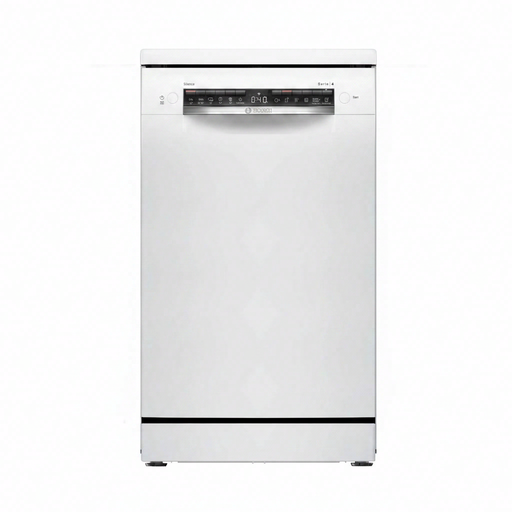 Image unavailable
Bosch SPS4HKW49E Series 4, freestanding, 45 cm, white
A freestanding slimline model to consider if you have a suitable space and want to compare the rack layout.
Bosch lists 44 dB and adjustable VarioFlex racks for this model. Bosch marks it as no longer available on its Dutch website, so check current availability when you order.
Joybuy
Frequently asked questions
Is 45 cm enough for the dishes from a weekend lunch?
According to the Consumentenbond, a slimline dishwasher usually holds around 9 to 10 place settings. Whether all your lunch dishes will fit in one load also depends on serving dishes, large plates and the rack layout; check the exact model.
Do I need to rinse plates before loading them?
No. Milieu Centraal recommends scraping off food, but not routinely rinsing the dishes by hand first. Follow your model’s manual for instructions on use and care.
What costs and guarantees should I compare besides the purchase price?
Compare any installation costs and electricity and water consumption using label figures for the same programmes. According to the Dutch government, there’s no fixed period for the statutory guarantee in the Netherlands: if a product doesn’t meet what you could reasonably expect under normal use, contact the seller. The manufacturer’s guarantee is additional.
Is an energy label compulsory for a new dishwasher in the Netherlands?
Yes. New domestic dishwashers covered by EU rules must have an energy label, which must be clearly visible when sold online. The label includes details such as the energy class, kWh per 100 eco cycles, water per eco cycle, capacity and noise; it doesn’t set a minimum energy class.


