
Thin slices of roast beef
You mainly slice roast beef thinly, so you’ll want to check the type of blade supplied and the adjustable slicing thickness first.


For thin slices of roast beef, a slicer supplied with a smooth blade is a good choice: Graef describes smooth blades as suitable for fine slices of cold meats. If storage space is your main concern, compare folding models by their dimensions when in use as well as the type of blade supplied; a serrated blade is not the same as a smooth blade. Clean kitchen utensils after contact with raw meat before using them for other food, as advised by the Netherlands Nutrition Centre.
You mainly slice roast beef thinly, so you’ll want to check the type of blade supplied and the adjustable slicing thickness first.
You share a small worktop or have limited cupboard space, so the dimensions when in use and how compactly it folds away matter.
You want to be able to clean the parts thoroughly after slicing and keep raw meat separate from prepared food.
| What to consider | What should you check? | Who is this important to? |
|---|---|---|
| Blade and slice thickness | Check whether a smooth blade is included or is confirmed as compatible with the exact model, and look at the adjustable slicing thickness. | If thin slices of roast beef are your main aim, you’ll want to know exactly which blade you’ll get. Around 29% of consumers prioritise the slicing result. |
| Worktop and storage space | Compare the dimensions when in use with the space available, and check the folded dimensions and room needed for separate parts too. | If you have a small worktop or limited cupboard space, you’ll want to be able to store the appliance without it getting in the way when in use. Around 29% of consumers give space top priority. |
| Cleaning after handling meat | Check which parts can be removed and follow the cleaning instructions for the exact model; don’t assume it is dishwasher-safe. | If you also use the slicer for other food, you’ll want to be able to clean the parts thoroughly after contact with meat. Around 24% of consumers prioritise cleaning and hygiene. |
| What’s included in the set | Check which blades and parts are included as standard, and whether any separately sold blade is compatible with this exact model. | If you want to know in advance whether the set has everything you need, check the included parts and their compatibility. Around 18% of consumers say the contents of the set are their top priority. |
The adjustable range doesn’t tell you which blade is included. Graef describes smooth blades as suitable for fine slices of cold meats, while several compact models are sold with a serrated blade.
Check what’s included, the blade type and compatibility with the exact model before choosing.
A suitable smooth blade may be sold separately; check whether you need one for your intended use.
Even a folding appliance needs space for the machine, carriage and food while you’re slicing.
Measure both your available worktop space and storage area, then compare them with the model’s dimensions and separate parts.
Removable and dishwasher-safe are two different things. FRITEL says the SL 3110 has a removable blade, but also states that the model is not dishwasher-safe.
Follow the cleaning instructions for the exact model and be prepared to clean it by hand after contact with meat.
Compare the folding SL 3110 with the larger SL 3855 Twin if you’re weighing up how much storage space you have and which blades are included.
The folding markant⁰⁵ is worth considering if width when stored is a major factor.
According to Graef, the MYtiny combines a folding design with the option of choosing a compatible smooth blade separately.
The folding AS 3912 is a model to compare for slicing thickness, connections and storage dimensions.
This selection includes electric slicers for meat and other foods, with both smooth and serrated blades, as well as a folding model.
 No image available
A smooth blade is listed for meat; check which parts are included before choosing.
The product description lists smooth and serrated blades, a slicing thickness of up to 23 mm, a removable carriage and a safety switch.
 No image available
The product description specifies a serrated blade; the blade type is an important consideration for very thin slices of roast beef.
The description lists a slicing thickness of up to 20 mm and a removable carriage.
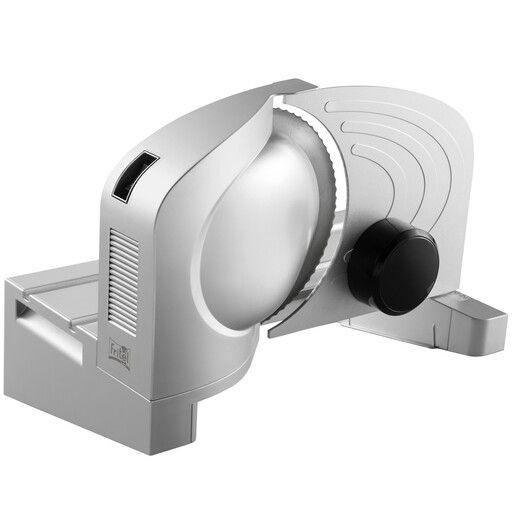 No image available
The product description lists meat as a food it can slice and specifies a removable serrated blade.
Listed specifications include a slicing thickness of 0–20 mm, a blade diameter of Ø 17 cm, 160 W and a carriage set at a 15° angle.
 No image available
The folding design is useful if you want to put the machine away after use; the blade supplied is serrated.
The product description lists a slicing thickness of 0–15 mm, a blade diameter of Ø 17 cm, 100 W, a removable carriage and a food holder. FRITEL states that the model is not dishwasher-safe.
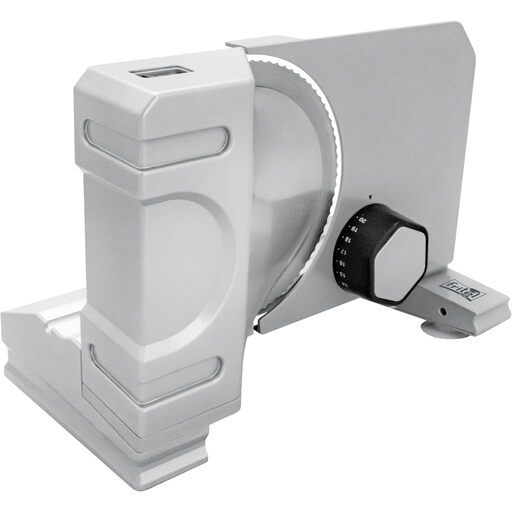 No image available
The product description lists meat as a food it can slice and includes a food holder to guide it towards the blade.
Listed specifications include a slicing thickness of 0–20 mm, a blade diameter of Ø 19 cm, 150 W and an angled carriage. The product description limits continuous use to 10 minutes, followed by a 30-minute cooling period.
Check whether a smooth blade is actually included with the exact model. Graef describes smooth blades as suitable for very thin slices of cold meats; according to FRITEL, the SL 3855 Twin comes with both a smooth and a serrated blade. This is not an independent test of the slicing results for every cut of roast beef.
The Netherlands Nutrition Centre advises washing kitchen utensils that have touched raw meat in hot water before using them for other food. Also follow the manual for removing and cleaning the blade and carriage; the FRITEL SL 3110, for example, is not dishwasher-safe.
According to the Netherlands Nutrition Centre, store opened sliced roast beef in the fridge for no more than two days, on the coldest shelf at 4 °C. For an unopened pack, follow the storage instructions and date on the packaging.
No. According to the Dutch government, there is no fixed statutory guarantee period in the Netherlands: you’re entitled to a product that does what you can reasonably expect it to do. If there’s a problem, contact the retailer; any manufacturer’s guarantee is in addition to your statutory rights.
Electrical appliances sold in the Netherlands must meet the applicable European safety rules, as explained by Business.gov.nl. For equipment with a rated voltage of 50–1.000 V AC, EUR-Lex sets out the scope of the European Low Voltage rules and the related conformity requirements. A CE mark is the manufacturer’s declaration of conformity, not proof of an independent test of slicing performance.