
Breakfast on a tight schedule
If you want to grab a slice and go on weekdays, check how many slices are in the pack and the weight per portion. A pre-sliced loaf saves you the job of cutting it, but doesn’t tell you how large each slice is.


For a quick weekday breakfast, sliced plain ontbijtkoek is a convenient option if you mainly want to grab a slice and go. If sugar and fibre content matter more to you, compare plain, wholemeal and zero varieties per 100 g and per slice. For varieties containing xylitol, check the warning on the packaging too.
If you want to grab a slice and go on weekdays, check how many slices are in the pack and the weight per portion. A pre-sliced loaf saves you the job of cutting it, but doesn’t tell you how large each slice is.
Compare the nutritional values of plain, wholemeal and zero varieties on the same basis. Look at sugar and fibre, and check the ingredients and warnings for varieties containing sweeteners.
A larger pack is most practical if you’ll eat the slices as part of your usual breakfast routine. Also check the ingredients and allergen information if they’re relevant to your choice.
First, decide what matters most for your breakfast: nutritional information, a slice that’s ready to eat, pack size or ingredients. Then compare the specific varieties on the label.
| What to consider | What to check before buying | Who it matters to |
|---|---|---|
| Sugar and fibre | Compare the nutritional values per 100 g and per slice; also check which sweeteners have been used. | If I’m choosing between plain, zero or wholemeal, I want to know the actual differences per slice. Around 36% of consumers give this nutritional information top priority. |
| Convenient slices and portions | Check whether the loaf is sliced and how many slices or portions are listed on the pack. | On a busy weekday, I want to be able to grab a slice without cutting it first. For around 29% of consumers, convenience comes first. |
| Pack size and how quickly you’ll use it | Compare the pack weight with how many slices you’ll use, and read the storage instructions. | If I don’t eat ontbijtkoek often, I want to avoid leaving an opened pack for too long. A suitable quantity is the first consideration for around 21% of consumers. |
| Ingredients and allergens | Read the current ingredients list, allergen information and any precautionary warnings about possible presence. | If I need to check ingredients because of an allergy, the product name alone isn’t enough to make a choice. For around 14% of consumers, checking the label comes first. |
These claims alone don’t tell you how much sugar and fibre a slice contains. The AH Zero and Peijnenburg wholemeal sliced varieties reviewed contain xylitol and carry a warning that excessive consumption may have a laxative effect.
Compare the nutritional information on the same basis, and check the ingredients and warnings for the variety you choose.
‘Wholemeal’ and ‘zero’ don’t tell you which allergens an ontbijtkoek contains. The PLUS plain sliced variety reviewed lists rye and states that it may also contain wheat, barley and oats.
If you have an allergy or coeliac disease, check the ingredients, allergens and any warnings on the current packaging.
Sliced ontbijtkoek won’t stay in the same condition indefinitely once opened. The product information checked for Peijnenburg and Albert Heijn recommends storing it in a cool, dry, dark place; Peijnenburg also suggests keeping it in a sealed tin or container.
Choose a quantity that suits how quickly you’ll use it, and follow the storage instructions on the pack once opened.
These brands offer several sliced varieties. The features listed apply to the products described and may not apply to the entire range.
Albert Heijn lists several Peijnenburg ontbijtkoek products, including sliced plain and wholemeal varieties.
Albert Heijn lists sliced ontbijtkoek in plain and zero varieties.
PLUS lists a 485 g pack of sliced plain ontbijtkoek.
ALDI lists a 485 g pack of sliced wholemeal ontbijtkoek and a 485 g sliced zero variety from Koek & Bakker.
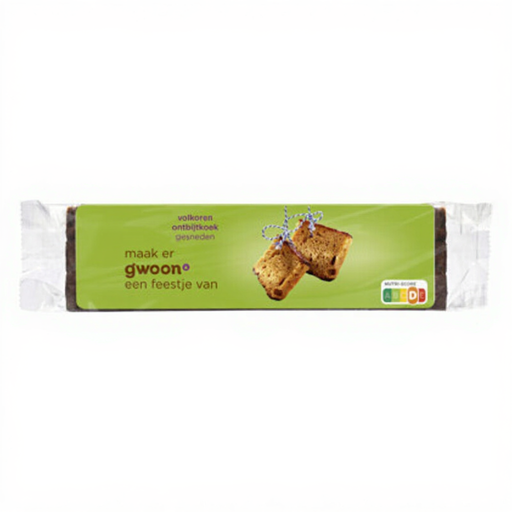
This sliced wholemeal ontbijtkoek is a handy choice if you want a ready-cut slice for breakfast on a weekday. Before comparing it with plain or zero varieties, check the nutritional values and portion size on the packaging.
 No image available
For anyone who wants a pre-sliced wholemeal variety to grab on a weekday. Check the pack for the number of slices and the nutritional values per 100 g and per slice; if you have an allergy, also read the current ingredients and allergen information.
You don’t have to slice it yourself, but slice sizes vary by product. Albert Heijn lists 12 slices in a 345 g pack of Peijnenburg plain and 16 portions of 30 g in a 485 g pack of AH plain. So, if a consistent portion matters to you, check the packaging.
Don’t choose based on the name alone: compare the nutritional values of the specific products per 100 g and per slice. The AH Zero and Peijnenburg wholemeal sliced varieties reviewed contain xylitol and carry a warning that excessive consumption may have a laxative effect.
Follow the storage instructions on the pack and seal the ontbijtkoek well after opening. The product information checked for Peijnenburg and Albert Heijn recommends storing it in a dry, dark place; Peijnenburg suggests using a sealed tin or container to keep it moist.
Don’t rely on the name ‘plain’, ‘wholemeal’ or ‘zero’. Check the current packaging for ingredients, allergens and any gluten-free claim. The regular varieties reviewed list rye; a separate gluten-free Peijnenburg ontbijtkoek is unsliced and also lists lupin and milk.