
Lunch shoppers who want minimal preparation
You can grab a pre-sliced piece for lunch without having to cut it yourself. Albert Heijn and ALDI describe their sliced versions as convenient for this purpose.


Choose sliced Dutch breakfast cake based on what matters most for your lunch: a plain version for a simple slice, a wholemeal version whose label lists the fibre content you’re looking for, or a version with no added sugar if you’ve also checked the ingredients and warnings. Compare the exact packs for fibre, sugars, allergens and portion size; the variant name alone doesn’t tell you everything.
You can grab a pre-sliced piece for lunch without having to cut it yourself. Albert Heijn and ALDI describe their sliced versions as convenient for this purpose.
If fibre, sugars or ingredients influence your choice, look beyond words such as wholemeal and zero. Product information from Albert Heijn and Jumbo shows that the figures vary between versions.
Check the pack weight, the number of slices if stated, and the storage instructions after opening. This will help you decide whether a pack suits the way you’ll use it.
First, decide which feature matters most for your lunch. Then compare the nutritional information and ingredients on packs that meet your requirements, using the same basis each time: per 100 g or per portion.
| What to consider | What should you check? | Who is this most important for? |
|---|---|---|
| Convenience and portion size | Check whether the cake is pre-sliced and how much a slice or portion weighs according to the pack. | If I want to take lunch with me without a knife, I need to be able to grab a slice straight away. Convenience is the top priority for around 29% of consumers. |
| Fibre and sugars | Compare fibre and sugars per 100 g; also check the ingredients and the portion you eat. | If you regularly eat Dutch breakfast cake for lunch, you’ll want to know what wholemeal or zero actually means for the version you choose. Around 29% of consumers give these ingredients and nutritional values top priority. |
| Packaging and storage | Check the net weight and the storage instructions for after opening. | If I want to get several lunches out of one pack, the quantity needs to suit how I use it. This is the main consideration for around 24% of consumers. |
| Allergens and sweeteners | Read the allergen information, ingredients and any warnings on the current pack. | If you need to avoid certain ingredients or are considering a zero version, don’t rely on the product name alone. This is the first selection criterion for around 18% of consumers. |
Albert Heijn’s product information lists 5.7 g of fibre and 34 g of added sugars per 100 g for its sliced wholemeal Dutch breakfast cake. Fibre content and added sugars are separate points to compare.
Compare the nutritional information for the exact versions side by side, using the same quantity, such as per 100 g.
According to Jumbo’s product information, the zero version in question contains maltitols and excessive consumption may have a laxative effect. A zero label therefore doesn’t replace the ingredients list or usage warning.
Check which sweeteners the version you choose contains and read the warnings on the pack.
The sliced plain version sold by Jumbo comes in a 550 g pack and is described as containing 18 slices.
Albert Heijn sells sliced plain and wholemeal Dutch breakfast cake in 485 g packs.
Jumbo sells sliced Dutch breakfast cake, including the 475 g zero version discussed here.
PLUS sells sliced plain Dutch breakfast cake in a 485 g pack.
ALDI describes sliced wholemeal and zero Dutch breakfast cake from Koek & Bakker, both in 485 g packs.
Lidl describes a 485 g pack of sliced wholemeal Dutch breakfast cake that is available in store only.
This product may suit you if you’re looking for a sliced wholemeal version for lunch. Check the current pack for its ingredients and allergen information.
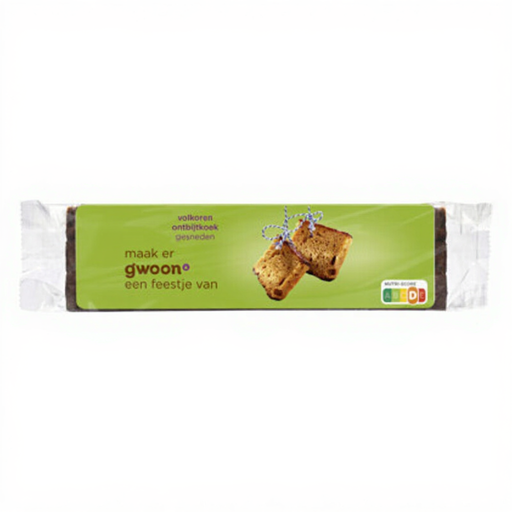 No image available
A sliced version for anyone who wants to grab a piece for lunch without cutting it themselves.
The pack contains 485 g. Before buying, check the current allergen information and compare the nutritional information per 100 g or per slice if the ingredients and nutritional values matter to you.
You can’t tell from the product category alone. Check the ingredients on the pack you’ve chosen, or ask the manufacturer about the exact version if this is important to your choice.
Compare the exact products to find out. According to Albert Heijn’s product information, its sliced wholemeal version contains 5.7 g of fibre per 100 g, while its sliced plain version contains 3.3 g per 100 g. This difference doesn’t necessarily apply to versions from other brands or tell you anything about their other ingredients.
As well as the zero label, read the ingredients and any usage warnings. According to Jumbo, the version discussed contains maltitols and states that excessive consumption may have a laxative effect.
Follow the storage instructions on the pack you’ve chosen. For the version discussed, Albert Heijn recommends a cool, dark and dry place. For the Peijnenburg version discussed, it recommends a dry, dark place and, ideally, a sealed tin or container.