
Parents keeping an eye on sugar
You want to compare the sugar content per slice. With a zero variant, you should also check which sweeteners it contains and what warning appears on the packaging.


For a school holiday lunch, start by comparing the sugars, fibre and portion size per slice. Among the products reviewed, a zero variant may contain less sugar, but you should also check the sweeteners and any usage warnings. If you mainly want pre-sliced portions for several occasions, look at the pack weight and number of portions. Don’t treat breakfast cake as a replacement for the wholemeal bread that forms the basis of lunch.
You want to compare the sugar content per slice. With a zero variant, you should also check which sweeteners it contains and what warning appears on the packaging.
You’re looking for a pre-sliced pack for several lunches or snack breaks. In that case, the number of slices and the portion size tell you more than the pack weight alone.
Before buying, you check for rye, gluten, other listed grains and any sweeteners. If you need to follow a gluten-free diet, don’t rely on the product name: check the latest allergen information.
Start with what matters most for your lunch occasion. Then compare products on a like-for-like basis: nutritional values per 100 g, as well as the size of a slice or portion.
| What to consider | What should you check? | Who is this important to? |
|---|---|---|
| Sugars and fibre | Compare the sugars and fibre per 100 g, and use the portion size shown on the pack to work out how much you’ll have. | If I want less sugar per slice and want to compare fibre too, that determines which variant I look at. For around 36% of consumers, this is the most important consideration. |
| Slices and packaging | Check the weight, the number of pre-sliced portions and the portion size. | For several lunches, I want to be able to share out the slices without having to cut them each time. An estimated 21% of consumers prioritise this convenience. |
| Wholemeal and sugars | Read the wholemeal flour content alongside the sugars listed in the nutritional information. | I’m looking for wholemeal rye, but I don’t want to assume that a wholemeal variant is therefore low in sugar. Around 29% of consumers prioritise this combination of checks. |
| Ingredients and warnings | Check the allergen information, ingredients and any warning about sweeteners. | If rye, gluten or a sweetener is a deciding factor for my household, I read the latest label before buying. For an estimated 14% of consumers, this check is the main priority. |
Albert Heijn and PLUS both state that their sliced wholemeal breakfast cakes contain 41% wholemeal rye flour, but they also contain around 34 g of sugars per 100 g.
Read the wholemeal flour content and nutritional information together if both matter to your choice.
The zero variants reviewed list sweeteners such as xylitol or maltitols and warn that excessive consumption may have a laxative effect.
Read the usage warning. Keep products containing xylitol out of reach of pets; the relevant product information states that they are not suitable for animals.
The sliced variants reviewed contain rye and gluten; some products also list other grains.
If you need to follow a gluten-free diet, check the latest allergen declaration and any cross-contamination information on the specific pack.
According to the Netherlands Food and Consumer Product Safety Authority, iodine compounds may be present in bakery products through baker’s salt. This does not mean that a specific breakfast cake contains baker’s salt.
Don’t rely on breakfast cake as a source of iodine without product-specific information. The Netherlands Nutrition Centre recommends bread made with baker’s salt as the bread component of children’s meals.
Sliced plain breakfast cake and a no added sugar variant, in packs containing 12 and 9 slices respectively.
Sliced wholemeal and zero breakfast cake for anyone who wants to compare portions and nutritional information by variant.
A 475 g sliced zero variant for anyone looking for a larger pack and keen to check the nutritional values.
Sliced plain and wholemeal breakfast cake in 485 g packs.
Lidl lists a 485 g pre-sliced wholemeal breakfast cake as a product sold in store.
ALDI lists a pre-sliced wholemeal variant and a pre-sliced zero variant from Koek & Bakker, both weighing 485 g.
This sliced wholemeal breakfast cake is a good fit if you’re looking for a pre-sliced pack for lunch or a snack break. Also compare the portion size and the latest label to make sure it suits your needs.
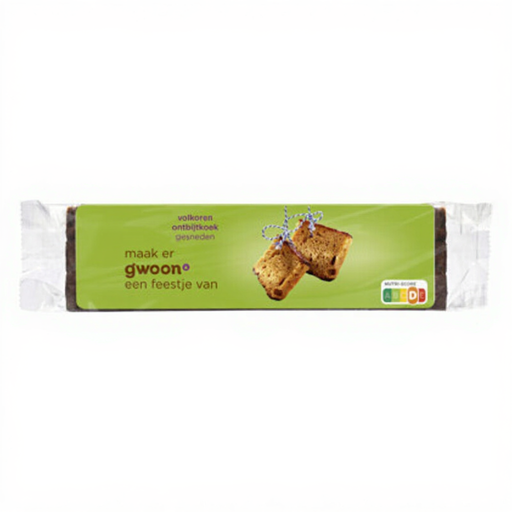 No image available
For anyone looking for sliced wholemeal breakfast cake for lunch or a snack break.
485 g pack. Check the portion size and the latest ingredients and allergen information on the pack, particularly if rye is a concern for you.
Don’t use breakfast cake as a replacement for the wholemeal bread that forms the basis of lunch. The Netherlands Nutrition Centre recommends wholemeal and brown bread for a bread-based meal; think of breakfast cake instead as an additional snack or part of your lunch.
Check the weight per slice or portion and the number of slices in the pack, not just the total weight. The Peijnenburg products reviewed list slices weighing 28 g; the Albert Heijn and Jumbo products reviewed use 30 g portions.
Check the sweeteners, allergens and usage warning for the specific zero variant. The products reviewed contain sweeteners such as xylitol or maltitols and warn of a possible laxative effect if consumed in excess. Product pages for products containing xylitol also state that they are not suitable for animals.
No. The fact that iodine compounds are permitted in baker’s salt does not confirm that a particular breakfast cake contains them. The Netherlands Food and Consumer Product Safety Authority explains that they may be used in bakery products; check the label or ask the manufacturer about the specific product.
Follow the storage instructions on the pack you buy. The product information reviewed recommends storing it in a cool, dark and dry place; Peijnenburg also recommends using a sealed tin or container.