Which option is right for you?
For a shared King’s Day celebration, it’s not just about whether the breakfast cake is sliced: the number of slices, ingredients and portion size can all affect your choice.
If you want to hand out slices
If you’re sharing breakfast cake with coffee or at breakfast, you’ll want to know how many portions you’ll get from one pack. For example, Peijnenburg states that its 550 g sliced plain variety contains 18 slices; check the slice count again for smaller packs.
If you’re comparing sugars per slice
For a variety with no added sugars, the nutritional information per slice matters more than the wording on the front of the pack. Also check the ingredients and any warnings about sweeteners.
If you’re looking for wholemeal ingredients
Sliced wholemeal breakfast cake may suit your preference for wholemeal ingredients. Also compare fibre and sugars per 100 g and per slice, so you’re not relying on the product name alone.
What should you look for when choosing?
As a practical starting point, look for a medium-sized sliced pack of around 475–485 g. The number of slices and the ingredients vary from product to product. First decide whether sharing slices, sugar content or wholemeal ingredients is your main reason for choosing a particular variety.
| What to consider |
What to check |
Who is it for? |
| Slices to share |
Check the pack weight and the number of slices in the exact variety. |
If I’m putting breakfast cake out for several people, I want to be able to hand out slices straight away and know how many portions I have. Around 37% of consumers prioritise this convenience. |
| Sugars per portion |
Compare sugars per 100 g and per slice. For varieties with no added sugars, also check the ingredients and any warnings. |
I want to choose a variety based on the amount of sugar in one slice, without mistaking a claim such as “zero” for sugar-free. Around 36% of consumers consider sugar content the most important factor. |
| Wholemeal and fibre |
Check the ingredients and compare fibre per 100 g and per slice, as well as sugars. |
If you’re specifically looking for wholemeal breakfast cake, you’ll want to know what that claim means for the slice you choose. For around 27% of consumers, wholemeal ingredients and fibre information are the top priority. |
Brands to compare
These brands offer relevant sliced varieties. Always compare the label of the individual product: the ingredients of one variety don’t apply to every breakfast cake from the same brand.
Peijnenburg
Offers sliced plain breakfast cake and a sliced variety with no added sugars.
- Peijnenburg states that its 550 g plain pack contains 18 slices.
- The variety with no added sugars contains 4.9 g of sugars and 17 g of fibre per 100 g, and includes xylitol. Don’t apply these figures to the plain variety.
Albert Heijn
Offers sliced plain, zero and wholemeal breakfast cake under its own brand.
- The range includes 485 g sliced own-brand options.
- Check the ingredients, nutritional information and number of slices on the product page or pack for the variety you choose.
Jumbo
Offers a 475 g sliced zero variety alongside classic breakfast cake.
- The zero variety is a separate option if you want to compare the sugars figure on the label.
- Jumbo warns that this variety may have a laxative effect if consumed in excess; check the ingredients too.
Koek & Bakker
ALDI offers sliced wholemeal breakfast cake and a sliced zero variety under this brand, both weighing 485 g.
- The wholemeal variety is pre-sliced; ALDI describes the zero variety as having no added sugars.
- Check the nutritional information, ingredients and allergens on the exact pack before choosing between the varieties.
PLUS
Offers a 485 g sliced plain breakfast cake.
- PLUS states that this variety contains 36 g of sugars and 3.3 g of fibre per 100 g.
- The product information lists rye. Check the current pack for ingredients and allergens when you buy it.
Sliced breakfast cake on Joybuy
This 485 g sliced pack is an option to compare if you’re looking for breakfast cake made with wholemeal rye flour to share. When choosing, also check the number of slices and the latest nutritional information per portion.
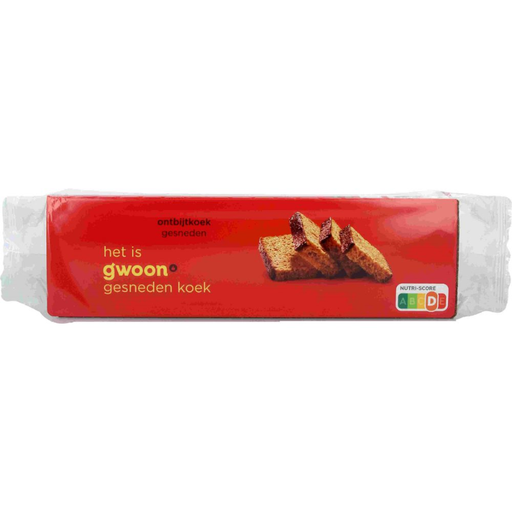 Image unavailable
g'woon sliced breakfast cake 485 g
A sliced option if you also want to consider wholemeal rye flour when handing out portions.
485 g pack. Check the current label for the number of slices, nutritional information and allergens.
View on Joybuy
Frequently asked questions
Is breakfast cake with no added sugars also sugar-free?
No. Peijnenburg states that its sliced variety with no added sugars contains 4.9 g of sugars per 100 g and uses xylitol. Compare the sugars figure and ingredients list for the exact variety.
Does breakfast cake automatically contain iodine because it’s made with bakers’ salt?
No, you can’t assume that for a specific breakfast cake. The Netherlands Food and Consumer Product Safety Authority permits iodine compounds in bakery products, but permission doesn’t confirm that they’re in every product. Check the product-specific information if this matters to your choice.
What should I check for allergens in sliced breakfast cake?
Check the allergen information for the exact variety on the current pack. For example, PLUS lists rye in its plain sliced breakfast cake; don’t assume the information is the same for another brand or variety.
How should I store an opened pack of breakfast cake?
Follow the storage instructions on the pack for your variety and seal the wrapper tightly after opening. Also check the best-before date on the pack.
Is a fibre claim enough to compare two varieties?
No. Consumentenbond points out that a product with a fibre claim can still contain a lot of sugar. So compare fibre and sugars per 100 g for both varieties, and check how much one slice weighs.


