
Artist working with fine lines or colour
You want to retain the detail in your sketches for your project, so compare test scans rather than relying on the stated resolution alone.


Choose an A4 flatbed scanner if the page fits within A4 and you can lay the sketchbook flat without forcing it open. For larger pages, or if you’d rather not press the binding against glass, an overhead scanner may be a better fit. With either option, compare a test scan with the original, as a stated resolution doesn’t guarantee accurate colours. A book-edge scanner or handheld scanner may be the answer if the inner edge of the page or portability is more important to you.
You want to retain the detail in your sketches for your project, so compare test scans rather than relying on the stated resolution alone.
You want to capture pages near the spine without forcing the binding, so how the scanner supports the book is an important part of your choice.
First check whether the entire page fits within the scanning area. For larger pages, an overhead A3 option may be more suitable than an A4 flatbed scanner.
Start with the size of your page and how safely your sketchbook can be laid open. Then use a test scan to check whether the lines and colours remain clear in the file format you need.
Choose this option if: your page fits within A4 and the book can lie flat on the glass without being forced open. Canon Netherlands and Epson Netherlands describe their models mentioned here as A4 flatbed scanners.
Bear in mind: you’ll scan each page separately and need to check that the drawing remains fully visible near the spine.
Choose this option if: you’re scanning a larger page or would rather not press the binding against glass. IRIS Netherlands lists A3 for the Desk 6 Pro; CZUR lists A3 for the Shine Ultra series.
Bear in mind: lighting, reflections and image correction. With CZUR, check the specific model too: the stated 24 MP applies to the Shine Ultra Pro, not the Shine Ultra.
Choose this option if: you can lay the book open on the glass and mainly want to check details close to the spine. Plustek describes the OpticBook 3800L as an A4 scanner for bound materials.
Bear in mind: Plustek’s pages differ on the stated book-edge measurement, so check the specification for the model on offer.
Choose this option if: you want to scan in different places and value being able to work independently. IRIS says the Book 7 can save directly to PDF or JPEG.
Bear in mind: you’ll need to move the device over each page yourself. Try a test scan to check that you can do this evenly.
| What to consider | What should you check? | Who is this most important for? |
|---|---|---|
| Lines and colour | Compare a test scan with the original under the same lighting and using the same output settings. | If I want to retain fine lines and colour differences for my school project, I’ll compare a test scan with the original first. Around 36% of consumers prioritise image quality. |
| Binding and spine | Check how far the book can safely open and whether details near the inner edge remain visible. | I don’t want to force the book’s spine, so I look at how the scanner supports the book. Around 29% of consumers give protecting the binding top priority. |
| Full page | Measure the whole page and compare its dimensions with the scanning area of the specific model. | If my sketches reach the edges, I want to avoid losing part of the page outside the scanning area. Around 21% of consumers prioritise being able to scan the full page. |
| Workspace and portability | Check whether you have a computer and enough space where you’ll be scanning; try a handheld scanner on a representative page. | I want to be able to scan where I work on my project, so I consider the set-up and how easy it is to use. Around 14% of consumers give ease of use and portability top priority. |
Stated resolutions don’t independently show how your drawings will look. Compare a test scan of a representative page with the original, using the same output settings.
Allow time for test scans and any image correction you may need.
A4 flatbed scanners and A3 cameras have different stated capture sizes. Measure the whole page, including its edges, and compare it with the scanning area of the specific model.
If a page won’t fit in a single scan, you may need to take several partial scans and spend extra time stitching them together.
How far a book can safely open depends on its binding. Check this first, and don’t force the book against the glass. Plustek’s manufacturer pages also give conflicting measurements for the book edge on the OpticBook 3800L, so check the specification for the model on offer.
Try a test scan of a page with details near the spine to check that the inner edge remains visible.
The CanoScan LiDE 400 is an A4 flatbed scanner for sketchbooks that can safely lie flat on the glass.
The Perfection V39II is an A4 flatbed alternative for images and documents.
The Desk 6 Pro is an overhead A3 option, while the Book 7 is a separate portable handheld scanner.
CZUR describes the Shine Ultra series as a foldable overhead A3 option for items including thin books and design drawings.
Plustek describes the OpticBook 3800L as an A4 flatbed scanner for bound materials.
This selection includes portable handheld scanners for scanning individual pages, an A4 flatbed scanner and an A3 document camera for different scanning set-ups.
 No image available
A good fit if you want to scan A4 pages individually and are looking for a portable handheld scanner.
A4; 600 × 600 dpi; automatic document feeder and OCR software; output to PDF, JPEG and TIFF.
 No image available
A good fit if you want a compact handheld scanner for A4 pages and plan to use it with a computer.
A4; 600 × 600 dpi; USB connection; automatic document feeder and OCR software.
 No image available
A good fit for a sketchbook that fits within A4 and can lie flat on the glass without being forced open.
A4; 1200 × 1200 dpi; USB and Wi-Fi; output to JPEG, PDF and TIFF.
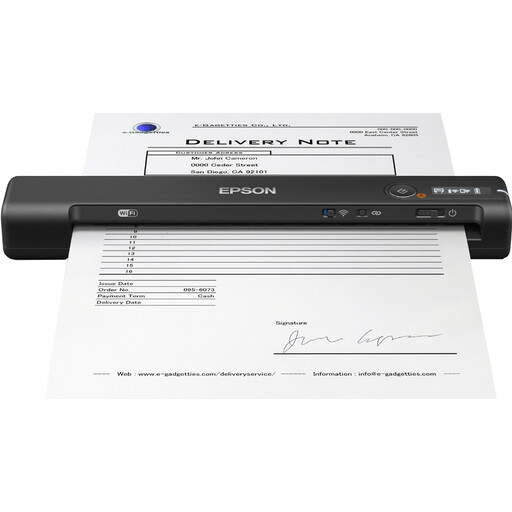 No image available
A good fit if you want a portable, battery-powered scanner with Wi-Fi for A4 pages.
A4; 600 × 600 dpi; rechargeable battery; Wi-Fi and USB connection.
 No image available
A good fit if you’re looking for an overhead camera for sheets up to A3 and want to use the scanner with a computer.
A3; 8 MP; USB connection; automatic cropping, page splitting and OCR software. The product description advises against scanning highly glossy materials.
Measure the page and check how far the binding can safely open. Don’t force a book that’s difficult to open against the glass. If needed, choose an overhead option and use a test page to check that the inner edge remains visible.
For the image itself, first check that the image file is usable. OCR can also be useful for written text; IRIS lists JPG and several PDF output options, including searchable PDF, for the Desk 6 Pro.
Check the current total price, any delivery charges, what’s included with the exact model, and what software and support are provided. According to the Dutch Government, consumers generally have 14 days to change their mind when buying online from a business. Your statutory rights for a faulty product are separate from any additional manufacturer’s warranty.
According to the Dutch Government, you automatically own the copyright to your own original drawings. Making a private copy of someone else’s protected work for personal use doesn’t give you permission to distribute or publish that copy. So check the rights for any images you’ve used before sharing your scans.