When choosing bread rolls for the Sinterklaas parade, start by thinking about when you’ll be handing them out. You can buy fresh rolls shortly before you set off, while bake-at-home rolls let you shop in advance if you have the time and equipment to prepare them. Check the ingredients and allergens for each variety if you’re catering for guests with dietary requirements. If you’d like the rolls cut in half, ask whether the shop can do this or cut them yourself after baking.
Who is this choice important for?
Organisers planning ahead
If you’re handing out several rolls at a set time, you’ll need to consider how many you need, where to store them and how long they take to prepare. Bake-at-home rolls are an option if you have suitable equipment available before it’s time to hand them out.
Adults catering for guests with allergies
If you’re buying for a group with different dietary requirements, check the information for each variety you choose. If gluten needs to be avoided, take care to use separate utensils for cutting, filling and serving the rolls.
Shoppers comparing types of bread
If you’re weighing up white, wholemeal and multigrain options, compare the ingredients and fibre per 100 g. According to the Netherlands Nutrition Centre, wholemeal bread in particular contains plenty of fibre, vitamins and minerals. The name ‘multigrain’ alone doesn’t tell you how much wholemeal flour a roll contains.
What should you look for when choosing?
First, decide when the rolls need to be ready and which ingredients your guests need to avoid. Then compare the type of bread, how many you need and whether the rolls can be cut.
| What to consider | What should you check? | Who should pay particular attention? |
|---|
| Serving and baking time |
Check whether the rolls are ready to serve or still need baking. If you’d like them cut, ask whether the shop can cut the rolls in half. |
If I’m handing out rolls at a set time, I want to know whether I’ll need oven space and time to prepare them; this is the top priority for around 31% of consumers. |
| Allergens and serving |
Read the ingredients and allergen information for the variety you’ve chosen. Use separate utensils to cut and fill gluten-free rolls. |
If I’m buying for guests with a food allergy or gluten intolerance, I need to be able to check and serve their rolls separately; this is the first requirement for around 31% of consumers. |
| Type of grain and fibre |
Check which types of flour are listed in the ingredients and compare fibre per 100 g. If iodised salt matters to your choice, check whether it’s listed. |
I want to see the difference between a white roll and a wholemeal or multigrain one; this comparison is the deciding factor for around 23% of consumers. |
| Quantities and availability |
Count how many rolls you need and check the pack size. Ask your chosen branch whether the variety you’re counting on is available. |
If I need just enough rolls for a group, I don’t want to rely on a variety that isn’t available in the shop; this is the main concern for around 15% of consumers. |
Common mistakes
-
Assuming ‘multigrain’ means wholemeal
A product name alone doesn’t tell you which grains a roll contains or how much wholemeal flour it includes. PLUS lists 56% wholemeal wheat flour and 7 g of fibre per 100 g for its multigrain rolls; these figures apply to that specific variety.
Read the ingredients list and compare fibre per 100 g when weighing up different rolls.
-
Preparing gluten-free and regular rolls with the same utensils
Crumbs from regular rolls can get onto gluten-free ones when you cut or fill them. The Netherlands Nutrition Centre points out that even a small amount of gluten can cause symptoms for people with coeliac disease.
Keep gluten-free rolls separate and use different knives, boards, tongs and fillings.
-
Refreezing frozen rolls after defrosting
For the frozen sourdough roll it reviewed, PLUS advises storing it at -18°C and not refreezing it after defrosting.
Plan how many you want to prepare in advance and follow the storage and preparation instructions on the pack you choose.
If the time you’re handing them out changes, any rolls already defrosted could go to waste.
-
Assuming the online range reflects what’s in store
Lidl says its fresh bread range can vary from branch to branch. So a roll shown online may not be available at your shop when you want to hand it out.
Contact your local branch in good time if you need a particular variety, and have an alternative in mind.
Otherwise, you may need to make an extra trip to the shops.
Brands to compare
Albert Heijn
Albert Heijn lists a 70 g white wheat roll, baked in store.
- For this roll, the product information lists iodised salt, wheat and 2.8 g of fibre per 100 g.
- Check the current packaging when you buy, and ask separately about having the rolls cut as you’d like.
Jumbo
Jumbo lists rolls in several varieties, including white, multigrain, frozen, sourdough and spelt.
- You can compare different product types and pack sizes.
- Check whether each variety is available at the time you need it.
Lidl
Lidl lists white rolls baked in store, as well as white rolls to bake at home.
- The two options let you choose between buying rolls just before you need them and baking them yourself.
- Lidl says its fresh bread range can vary from branch to branch. If you need allergen information for an unwrapped roll, ask in store.
Aldi
Aldi lists individual white rolls to buy in store.
- Buying rolls individually lets you choose exactly how many you need.
- Check the ingredients and allergens in store, and ask whether the rolls can be cut.
Plus
PLUS lists white and multigrain rolls to bake at home, a frozen sourdough variety and a separate gluten-free roll.
- For its individual varieties, PLUS provides ingredients and preparation or storage information that you can compare before buying.
- Read the information on the pack you choose, particularly if you have dietary requirements or need the rolls ready at a set time.
Dirk
Dirk lists individual 80 g white and brown rolls, as well as 300 g packs of white or multigrain rolls.
- You can weigh up buying individual rolls against getting a pack for the group.
- Check the ingredients and allergens on the individual pack, or ask about them when buying rolls loose.
Bread rolls on Joybuy
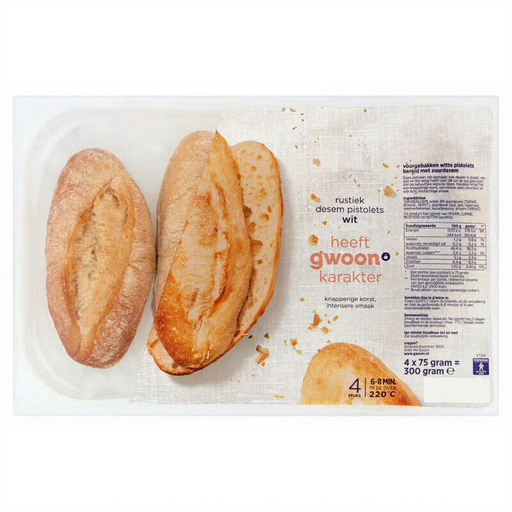
These white rolls, sold in a pack of four, are an option if you want to plan how many you’ll need for the parade. Before buying, check whether they need to be prepared and whether you can have them cut as you’d like.
 No image available
g'woon White Rustic Pistolet, 4 pieces
The pack of four makes it easier to work out how many rolls you’ll need for the group.
Check how they need to be prepared and ask whether the rolls come pre-cut if you’re planning to hand them out at a set time. If you have dietary requirements, check the current ingredients and allergen information.
View on Joybuy
Frequently asked questions
Should I choose fresh or bake-at-home rolls for a Sinterklaas parade?
Fresh rolls are a good choice if you’re buying them shortly before you hand them out. Bake-at-home rolls work well if you want to shop in advance and have the time and equipment to prepare them on the day. PLUS says its white rolls take 8–10 minutes to bake in an oven at 220°C. Always follow the instructions for the variety you buy.
Where can I find allergen information for individual rolls?
Ask the seller about allergens in individual rolls; for packaged rolls, you’ll find allergen information on the label. The Netherlands Food and Consumer Product Safety Authority sets out the information requirements for both packaged and unpackaged food. Check the information for the specific variety you’ll be handing out.
Can someone with coeliac disease eat a regular white or multigrain roll?
A regular roll containing gluten isn’t a gluten-free option. Check that the roll you choose is labelled gluten-free, and prevent crumbs from regular rolls coming into contact with it when cutting and serving. According to the Netherlands Nutrition Centre, even a small amount of gluten can cause symptoms for people with coeliac disease.
Does every roll contain iodised salt?
No. Don’t assume every roll contains iodised salt. According to the Netherlands Nutrition Centre, using baker’s salt when baking bread isn’t compulsory. Check the ingredients of the product you’ve chosen if you want to know which salt it contains.


