
Vandaag of morgen in huis

Kwaliteit gegarandeerd

Welkomstaanbiedingen ontgrendelen: GRATIS bezorging | Tot 80% korting | Gratis 30 dagen JoyPlus-proefperiode
Download de app
A sink strainer may seem like a simple kitchen accessory, but the wrong model can quickly become a source of frustration. A strainer that doesn’t fit your sink properly, lets food scraps through or is difficult to clean won’t be much use. Products are also sold under similar names, from sink filters and drain strainers to extendable colanders and kitchen drain baskets.
So don’t just look at the appearance or the number of items in a pack. The shape, dimensions, mesh size and material all affect how well a product suits your everyday needs.
An extendable colander may seem flexible, but it still has a minimum and maximum length. A fixed-size model may be too small for your sink, or sit unstably on the edges. Measure the inside of your sink beforehand, and check the width of the edges the strainer will rest on.
For a drain strainer that fits over the plughole, diameter is especially important. A model measuring 8 cm, for example, won’t necessarily fit every plughole.
A coarse kitchen strainer lets water through quickly, but is less effective at catching small food scraps. A fine-mesh filter catches more particles, but can fill up more quickly and needs cleaning more often.
For pasta, rice and vegetables, a sink colander with evenly spaced holes is usually practical. For tea, stock or sauces, a fine kitchen strainer or filter mesh is a better choice.
Words such as “durable” or “rust-resistant” don’t tell you much if the material isn’t clearly specified. Some products list 304 stainless steel or 18/8 stainless steel as the material. These are verifiable product specifications. Other items are listed simply as “metal” or “plastic”.
Check the care instructions too. According to the product information, one metal strainer may be dishwasher-safe, while another model may need to be washed by hand with a soft sponge. Don’t use steel wool or harsh cleaners if the manufacturer advises against them.
Check the following before you order:
A telescopic sink strainer is useful in a small kitchen or rented home, but always place it fully extended and securely across the sink.
For everyday use, stainless steel products are easy to compare by checking the stated material specification. Product information for 304 stainless steel often refers to a coating-free surface and corrosion resistance. This remains a manufacturer’s product specification, not a guarantee that the material will stay stain-free in all conditions.
Don’t leave salt, acidic substances or food scraps on metal surfaces for long periods. Rinse your sink strainer after use and dry it thoroughly.
Choose the type to suit the task:
Disposable filter mesh can be practical for everyday use, but check how many filters are included and whether you need to buy a holder separately.
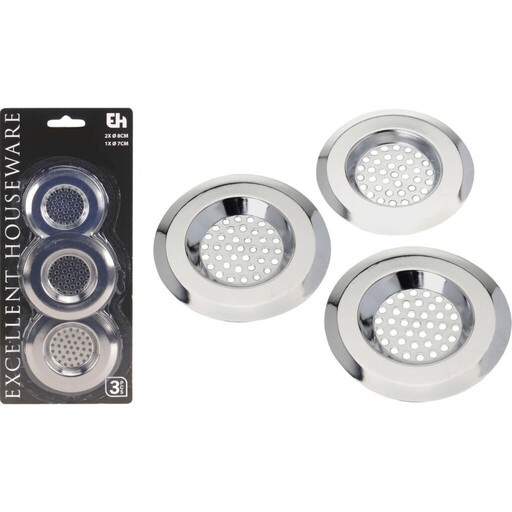
Why it suits this need: This set of three stainless steel drain strainers is for households looking for a simple solution or spares. The stated diameter is 8 cm.
The fixed size makes it easy to check the fit in advance. Just make sure 8 cm matches the diameter of your plughole.
Set of 3; stainless steel construction; dishwasher-safe according to the product information.

Why it suits this need: The medium version is designed for washing vegetables, rinsing fruit, draining crockery and temporary storage. Its telescopic design fits sinks in several sizes.
The dimensions and extendable design are clearly stated. Before use, check that the strainer is fully extended and stable.
304 stainless steel according to the product information; dimensions 42,6 × 21 × 6,9 cm; dishwasher-safe according to the manufacturer.

Why it suits this need: This set is designed for cooking, blanching, draining noodles and deep-frying. The three sizes give you options for different pans and portions.
The set includes three stated sizes and fine, evenly spaced mesh. This makes it easier to choose the right size for what you’re preparing.
Three skimmers made from 304 stainless steel; handles with hanging holes; dishwasher-safe according to the product information.
A sink strainer will generally last longer if you rinse it straight after use. Remove stuck-on food scraps with a soft brush or sponge, and dry metal parts thoroughly. Check filter mesh regularly for tears. A damaged filter may let food scraps through or develop sharp edges.
Don’t use a spider skimmer as an ordinary drain strainer if its size or design isn’t intended for that purpose. The handle can get hot when used in boiling water or oil. Always follow the manufacturer’s safety information.
We’ve put together a complete, up-to-date list of products that meet these strict selection criteria and the applicable European safety regulations.
Measure the inside width of your sink and the diameter of the plughole. For an extendable model, check both the minimum and maximum length. Also check that the edges rest securely on the sink.
Empty the strainer after each use and rinse off stuck-on residue straight away. Choose a mesh size to suit your needs: larger openings for quick draining and finer filtering for small particles. Don’t pour fat or large food scraps down the drain.
According to the stated product specifications, stainless steel is a commonly used material for kitchen strainers and drain filters. Its lifespan also depends on how you care for it. Rinse off salt, acidic substances and food scraps, avoid abrasive cleaners, and dry the product after cleaning.
