
Vandaag of morgen in huis

Kwaliteit gegarandeerd

Welkomstaanbiedingen ontgrendelen: GRATIS bezorging | Tot 80% korting | Gratis 30 dagen JoyPlus-proefperiode
Download de app
A blocked drain, food scraps in the trap, or a colander that’s too big for your small sink – a sink strainer can make everyday kitchen tasks much easier. Yet not every strainer is suitable at first glance. Some models only catch coarse debris, while others are designed as a drainer basket, fruit and vegetable colander, or a draining tray for the sink.
The right choice therefore depends on your sink, the type of food you prepare, and how you prefer to clean.
A cheap drain strainer can be handy as a spare or for a second sink. However, do check that the diameter, shape and drain opening match your sink. A universal model doesn’t automatically fit every drain.
Also pay attention to the material. Thin metal or a fragile coating can warp, discolour or become damaged more quickly with daily use. A stainless steel product is generally easier to rinse off, but the exact grade of steel and finish still matter.
A very fine mesh catches small food particles, but it can also fill up faster with rice, coffee grounds or grease. This means the water drains less efficiently. A sink filter is not a substitute for careful waste separation: remove large scraps by hand or with kitchen paper first.
If you mainly wash vegetables or let crockery drain, you’ll often be better off with a roomy sink strainer or a sink drainer basket rather than a small filter for the drain opening.
A telescopic model must sit stably on the edges of the sink. So measure the internal width before you order. With an adjustable drainer basket, it’s not just the length that matters, but also the width, height and load stability.
In a small flat or student kitchen, also consider storage space. An expandable food strainer for the sink can be more practical than a fixed basket, while a small round filter takes up less room.
For daily contact with vegetables, fruit, rice and crockery, stainless steel is commonly used. The product description might mention 304 stainless steel, for example. This is a material specification, not a guarantee that the product will remain free from stains or wear under all conditions.
A coating-free finish prevents a paint layer from peeling off due to scratches. Also check that the edges are smooth and that the mesh or drainage holes are evenly distributed. A stainless steel colander with dense, regular holes is suitable for washing and draining; a simple drain strainer with larger openings is more focused on catching coarse debris.
Compare the product’s measurements with your sink:
The Maxcook models below have an adjustable length of 29 to 44 cm according to the product description. The width varies by version: 21.2 cm for the large model and 15.5 cm for the medium model.
A sink strainer only works well if you empty it straight after use. Rinse food scraps away with water and use a mild washing-up liquid. With stainless steel products, it’s wise to dry them thoroughly after cleaning and to avoid abrasive sponges or wire wool.
A dishwasher-safe product can save time, but always check the manufacturer’s care instructions. A kitchen drain filter that often comes into contact with grease, salt or acidic food residue needs extra attention to minimise limescale and discolouration.
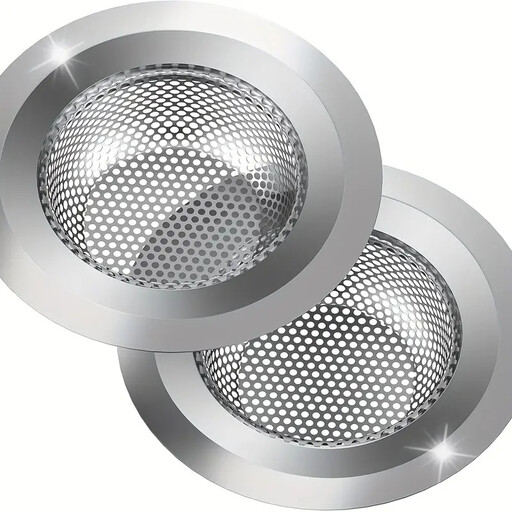
Why this fits the profile: The set includes two reusable filters for households that mainly want to keep coarse food scraps out of the drain and have a spare on hand.
With a second filter, you have a spare while one is being cleaned. Do check the dimensions of your drain before purchasing.
Set of 2, reusable according to the product description and designed to catch solid debris.
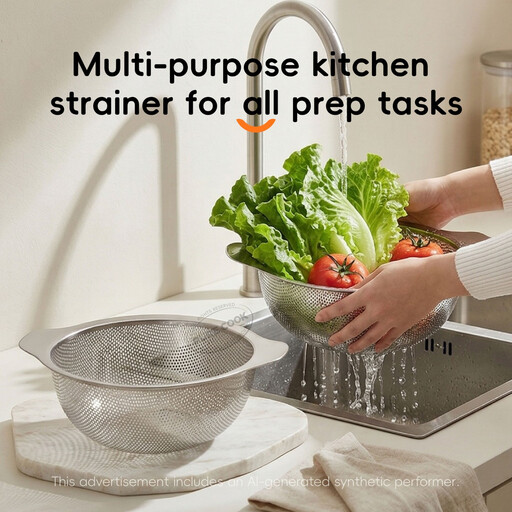
Why this fits the profile: This medium-sized model is designed for washing, draining and temporarily storing ingredients or crockery. It’s suitable for families and home cooks who want one multi-functional basket.
The product description mentions 304 stainless steel, a coating-free finish and evenly distributed drainage holes. This makes the specifications verifiable before purchase.
Dimensions of 27.3 × 22.6 × 9.1 cm, double handles and applications for vegetables, fruit, rice and crockery.

Why this fits the profile: The large, adjustable basket is aimed at intensive washing and draining of lots of vegetables, fruit or several plates at once.
The adjustable range of 29 to 44 cm helps with different sink widths. Still measure your sink and position the basket stably before filling it.
304 stainless steel, a length of 29–44 cm and a design that can be used as a colander and sink drainer basket.
We’ve put together a full, up-to-date list of products that fully meet these strict selection criteria and current European safety regulations.
Empty the strainer as soon as you’ve finished cooking. Rinse fine mesh immediately so that rice, flour or vegetable residue doesn’t dry on. With stainless steel, use a soft sponge and mild washing-up liquid. Dry the product after cleaning, especially if hard water leaves visible limescale marks.
Don’t use a sink strainer as a bin for oil, fat or large bones. Even a sturdy drain filter can clog more quickly as a result. With an adjustable model, regularly check that the sliding parts still move smoothly and that the basket doesn’t wobble.
Measure the diameter of the drain opening and compare it with the product specifications. A loose filter for the drain opening has different dimensions to a kitchen colander or telescopic drainer basket. Also pay attention to the shape of the rim: a round strainer and a basket with wide support rims are not interchangeable.
This varies by product. Some models are described as dishwasher-safe; for others, the product description recommends hand washing with mild washing-up liquid. Check this before use and avoid abrasive products that could damage stainless steel or a coating.
A drain strainer catches solid food scraps before they enter the drain. This can reduce the risk of blockages, but it’s not a complete solution for grease, oil, limescale or residue that passes through the strainer. So empty and clean the strainer regularly.
