
Solo diners who want breakfast straight away
You want breakfast for one without measuring out muesli and dairy. A ready-made combination could suit you if the ingredients, storage instructions and use-by date fit your plans.


If you eat on your own and want breakfast for one without measuring anything out, look for a ready-to-eat muesli option and check the product format and storage instructions on the packaging. If you eat muesli several times a week, you could portion out a larger bag yourself and serve it with yoghurt, milk or quark. A product with ‘portion’ in its name isn’t automatically an individual sachet of dry muesli.
You want breakfast for one without measuring out muesli and dairy. A ready-made combination could suit you if the ingredients, storage instructions and use-by date fit your plans.
You plan several breakfasts and add your own yoghurt, milk or quark. A larger bag of dry muesli lets you decide how much to have each morning, but you’ll need to portion it yourself and store it according to the packaging.
For you, factors such as fibre, sugars or allergens may matter more than the pack size. Compare the nutritional information and ingredients for the exact variant you want to buy.
First decide whether you want a ready-to-eat combination or dry muesli. Then consider how many breakfasts you’re planning and which label information matters to you.
Suitable if: you want breakfast for one without measuring out muesli and dairy yourself. Albert Heijn lists a product called AH Portie muesli yoghurt naturel.
Bear in mind: the name alone doesn’t tell you how the product should be stored or exactly what the portion contains; check the current packaging.
Suitable if: you want to make your own portions during the week and choose your dairy or another topping separately. Jumbo lists muesli in packs of 500 g, 900 g and 1 kg, among other sizes.
Keep in mind: you’ll need to portion it yourself and store it after opening; a larger pack isn’t an individual breakfast portion.
| What to consider | What to check before buying | Who it matters to |
|---|---|---|
| Product format and portion | Check whether it’s dry muesli or a combination with yoghurt, and look at the net weight and storage instructions. | I want to be able to grab breakfast for one without measuring anything out. Around 30% of consumers prioritise something ready to eat. |
| Nutritional information | Compare fibre, sugars, fat and salt per 100 g; also check the ingredients for the exact variant. | When choosing between variants, I want to assess the nutritional value rather than rely on the front of the pack alone. Around 30% of consumers prioritise comparing labels. |
| How much you need for the week | Match the pack size to the number of breakfasts you’re planning and follow the storage instructions after opening. | I don’t eat muesli every morning and want to choose an amount I’ll actually use. For around 20% of consumers, the amount needed for the week is the first consideration. |
| Allergens | Read the ingredients, allergen information and any warnings on the packaging of the variant you choose. | Before weighing up convenience or taste, I need to know which allergens are listed for this variant. Around 20% of consumers prioritise checking this. |
With a combination product, you can’t choose the amount of muesli and dairy separately. The storage instructions may also differ from those for dry muesli.
Check the current packaging for the product format, net weight, ingredients and storage instructions.
A pack containing several portions is less practical if you only eat muesli occasionally or want to vary your breakfast from one day to the next.
Decide how many breakfasts you want to make that week and choose a pack size to match.
With a larger bag, you’ll need to portion it yourself and store it according to the label after opening.
A name containing ‘crunchy’, ‘protein’ or ‘zero sugar’ doesn’t tell you everything about a variant’s nutritional value or ingredients.
Compare the nutritional information per 100 g and the ingredients lists on the packs you’re considering.
The Netherlands Food and Consumer Product Safety Authority says that allergens must be clearly listed on the labels of prepacked foods. Information for a different flavour or a pack you bought previously is no substitute for checking the label on this variant.
Before buying, read the allergen information and any warnings on the exact pack.
Albert Heijn lists AH Portie muesli yoghurt naturel and also offers a range of muesli and granola.
Jumbo lists dry muesli in several larger pack sizes, including 500 g, 900 g and 1 kg variants.
Albert Heijn lists several Quaker Cruesli variants if you’re specifically considering crunchy muesli.
ALDI lists both wholegrain and crunchy muesli under the Golden Bridge brand, in packs containing several portions.
Lidl’s range in the Netherlands includes crunchy muesli and fruit muesli, among other options.
These crunchy muesli and Cruesli options come in 375 g or 400 g packs. They’re suitable if you want to put together your own breakfast portions for the week; check the packaging if you’re looking for individually packed portions instead.
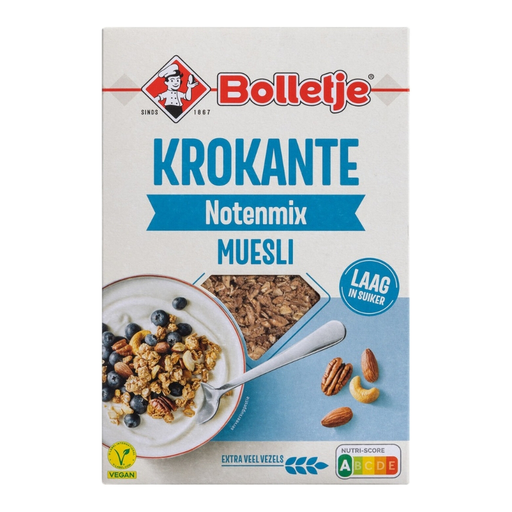 Image unavailable
An option if you want to make your own portions of crunchy muesli for several breakfasts.
The pack contains 375 g. Check the current packaging for individual portions and allergen information if these are important to your choice.
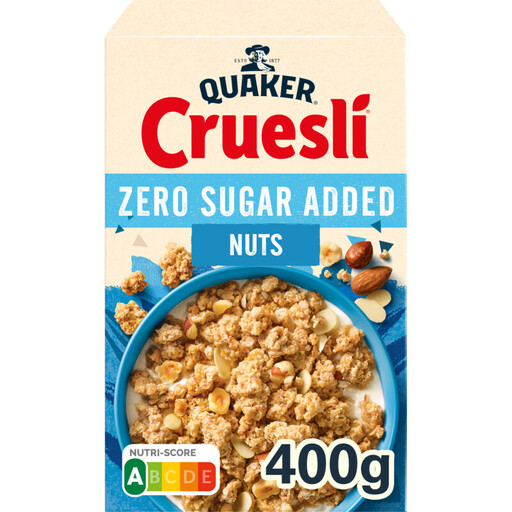 Image unavailable
An option if you want to portion out nutty Cruesli yourself for several breakfasts.
The pack contains 400 g. Check the current ingredients list and nutritional information to assess the ‘Zero Sugar’ claim; also check the allergen information.
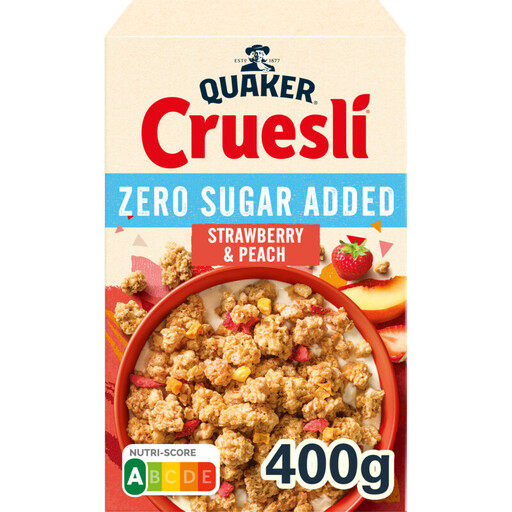 Image unavailable
An option if you want to portion out a strawberry and peach Cruesli variant yourself.
The pack contains 400 g. When comparing nutritional values, use the figures and their measurement basis on the current label; check the allergen information there too.
No, the product name alone doesn’t make that clear. For example, Albert Heijn lists AH Portie muesli yoghurt naturel; check the packaging to see what’s included, how much there is and how the product should be stored.
Compare the values per 100 g, including fibre, sugars, fat and salt, and read the ingredients list. The Netherlands Nutrition Centre describes the label as a useful way to compare products on these characteristics; also consider how much you’ll use for each breakfast.
Read the allergen information on the label of the exact pack. The Netherlands Food and Consumer Product Safety Authority says allergens must be clearly listed on the labels of prepacked foods; also check for any warnings about cross-contamination.
A larger bag could suit you if you’re planning several breakfasts and want to portion it yourself. Choose a pack size that matches what you expect to use that week, and follow the storage instructions on the packaging after opening.
A claim like this doesn’t give you the product’s full nutritional information. Read the current nutritional information and ingredients for the specific variant before comparing it with another type of muesli.