Start by checking the mounting and connection. If the brake makes the pedal plate or seat move, it’s harder to repeat your inputs. An adjustable load-cell set is worth considering if you want to practise brake pressure and your cockpit is sturdy enough. A simpler, upgradeable two-pedal set may be a better fit if space, mounting or starting with a lighter brake load matters more. None of these features proves that you’ll drive faster.
Who are sim racing pedals for a compact cockpit for?
Drivers with a compact cockpit
If you want to practise using the throttle and brake without the seat, pedal plate or pedals shifting, compare the space available, mounting points and the brake force you’ll need. Sim-Lab highlights brake type, adjustability, construction and mounting as things to consider.
Drivers who want to practise brake pressure
If you want to adjust and repeat your braking input from lap to lap, consider an adjustable brake and check that your cockpit is sturdy enough. The iRacing instructions explain how to calibrate load-cell pedals.
Drivers who want to upgrade their existing setup
If you want to start with two pedals or keep your existing wheel base, check the connection and upgrade requirements for the exact set. Fanatec, MOZA Racing and Thrustmaster each specify different connection and upgrade requirements.
What should you look for in sim racing pedals for a virtual oval?
Simple two-pedal set
A good fit if: you want to start with a throttle and brake, and a lighter brake load or the option to upgrade later matters more than force-based braking.
Bear in mind: the standard Fanatec CSL Pedals have a position-sensitive brake. According to Fanatec, a load-cell upgrade or standalone USB connection to a PC requires additional hardware.
Adjustable load-cell set
A good fit if: you want to practise using a signal based on braking force and your cockpit can handle the brake resistance you choose.
Bear in mind: mounting and connections vary by set. For console use with the T-LCM, Thrustmaster specifies connection via a compatible wheel base with RJ12.
Separately mountable pedals for a rigid frame
A good fit if: you already have a very sturdy base and want to adjust pedal position and brake resistance separately.
Bear in mind: Heusinkveld specifies that Sprint should be mounted on a very rigid base. A separate baseplate also needs to fit your setup.
| What to consider |
What should you check? |
Who is this important for? |
| Fit and stability |
Measure the available space and compare the mounting points. Check that both the pedal plate and seat stay firmly in place with your chosen brake resistance. |
I want to know whether the pedals and seat will stay put when I brake in my compact cockpit. Around 33% of consumers put fit and stability first. |
| Brake and throttle input |
Compare the brake type, adjustable resistance and calibration. After mounting, check that the simulator registers the full range of movement. |
I want to adjust my brake pressure while practising and repeat the same input. Around 27% of consumers give controllable braking input top priority. |
| Platform and connection |
Note your platform and the full name of your wheel base, then check the connection instructions for the exact pedal set. |
I want to keep using my current wheel base or platform and know in advance which connection I need. Around 20% of consumers base their choice mainly on compatibility with existing equipment. |
| Upgrades |
Check what’s included with the exact set and which upgrades are compatible. Don’t assume that parts from the same brand are interchangeable. |
I want to start small and have the option to upgrade later, without relying on an upgrade that won’t fit. Around 20% of consumers focus mainly on upgrade options and any additional parts required. |
Common buying pitfalls with sim racing pedals
-
Confusing sensor rating with the force applied by your foot
Sensor capacity and the actual force applied to the brake pedal are different specifications. Heusinkveld lists a 120 kg load cell and a maximum actual braking force of 65 kg for Sprint.
Compare like-for-like force ratings, then check that they suit your cockpit and preferred brake resistance.
-
Assuming USB works with every console
For console use, Thrustmaster specifies connecting the T-LCM via a compatible Thrustmaster wheel base with RJ12. This is different from connecting to a PC via USB.
Check the official instructions for your platform, wheel base and full pedal model name.
The connection method described may require a compatible wheel base or other compatible hardware.
-
Assuming an upgrade is included or interchangeable
The standard Fanatec CSL Pedals are sold without a load-cell kit. Fanatec also states that the load cells for the ClubSport V3 and CSL Elite Pedals V2 are not interchangeable.
Before buying, check what’s included with the exact set and whether the upgrade is compatible.
Depending on the combination you choose, you may need a separate kit, adapter or mounting plate.
Brands to compare when choosing sim racing pedals
Fanatec
The CSL Pedals, CSL Elite Pedals V2 and ClubSport Pedals V3 are worth comparing if you want to start with two pedals or are looking for a set with a load-cell brake.
- Fanatec says the standard CSL set can be upgraded with a load-cell kit later; the CSL Elite Pedals V2 have a load-cell brake.
- Check the connection and compatibility of the exact upgrade: standalone USB use with a PC requires additional hardware for the standard CSL set, and parts are not automatically interchangeable.
MOZA Racing
The SR-P is a two-pedal option with a load-cell brake to compare if you want to check the dimensions, pedal spacing and PC connection in advance.
- MOZA lists a USB connection and adjustable pedal spacing for the SR-P.
- MOZA gives dimensions of 410 × 310 × 170 mm for the two-pedal set without a clutch. Check that this specific version will fit your cockpit.
Thrustmaster
The T-LCM is a load-cell option to compare if you want to check its connection to your existing wheel base.
- Thrustmaster lists adjustable springs and calibration.
- For console use, Thrustmaster specifies connecting via a compatible Thrustmaster wheel base with RJ12. Check which combination your own system requires.
Heusinkveld
Sprint is a separately mountable option for anyone who wants to adjust pedal position and brake resistance and already has a very rigid frame.
- Heusinkveld lists a maximum actual braking force of 65 kg for Sprint.
- The manufacturer requires a very rigid mounting base. A separate baseplate also needs to fit your frame and the available space.
Joybuy product selection for this setup
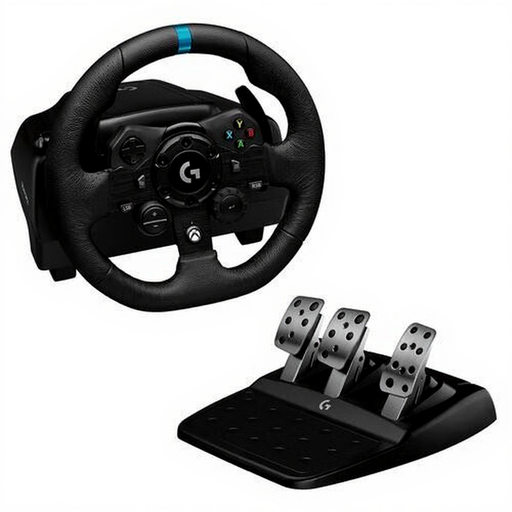
The product featured below is a steering wheel and pedal set for PC and Xbox, not a standalone pedal set. Check that the complete set suits your platform and cockpit.
 No image available
Logitech G G923 Black Steering Wheel + Pedals
This steering wheel and pedal set could be a good fit if you’re looking for a wheel as well as pedals.
The product description mentions a progressive brake spring and pedal sensitivity adjustment via G HUB on PC. These are product claims, not independent performance tests.
The product name lists USB 2.0 and PC, Xbox One, Xbox Series S and Xbox Series X.
View on Joybuy
Frequently asked questions about sim racing pedals
Do I need a load-cell brake straight away for a virtual oval?
No, not if you’d rather start with a simple set or prioritise mounting and available space. Choose an adjustable load-cell set if you specifically want to practise applying braking force, and check first that your cockpit is sturdy enough. A load cell doesn’t guarantee faster lap times.
How do I set up new pedals in the simulator?
First, check that your platform recognises the controller, then calibrate the throttle and brake in the simulator. For iRacing, the official guide recommends a Brake Force Factor of 0,00 for load-cell pedals and 1,60–2,00 for the position-sensitive pedals mentioned there. This guidance applies specifically to the game.
What should I check if a pedal doesn’t reach its full range?
Check the connection and calibration before deciding that there’s a fault. For the SR-P, MOZA describes setting the minimum and maximum values and recalibrating in Pit House, among other steps.
What can I do in the Netherlands if pedals bought online turn out to be faulty?
According to the Dutch Government, the seller must provide a solution if a product is faulty. The Netherlands has no fixed statutory guarantee period; what you can expect depends, among other things, on the product, its price and the information provided.
Do I have a cooling-off period when buying online in the Netherlands?
For online purchases from a business, you generally have a 14-day cooling-off period, according to the Dutch Government. Check the applicable terms and conditions; buying online from a private seller is a different situation.


