Who should consider these pedal options?

Drivers practising braking points

If you want to compare your braking over consecutive laps, it helps to have the right brake settings and calibration. Visible braking references and a properly set up single monitor also play a part; iRacing and Sim-Lab explain relevant practice and setup considerations.

Drivers without a permanent cockpit

If you use pedals on the floor or on a separate stand, consider how the set will stay in place and whether its brake resistance is suitable for your mounting arrangement. Fanatec, Sim-Lab and Heusinkveld explain the mounting requirements for their own products.

Drivers with an existing wheelbase

If you want to connect pedals separately from a steering wheel, check that the connection method works with your platform and exact wheelbase model. Fanatec Support and Thrustmaster Support explain the different connection options for each product and use case.

What to look for in sim racing pedals

Position sensing with an upgrade option

A good fit if: you want to start with a two-pedal set and practise braking points on a floor or desk setup. Fanatec describes the CSL Pedals as a set with Hall sensors.

Bear in mind: the standard brake measures pedal position, not braking pressure; a separate kit is needed for a load-cell brake. For standalone PC use without a Fanatec wheelbase, Fanatec Support lists a USB adapter or load-cell kit as connection options.

Load-cell set with adjustable resistance

A good fit if: you have a stable mounting setup and want to practise applying consistent brake pressure and releasing the brake. The Thrustmaster T-LCM uses interchangeable springs; Logitech G lists interchangeable brake elastomers for the PRO Racing Pedals.

Bear in mind: adjusting the resistance takes time. Thrustmaster describes USB as an option for supported PCs, and RJ12 via a compatible Thrustmaster wheelbase for consoles.

Mechanically adjustable cockpit pedals

A good fit if: you already have a suitable pedal plate and want to adjust the position, angle or resistance to suit your seating position. Sim-Lab describes these adjustment options for the XP1.

Bear in mind: check the mounting points and available space, and decide whether you need the two- or three-pedal version. The XP1 specifications are not proof of faster lap times.

What to consider What should you check? Who is this important for?
Repeatable braking input Check which sensor type the brake uses and calibrate the start and end points in your game. I want to compare my braking from lap to lap and review my settings. Around 36% of consumers prioritise repeatable braking input.
Stable mounting Check the mounting points and dimensions, and make sure the seat stays in place. If the pedals or seat can move, I want to check first that the set will stay secure on my floor, stand or cockpit. Around 29% of consumers prioritise stable mounting.
Connection to your system Compare your platform and exact wheelbase with the connection method specified by the manufacturer for your chosen set. I want to use a separate set with my own platform and wheelbase, not just a PC. Around 21% of consumers make connection to their existing system their top priority.
Pedal feel and seating position Check whether you can adjust the angle, distance and brake resistance, and which options are included with your chosen version. I want to adjust the pedals to suit my seating position without paying for features I don’t need. Around 14% of consumers prioritise ergonomic adjustment.

Common mistakes when choosing sim racing pedals

  • Mistaking a Hall sensor in the brake for a load cell

    The standard Fanatec CSL Pedals measure pedal position; the load-cell brake is a separate kit. So, a set’s listed Hall sensors don’t necessarily mean the brake measures pressure.

    Check which sensor type the brake uses on the exact version you’re considering, rather than relying on sensor details listed elsewhere for the set.

  • Choosing a stiff brake without suitable mounting

    The Heusinkveld Sprint manual calls for a very sturdy base because of the potentially high braking forces. This mounting requirement applies to this model and shouldn’t be generalised to every pedal set.

    Before buying, check that your pedal plate, seat and mounting points are suitable for the set you’ve chosen.

  • Confusing PC connectivity with console compatibility

    Connection options vary between sets. For T-LCM pedals, Thrustmaster lists USB for supported PCs and RJ12 via a compatible wheelbase for consoles. Fanatec sets out separate requirements for using the standard set independently on a PC.

    Check your platform, the exact wheelbase model and the connection instructions for your chosen pedal set together.

  • Assuming different specifications describe the same force

    Sim-Lab lists a 200 kg load-cell design for the XP1 and a maximum pressure of 100 kg on the brake pedal. These are different measurements, not two ways of describing the same operating force.

    Only compare specifications when it’s clear what the manufacturer is measuring, and choose the brake resistance with your mounting setup and preferred feel in mind.

Brands to compare

Fanatec

The CSL Pedals are a two-pedal set with Hall sensors, which can be upgraded with a separate load-cell brake kit.

  • Fanatec describes support surfaces that let the standard set rest against a hard surface or be mounted in place.
  • The standard brake measures pedal position. For standalone PC use without a Fanatec wheelbase, Fanatec Support lists a USB adapter or load-cell kit as possible connection options.

Thrustmaster

The T-LCM is a three-pedal set with a load-cell brake and interchangeable springs for adjusting mechanical brake resistance.

  • According to Thrustmaster, the included springs allow you to adjust the mechanical resistance.
  • For console use, Thrustmaster describes connecting via RJ12 to a compatible Thrustmaster wheelbase; its documented direct USB connection is for supported PCs.

Logitech G

According to Logitech G, the PRO Racing Pedals combine a load-cell brake with repositionable pedal modules and interchangeable springs and elastomers.

  • The modules and mechanical components offer different ways to adjust the pedal setup.
  • Before buying, check that your exact steering wheel and platform combination supports the pedals you’ve chosen.

Sim-Lab

The XP1 Loadcell Pedal Set is designed for a cockpit setup, with adjustable resistance, preload, travel and pedal angle.

  • Sim-Lab describes a range of mechanical adjustments for the pedal set.
  • Check your cockpit’s mounting points and decide whether you need the two- or three-pedal version.

Heusinkveld

The Sprint pedals are an option for a permanent simulator setup, with mechanical adjustment options.

  • The product manual describes mechanical adjustments for the Sprint pedals.
  • The manual requires a very sturdy base; a separate clutch pedal is included only with the three-pedal set.

Steering wheel and pedal bundles at Joybuy

This selection at Joybuy features steering wheel and pedal bundles for anyone who needs both while practising.
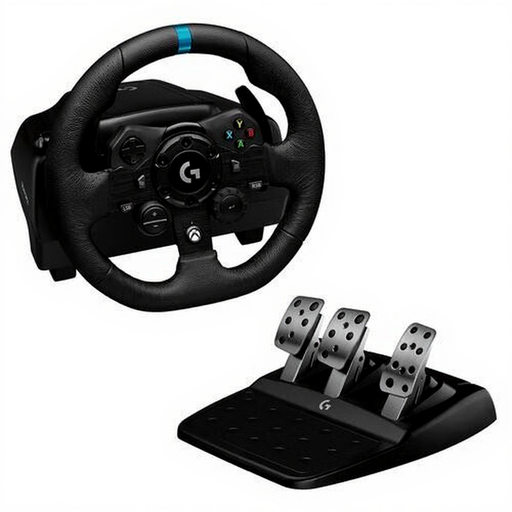
Logitech G G923 Black steering wheel with pedals

Logitech G G923 Black steering wheel with pedals, PC and Xbox

The product information describes a progressive spring brake pedal, an option to consider if you want to practise your braking input with the included pedal set.

The product name lists PC, Xbox One, Xbox Series S and Xbox Series X. Check that your game and exact setup are supported.

Joybuy
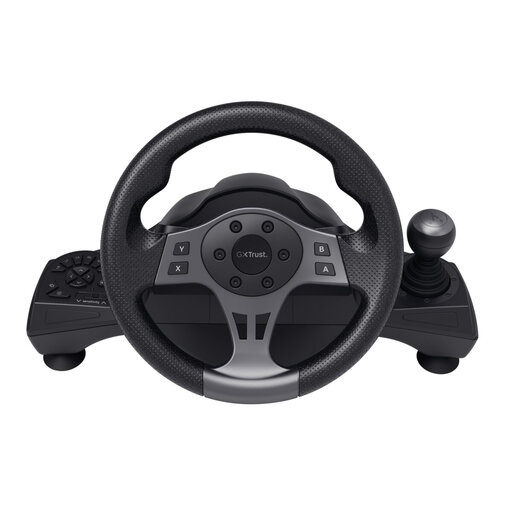
Trust GXT 289 Movi-Racing Wheel with pedals, black, PC

Trust GXT 289 Movi-Racing Wheel with pedals, black, PC

The product information lists separate accelerator and brake pedals, plus clamps for a desk or table, which could be useful if you don’t use a cockpit.

The product name lists PC. Check that your game and the other parts of your setup are compatible.

Joybuy
Thrustmaster T598-P steering wheel with pedals, PS5, PS4 and PC

Thrustmaster T598-P steering wheel with pedals, PS5, PS4 and PC

The product description lists metal two-pedal controls with adjustable resistance, which could be useful if you want to adjust how firm the pedals feel.

The product name lists PS5, PS4 and PC. Check compatibility with your specific game and setup.

Joybuy

Frequently asked questions

Can different pedals help you find braking points with a single monitor?

Pedals don’t change what you can see on screen. For iRacing, iRacing Support explains how to use viewing distance and screen width to set up your display; you should also practise using recognisable braking references. For other games, check their own display settings.

How do I set up new pedals for iRacing?

Calibrate a new controller in iRacing. For the listed load-cell pedals, iRacing Support specifies a Brake Force Factor of 0.00; for the listed position-sensing pedals, it gives values of 1.60–2.00. These are iRacing settings, not general values for other games.

Can I connect T-LCM pedals directly to a console via USB?

No. According to Thrustmaster’s connection instructions, for console use you connect T-LCM pedals via RJ12 to a compatible Thrustmaster wheelbase. Direct USB is the documented option for supported PCs.

What are my rights when buying online in the Netherlands?

For a standard online purchase as a consumer, you generally have a statutory cooling-off period of up to 14 days after delivery, subject to legal exceptions. ACM ConsuWijzer also explains that your statutory guarantee is separate from any manufacturer’s warranty. If a product doesn’t perform as you could reasonably expect under normal use, the retailer is your point of contact for an appropriate solution.
