Who is this guide for?

Sim racer who wants to see more of the corner

You race on a single PC screen and want a better view of the track beside your car, without setting up three monitors. Viewing distance and the right field-of-view settings are important when choosing a screen.

Sim racer who tracks moving details

You want to keep an eye on braking points and changes in the track view as you drive. So don’t look at refresh rate alone: check tested motion handling and the frame rate your PC can deliver, too.

Sim racer with limited space or a mixed setup

You may use a console or have limited room. Check that the aspect ratio, dimensions and connection are right for your device and setup.

What should you look for?

Standard-width 16:9 screen

Choose this if: you race on a console, have limited horizontal space or want to see the entire screen easily from your seating position.

The trade-off: at a similar viewing height, you’ll see less to either side than on a 21:9 ultrawide.

21:9 ultrawide

Choose this if: you race on a PC with one screen and want to see more of the track beside your car.

The trade-off: bear in mind its physical width and check that your game and device support this aspect ratio. The RTINGS guide to ultrawide gaming monitors says that consoles don’t support ultrawide aspect ratios.

What to consider What should you check? Who is this most important for?
Side view and field of view Check the screen width, supported aspect ratio and viewing distance; adjust the simulator’s field of view to suit your position. If I want to see more of the corner on a single monitor, I want the screen width to suit my viewing distance and racing simulator. Around 36% of consumers put extra side vision first.
Motion handling Compare tests of the exact model at different refresh rates and check the mode used by the input you’ll connect to. If I want to track braking points and changing details, I look at how motion is displayed, not just the stated refresh rate. Around 29% of consumers prioritise motion handling.
Contrast and visibility Look at tests of contrast, brightness and motion; for OLED, also check the guidance on fixed elements remaining visible for long periods. When light and dark areas of the racing scene matter to me, I want to weigh up the panel’s characteristics alongside the risks of use. Around 21% of consumers put image contrast first.
Space and compatibility Check the dimensions, including the stand, connections, and the aspect ratio and display mode supported by your device and game. If I’m looking for a screen for my console, PC and available space, I want to know in advance which combination will actually fit. Around 14% of consumers put setup compatibility first.

Common buying pitfalls

  • Assuming a stated 1 ms response time means a sharp picture through every corner

    A GtG response time is a manufacturer’s specification; it doesn’t prove how clearly motion is displayed on that specific screen while racing.

    Compare motion-handling tests for the exact model, including at the refresh rates you’ll actually use.

  • Buying an ultrawide without checking your device and connection

    The aspect ratio or display mode you expect won’t necessarily be available with every game, device or monitor input.

    Before buying, check your game’s aspect ratio, your PC or console’s output, and the resolution and refresh rate supported by the input you plan to use.

  • Not accounting for fixed interface elements remaining on screen for long periods with OLED

    RTINGS highlights a risk of burn-in when static elements remain on screen for extended periods.

    Check the guidance for the exact OLED model and consider LCD if fixed cockpit information often stays in the same place for a long time.

Brands and models to consider

AOC

According to AOC’s product specifications, the CU34G2XP/BK is a 34-inch 21:9 LCD ultrawide with 3440 × 1440 resolution, 180 Hz and FreeSync Premium.

  • The stated 1 ms is an AOC GtG specification.
  • This figure isn’t an independent measurement of motion clarity while racing; assess this model’s motion handling separately.

Dell Alienware

Dell describes the AW3426DWM as a curved 34-inch VA ultrawide with 3440 × 1440 resolution and a refresh rate of up to 240 Hz.

  • Dell lists different GtG figures for each speed mode.
  • According to Dell, the HDMI inputs have a different maximum resolution and refresh-rate combination from the screen specification. Check the mode you want for each connection.

Samsung

According to Samsung, the Odyssey G5 LC34G55TWWPXEN is a 34-inch ultrawide with 3440 × 1440 resolution, 165 Hz and 1000R curvature.

  • Curvature is a specific feature to consider when choosing where to position the monitor and deciding what you prefer.
  • Curvature doesn’t prove that this model makes a wet racing line easier to see.

LG

According to LG, the UltraGear 34GX900A-B is a 34-inch 21:9 OLED screen with 3440 × 1440 resolution and 240 Hz.

  • LG lists HDMI 2.1 and USB-C with 65 W Power Delivery in the model specifications.
  • With OLED, you’ll need to weigh up the risk of burn-in when fixed interface elements remain visible for long periods.

ASUS ROG

According to ASUS ROG, the ROG Swift OLED PG34WCDN is a 34-inch 3440 × 1440 QD-OLED ultrawide.

  • ASUS ROG specifies a refresh rate of up to 360 Hz; this is most relevant if your PC can deliver enough frames.
  • A gaming monitor ranking doesn’t test how well you can learn to drive a wet racing line.

Joybuy monitors for a single-screen setup

These are 21:9 ultrawide monitors for anyone looking for extra horizontal screen space on a single screen. Compare the dimensions, connections and features of each model with your own setup.

LG UltraWide 34U601B-B WQHD VA monitor, 34 inches, 1800R, 120 Hz

LG UltraWide 34U601B-B, WQHD VA monitor, 34 inches, 1800R, 120 Hz

An option if you’re looking for a single curved ultrawide; bear the screen width and viewing distance in mind when positioning it.

The product name lists WQHD, a VA panel, 1800R curvature and 120 Hz.

Joybuy

Gawfolk 34-inch UWQHD gaming monitor, 3440 × 1440, 144 Hz, 1500R, VA

Gawfolk 34-inch UWQHD gaming monitor, 3440 × 1440, 144 Hz, 1500R

A good fit if you’re considering a single curved ultrawide and can accommodate its physical width in your seating setup.

The product name lists 3440 × 1440, 144 Hz, 1500R and a VA panel. Check that your PC and connection support the mode you want.

Joybuy

Gawfolk GF340C-H, 34-inch UWQHD gaming monitor, 3440 × 1440, 165 Hz, 1500R

Gawfolk GF340C-H, 34-inch UWQHD gaming monitor, 3440 × 1440, 165 Hz

A curved ultrawide to compare if you’re looking for extra horizontal screen space on a single monitor.

The product name lists 3440 × 1440, a VA panel, 1500R and 165 Hz. Check the display mode supported by the connection you want to use.

Joybuy
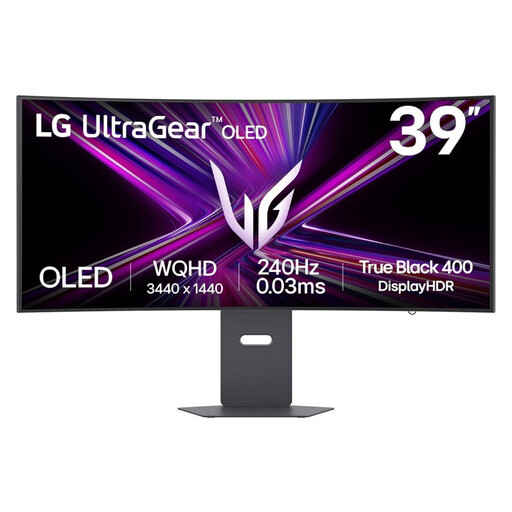
LG UltraGear 39GX900A-B, 39-inch OLED ultrawide, 3440 × 1440, 240 Hz, 800R

LG UltraGear 39GX900A-B, 39-inch OLED ultrawide

An option if you’re considering a larger OLED ultrawide; check that its size and curvature suit your viewing distance.

The product information lists 3440 × 1440, 240 Hz and 800R. RTINGS highlights a risk of burn-in when fixed interface elements remain visible for long periods.

Joybuy

LG 45GX900A-B, 44.5-inch OLED monitor, 3440 × 1440, 240 Hz

LG 45GX900A-B, 44.5-inch OLED ultrawide

Consider this larger curved screen if you’re looking for extra horizontal screen space and have enough room for the monitor.

The product information lists 3440 × 1440, OLED, 240 Hz and 800R. With OLED, the risk of burn-in from fixed interface elements remaining visible for long periods is still worth considering.

Joybuy

Frequently asked questions

Will a wider screen automatically make me faster on a wet track?

No. A wider screen can show more of your surroundings if the simulator supports the format, but iRacing says that the usual, well-worn racing line can actually be more slippery in the rain. A monitor can’t guarantee a speed advantage; finding grip still depends on the conditions and how you drive.

How do I set up a single monitor in iRacing?

From your usual driving position, measure the distance from your eyes to the screen and the screen’s width, then enter those figures in the monitor settings. iRacing explains how to choose a flat or curved single screen and let the simulator calculate the field of view. These instructions are specific to iRacing.

Is a 21:9 monitor suitable for a console?

Don’t assume that a console supports an ultrawide aspect ratio. The RTINGS guide to ultrawide gaming monitors says that consoles don’t support this aspect ratio; check your own console’s and game’s output modes before choosing an ultrawide, too.

What if the monitor doesn’t suit my setup after I’ve bought it?

For a standard monitor bought online in the Netherlands, you generally have a legal cooling-off period of up to 14 days after delivery. ACM ConsuWijzer also explains that there are exceptions to the right to cancel; check the seller’s returns information as well.

Is a two-year manufacturer’s warranty the same as a legal guarantee?

No. ACM ConsuWijzer explains that the legal guarantee is separate from a seller’s or manufacturer’s warranty. If a fault occurs under normal use and the product doesn’t meet what you could reasonably expect, the seller is responsible for providing an appropriate solution at no cost. The period isn’t automatically the same fixed number of years for every monitor.
