
Vandaag of morgen in huis

Kwaliteit gegarandeerd

Welkomstaanbiedingen ontgrendelen: GRATIS bezorging | Tot 80% korting | Gratis 30 dagen JoyPlus-proefperiode
Download de app
A side table with storage might seem like a simple purchase, but there are big differences in size, weight capacity and construction. A table that looks spacious online may take up too much floor space in a small UK living room. A basket might also look mainly decorative, when what you really need is somewhere to keep books, remote controls or chargers.
So don’t focus on colour and style alone. Check the dimensions, storage type and stability too. That way, you can avoid ending up with a wobbly table, a sagging top or impractical storage after just a few months.
A table beside the sofa should be roughly level with the armrest or seat. Its diameter or width is just as important. A round side table measuring 45 cm across can take up a lot of space next to a wide armchair, especially if there’s a walkway alongside it.
Measure the following before you buy:
A metal side table can be stable, but this depends on the thickness and shape of its frame. For a wooden table, the joints, the thickness of the top and the position of the legs all matter. Check the stated maximum weight capacity too. A table top used for a lamp and a cup has different requirements from one that regularly holds books or equipment.
A basket is handy for throws, magazines or toys, but less suitable if you often need to reach small items. Open shelves give you quicker access, but leave everything on show. A 3-tier side table provides more surface space, but you’ll need to pay extra attention to its height and the distance between the shelves.
A compact coffee table for small spaces shouldn’t just be small; it should still be practical to use. A round design has no sharp corners, which can make it a good choice beside a sofa or bed. As well as checking the overall size, look at the dimensions of the basket or shelf. A wide table with shallow storage may be less practical than you expect.
For a bedroom bedside table, a height close to that of your mattress is often useful. For a living room side table, the height of your sofa or armchair is the main factor in how easily you can reach for a glass or book.
Look for separate weight limits for the table top and shelves. A product with a metal frame isn’t automatically suitable for heavy loads. Some models have a higher weight limit for the top than for the bottom shelf.
Consider how the materials work together:
If a product lists an E1 classification, this refers to the emissions class of the board material. Check the product information and manufacturer’s details if this is important to your purchase.
Adjustable feet are useful on uneven floors and can help prevent scratches. Check whether the legs form one continuous frame or are made up of several separate parts. Clear instructions and numbered components make assembly easier.
Quick assembly is handy, but check all the joints again once everything is tightened. Don’t use the table until the frame is stable and the top is properly secured.
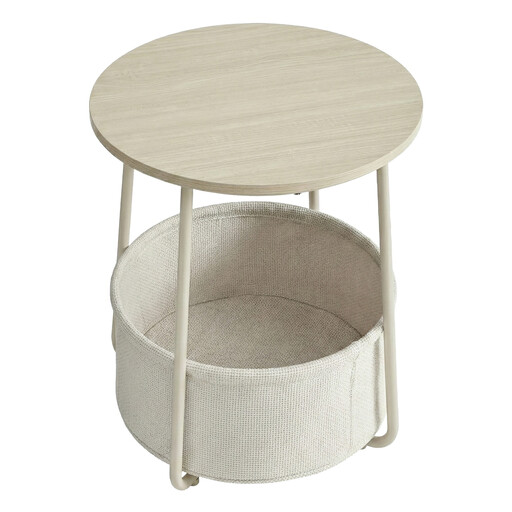
Why it suits this buyer: Its round shape and compact dimensions of 45 x 50 cm make it a good fit beside a sofa, armchair or bed. The fabric basket provides a handy spot for books, remote controls or a throw.
The product description lists four adjustable feet, so you can improve stability on a floor that isn’t completely level. The stated maximum weight capacity for the table top is 35 kg.
Round top, fabric basket, U-shaped steel legs and an estimated assembly time of around 5 to 10 minutes.
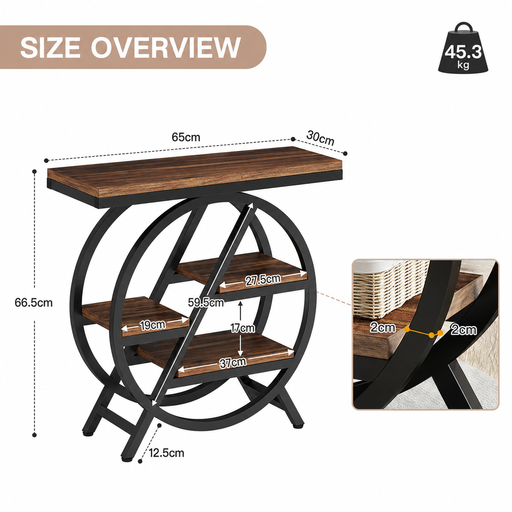
Why it suits this buyer: This model is designed for anyone who wants several open tiers for books, lamps and decorative items. The combination of rustic brown board and a geometric metal frame suits industrial or rustic décor.
The three separate shelves keep your belongings visible and within easy reach. The specifications list adjustable feet and a metal frame; check the stated total weight capacity before use.
3-tier side table with 1.5 cm-thick E1-classified chipboard shelves, adjustable feet and a geometric frame.

Why it suits this buyer: Measuring 40 x 40 x 55 cm, this model works as a metal side table beside the sofa, a bedroom bedside table or an extra surface in a home office.
The two mesh shelves can be fitted flat or at a slight angle. The product specifications list a capacity of 20 kg for the table top and 5 kg per shelf, so you can distribute the load between the levels.
Steel frame, two adjustable metal shelves, stated weight capacity for each level and assembly using the included Allen key.
We’ve put together a full, up-to-date list of products that meet these strict selection criteria and the applicable European safety regulations.
A table’s lifespan depends on how much weight it carries, how it’s assembled and how it’s cared for. Don’t load a side table beyond the limits in the product specifications. Use coasters to protect it from moisture, and clean board materials with a slightly damp or dry cloth, depending on the care instructions. Avoid prolonged exposure to moisture and direct sunlight if the manufacturer recommends doing so.
Carefully retighten the screws after the table has been in use for a while. A wobbly frame is often caused by a loose joint or an uneven floor, not just the design.
Measure from the floor to the top of the armrest. A table that’s roughly level with, or slightly lower than, the armrest is usually practical for drinks and small items. Check that you can also reach the basket or shelf easily.
Yes. A round design can work well if you want to avoid sharp corners or need to place a table in a narrow walkway. Check the diameter, though, and leave enough room to walk around it.
It varies by model and by component. Look for separate weight limits for the table top and shelves. For example, don’t assume a stated limit of 20 kg applies to every shelf; the manufacturer may specify a lower limit for them.
