
Vandaag of morgen in huis

Kwaliteit gegarandeerd

Welkomstaanbiedingen ontgrendelen: GRATIS bezorging | Tot 80% korting | Gratis 30 dagen JoyPlus-proefperiode
Download de app
A side table may seem like a simple purchase, but small differences in size, stability and material can determine whether you use it every day or push it aside after a few months. A table next to the sofa, for example, needs to be close enough for you to reach a drink or the remote, while a hallway table mainly needs enough storage space and a suitable width.
Also watch out for these three common pitfalls:
Measure your space beforehand and check the product specifications to avoid making the wrong purchase. Below, you’ll find out what to look for in an industrial-style side table, wooden side table, metal side table or model with storage.
First, measure the space where you plan to put the table. For a table to go next to the sofa, check:
A tabletop around 45 cm wide can be practical next to an armchair or sofa, while a longer console table is better suited to behind a sofa or in a hallway. A C-shaped side table is designed to slide partly under a sofa. This makes it suitable for a laptop, book or drink, but check that the base will fit underneath your furniture.
Using the table as a bedside table? A height that roughly matches the mattress or bed frame is usually more practical than a very low model. For a conservatory or covered outdoor space, ease of care and moisture resistance are particularly important.
A metal side table with a powder-coated finish usually has a smooth surface that can be cleaned with a lightly damp cloth. If you plan to use it outdoors, check that the product information confirms it is suitable for outdoor use. A product described as suitable for a patio or garden is not automatically designed to be left unprotected in rain and frost all year round.
A wooden side table or a table made from engineered wood adds a warm touch. Pay attention to the thickness of the top, the finish and the care instructions. Some models may have a water-repellent or scratch-resistant surface, according to the product description. Treat this as a product specification from the brand and use the table as directed.
An open design with several tiers gives you space for books, baskets, plants or decorations. Check that the shelves are high enough for the things you want to store. A coffee table usually offers more surface space, but also takes up more room than a compact side table.
Look at the construction as well as the maximum weight capacity. A table with adjustable feet can help on an uneven floor and stop the furniture from rocking. After assembly, check that all the connections are secure and distribute heavy items across the top or shelves.
For example, the product information for the models below states a weight capacity of 20 kg for the steel model and up to 150 kg for the console table. These are the stated product specifications. Place heavy items evenly and always follow the assembly instructions.
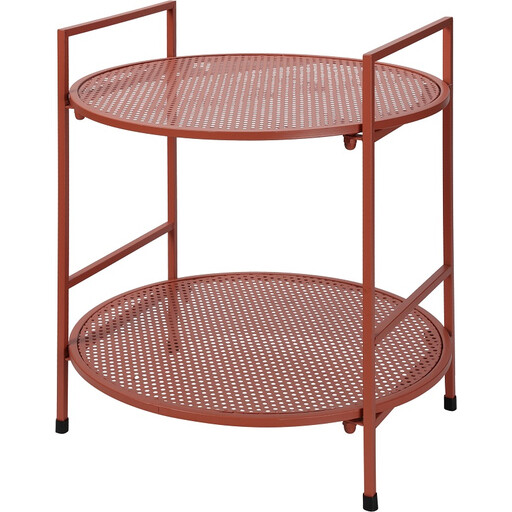
Why it suits this profile: This compact model has two tiers and fits beside a chair or sofa, or in a covered conservatory. Its stated dimensions are 45 x 50 cm.
The product information specifies a metal construction, simple assembly and a maximum weight capacity of 20 kg. This makes its practical limits clearer than a general claim about sturdiness.
Powder-coated carbon steel, two tiers, easy to clean with a damp cloth and suitable for outdoor use according to the product description.
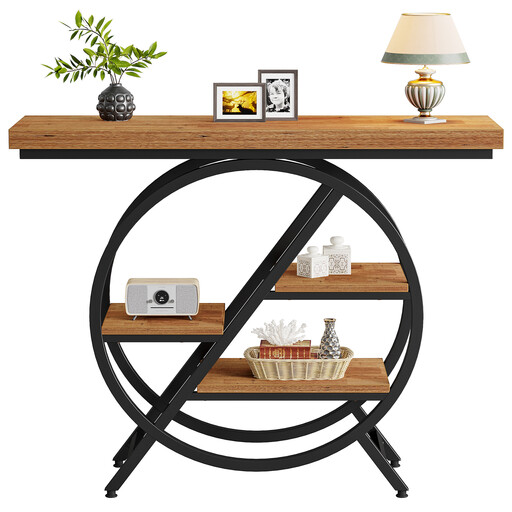
Why it suits this profile: At 100 cm long, with three staggered tiers, this model works as a hallway table, a table behind the sofa, a TV stand or open storage unit.
The product description specifies a 4 cm tabletop, a metal frame, four adjustable feet and a stated weight capacity of up to 150 kg. Before buying, check that this capacity suits how you plan to use it.
Three storage tiers, adjustable feet, a geometric metal frame and a surface that is easy to care for according to the product description.
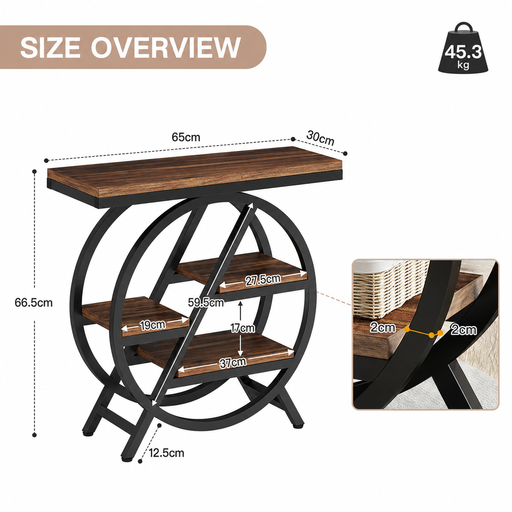
Why it suits this profile: This model combines a wood-effect look with three shelves and can be used as a side table, bedside table or storage table next to the sofa.
The specifications state that the shelves are 1.5 cm thick, with four adjustable feet and a weight capacity of up to 13.6 kg. This helps you match what you place on it to its capacity, such as books, a lamp and lightweight decorations.
Three tiers, adjustable feet, an industrial-style metal frame and a water-repellent, scratch-resistant veneer surface according to the product description.
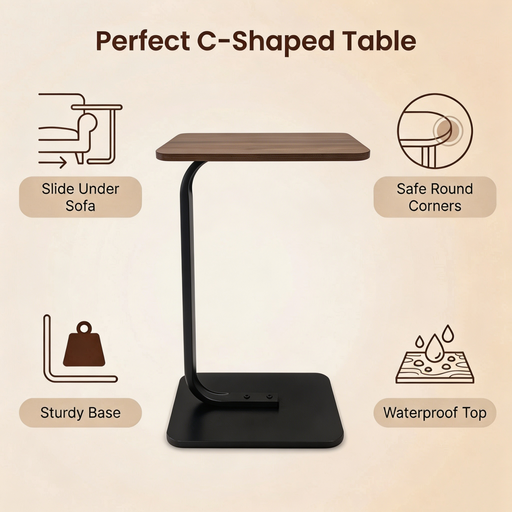
Why it suits this profile: The C-shaped design is made for use beside a sofa or bed. It can serve as a compact TV tray or work surface when floor space is limited.
The C-shaped design lets you bring the tabletop closer without adding a wide coffee table. Check the clearance under your sofa or bed beforehand.
Compact C-shaped design, metal frame and suitable as a side table or TV tray according to the product name and presentation.
Before ordering, check the full dimension drawing, not just the length and height. The width of the base may affect the amount of space you have to walk past it. For a model with shelves, also check the distance between tiers and the height of the items you plan to store.
Keep these points in mind during assembly:
A metal side table can work well in a modern or industrial-style room, while a wooden design may suit a rustic living room better. A longer console table is often a more practical choice for a hallway than a small side table. If you want a table that serves more than one purpose, consider a side table with storage.
We’ve put together a complete, up-to-date list of products that meet these strict selection criteria and the applicable European safety regulations.
Measure the height of the armrest or seat and choose a tabletop that is close to it. This makes it easy to reach for a drink or book. With a C-shaped model, you should also check that the base will fit under the sofa.
A powder-coated metal model can be a practical choice for a patio or covered garden. Always check the product description and care instructions. If there is prolonged rain, frost or strong wind, it’s best to put the table somewhere sheltered unless the manufacturer specifically says otherwise.
It depends on how you plan to use it. Open shelves are handy for books, plants and decorations, but they also collect dust more quickly. A simple tabletop is easier to move and keep clean. Choose based on the space you have, how much storage you need and the maximum weight capacity.
