
Vandaag of morgen in huis

Kwaliteit gegarandeerd

Welkomstaanbiedingen ontgrendelen: GRATIS bezorging | Tot 80% korting | Gratis 30 dagen JoyPlus-proefperiode
Download de app
A side table may seem like a straightforward purchase, but the wrong style can quickly disappoint. A table that looks sturdy in the product photo might take up too much space in a small living room. A beautiful metal frame might wobble on an uneven floor. And a tabletop without extra storage could leave you with even more clutter beside the sofa.
That’s why it’s worth looking beyond colour and style. The dimensions, weight capacity, material and intended use all determine whether a side table will suit your day-to-day needs.
A modern side table, industrial-style side table or gold side table might complement your interior, but that doesn’t tell you anything about its stability or upkeep. Always check the size of the tabletop, the table’s height and whether its construction is suitable for the items you plan to put on it.
For example, a round side table with a diameter of around 47 cm could work well beside an armchair or sofa, while a larger coffee table will need more room to move around.
Measure the available space before you order. Remember to allow for:
A small side table is handy in a flat, bedroom or home office, but may not have enough surface area for a lamp, book and glass at the same time. A 100 cm console table, on the other hand, is better suited to the space behind a sofa or in a hallway.
Not every tabletop is designed for heavy equipment, stacks of books or ornaments. Check the stated maximum weight capacity, and make sure you know whether it applies to each shelf or the whole table.
The material matters too. A coated metal side table may be easy to wipe clean, while a wooden side table or one with a veneer finish may need to be cleaned with a soft, slightly damp cloth. Avoid abrasive cleaners if the product information recommends against them.
A side table in the living room is usually most convenient when its top is roughly level with the sofa seat or armrest. A similar height can work well for a bedside table, making it easy to reach a lamp, phone or book from bed.
Don’t just check the height: consider the footprint too. A round table has no sharp corners, which can make it a good choice beside a chair. A rectangular style often makes better use of a narrow wall or the space behind a sofa.
Pay attention to the combination of materials:
X-shaped cross-bracing, adjustable feet or a wider base can help keep a table stable. They don’t replace properly tightening the fixings during assembly.
A side table with storage is handy if you want to keep books, remote controls or magazines out of sight but within easy reach. A multi-tier style can also work as a bedside table, plant stand or extra table in a home office.
Check whether the shelves are open, how much weight they can hold and whether they can be positioned flat or at an angle. That last point can make a difference if you want to arrange books or magazines neatly.
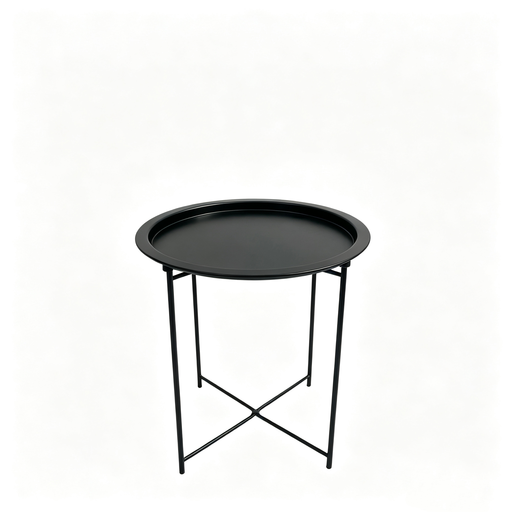
Why it suits this profile: Its compact, round shape, measuring 47 x 50 cm, makes it a good fit for a small living room, bedroom, balcony or study. According to the product information, it’s designed for easy assembly with a modular structure.
The dimensions and material specifications are clearly listed. The product description says the round metal top is easy to wipe clean. Before you buy, check that the size will suit your seating area.
Water-resistant metal tray, matt black finish, lightweight design and a frame with cross-bracing, according to the product information.
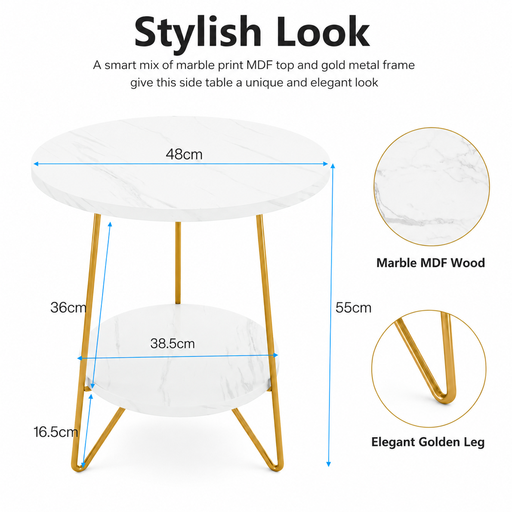
Why it suits this profile: This style pairs a white faux marble top with gold-coloured metal legs. With a diameter of 18.7 inches and a height of 21.65 inches, it’s suitable beside a sofa, armchair or bed.
The product information gives a recommended maximum weight of 15 kg and advises placing the table on a flat, stable surface. This helps you choose items that are suited to its construction.
Two tiers, a compact round design and powder-coated metal legs, according to the product specifications.

Why it suits this profile: Measuring 40 x 40 x 55 cm, this style has two adjustable mesh shelves, making it suitable for books, magazines and accessories beside a sofa or bed.
The weight capacity is listed separately: up to 20 kg for the tabletop and 5 kg per mesh shelf. This makes it easier to distribute heavier and lighter items safely.
Steel frame, vintage-coloured engineered wood and adjustable shelves. Assembly uses the supplied Allen key and instructions.
A small style beside the sofa is often all you need for a relaxing seating area. If you want to store several items, choose a side table with storage or a three-tier style. A narrow console table is practical in a hallway, while a wider coffee table is better for sharing around the sofa.
If you’re mainly looking for a decorative accent, consider how the colour and material will work with the rest of the room. A gold side table will stand out more than a black metal style. Before you order, check which parts are included, along with the assembly instructions, dimensions and maximum weight capacity.
We’ve put together a complete, up-to-date list of products that meet these strict selection criteria and the applicable European safety regulations.
Measure the height of the armrest or seat. A tabletop roughly level with the armrest is usually handy for drinks, a lamp or a remote control. Also check that the table won’t obstruct the sofa or walkway.
That depends on the product information and finish. According to the description, a metal table with a water-resistant top or anti-rust coating may be better able to withstand splashes. However, that doesn’t automatically mean it’s suitable for prolonged exposure to rain. Use and store the table according to the manufacturer’s instructions.
A round side table has no sharp corners and often works well beside an armchair or in a compact seating area. A rectangular style makes better use of a narrow wall, the space behind the sofa or an area beside the bed. Choose based on the space available and what you want to put on the tabletop.
