For photographing a sheet of calligraphy on a small table, you may not need a separate shutter release: first set up your camera or phone securely, then try a compatible app or the self-timer. Apple Support explains how to use the iPhone self-timer, while Canon UK describes app control for compatible cameras. If you do choose a separate remote, check the exact camera model and its connection or wireless capabilities. A shutter release lets you take the picture without touching the camera, but it won’t make an unstable setup steady.
Who might need a separate shutter release?
Photographers with a mirrorless or DSLR camera
You want to photograph the sheet from a fixed setup without touching the camera to take the picture. Check which accessory is compatible with your exact camera model; manufacturers such as Canon and Nikon list compatibility by model.
Creative makers with limited table space
You want to avoid running a control cable across the paper or through your setup. Compare a compatible wireless remote with your camera’s app.
Smartphone photographers without extra equipment
You want to check whether a stable phone setup and the built-in self-timer will do the job before buying a separate remote.
What should you look for when choosing one?
App or self-timer
Choose this when: your device has a suitable app or the timer is all you need for the shot.
Bear in mind: app control must be compatible with your camera model; a timer doesn’t offer the same direct control as a separate remote.
Wired shutter release
Choose this when: you’ll be close to the small table and your camera supports the cable connection.
Bear in mind: the cable needs to fit around your setup; connections and any adapters required vary by model.
Wireless shutter release
Choose this when: you want to take the picture from beside your setup without a cable, and your camera supports that specific remote.
Bear in mind: Bluetooth doesn’t automatically mean a remote will work with every camera. Check your model and the pairing instructions.
Infrared shutter release
Choose this when: your camera has a compatible built-in infrared receiver.
Bear in mind: JJC says the IR-C2 must be used in front of the camera; infrared isn’t automatically an alternative to Bluetooth.
| What to consider |
What should you check? |
Who is this important for? |
| Compatibility |
Compare the full camera model with the accessory’s compatibility list. For a cable, check the connection and whether an adapter is needed. |
If I buy a separate remote, I want to be sure it will communicate with my camera. Around 36% of consumers put compatibility first. |
| Taking pictures without touching the camera |
Check whether an app or self-timer solves the same control problem as a separate remote. |
If I don’t want to touch the camera when taking the picture, what matters most is whether my existing controls are enough and the setup stays steady. Around 29% of consumers prioritise this need. |
| Space around the sheet |
Check whether you can run a cable along the edge of the table without moving the paper, camera or support. |
With limited table space, I want to keep the paper and controls clear. Around 21% of consumers say a tidy setup matters most. |
| Extra equipment |
First take a test shot using your existing controls, then decide whether you need a separate remote. |
If I only photograph a sheet now and then, I don’t want to buy an accessory that duplicates my app or timer. Around 14% of consumers prioritise simplicity without extra equipment. |
Common buying mistakes
-
Assuming Bluetooth is a universal camera standard
The Canon BR-E1 and Nikon ML-L7 are designed for specific compatible camera models. So, seeing Bluetooth in the description doesn’t tell you whether a remote will work with your camera.
Before buying, check your camera’s full model name against the manufacturer’s compatibility information.
-
Buying a cable without checking the connection
Plugs aren’t interchangeable. Some cameras also need an adapter; Fujifilm explicitly specifies one for certain RR-100 combinations.
Check the camera port, plug and any model-specific adapter requirements. Also consider where the cable will run around the sheet.
-
Expecting a shutter release to fix every blurry photo
A remote lets you take the picture without touching the camera, but it won’t correct an unstable support or poor framing.
Set up your camera or phone securely first, then check the framing and focus with a test shot. Only choose a separate remote if it solves a control issue you still have.
Brands to compare
Canon
Canon offers the wireless BR-E1 and wired RS-80E3, among other accessories, for the listed EOS and PowerShot models.
- Canon describes the BR-E1 as having a shutter button and a separate AF-start button.
- The RS-80E3 uses an E3 connection; it isn’t automatically compatible with every Canon camera.
Nikon
The ML-L7 is a Bluetooth remote for specific Nikon cameras. Nikon also offers wired accessories for certain connections.
- Nikon lists separate buttons for taking photos and recording video on the ML-L7.
- The description ‘Nikon camera’ doesn’t guarantee compatibility; check your exact model.
Fujifilm
The wired RR-100 is designed for cameras on Fujifilm’s compatibility list.
- Fujifilm lists an L-shaped 2.5 mm plug extension cable as included.
- For the X-S10 and X-T200, Fujifilm specifies a separate 2.5-to-3.5 mm adapter when using the RR-100.
Sony
The RMT-P1BT is Sony’s Bluetooth option for cameras that support this remote.
- Sony says the RMT-P1BT works with the built-in Bluetooth receiver on a compatible camera, without a cable or extra receiver.
- This model description doesn’t confirm that every Sony camera is compatible.
JJC
JJC offers the IR-C2 as an infrared option for cameras with a compatible built-in receiver.
- JJC explicitly states that a built-in infrared receiver is required.
- The remote must be used in front of the camera; the IR-C2 isn’t a universal replacement for Bluetooth remotes.
Joybuy product picks
This selection includes phone tripods and remotes for certain smartphones or cameras. Before buying, check that the holder, remote and any camera or phone compatibility suit your setup.
 No image available
KINSI Selfie Stick with Tripod, 170 cm
The Bluetooth remote and rotating phone holder are designed for hands-free smartphone photography.
The title specifies an extendable 170 cm tripod, a rotating holder and support for smartphones from 4.7 to 6.0 inches.
Joybuy
 No image available
KINSI Smartphone Tripod with Bluetooth Remote Control
This model could suit a tabletop smartphone setup if you want to take pictures without touching your phone.
The product title specifies a folding tabletop tripod with adjustable height and a Bluetooth remote.
Joybuy
 No image available
Osmo Action GPS Bluetooth Remote Controller
This remote is only an option if your camera is one of the listed Osmo models and the controls suit the way you shoot.
The product title specifies compatibility with Osmo Action 4, Osmo Action 5 Pro, Osmo 360 and Osmo Action 6.
Joybuy
 No image available
Ulanzi JJ02 Bluetooth Selfie Stick, 3-in-1
The Bluetooth remote and mini tripod are designed for hands-free smartphone photography.
The product title specifies support for iPhone and Android, an extendable mini tripod and dual cold shoe mounts.
Joybuy
 No image available
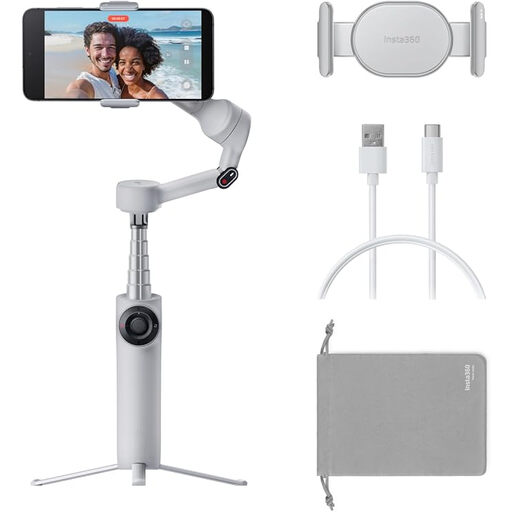
Insta360 Flow 2 Gray
This smartphone gimbal could be useful if you’re looking for a setup with an integrated tripod and remote control.
The product title specifies an integrated tripod and selfie stick, and use with iPhone and Android. The product description mentions control via a second phone.
Joybuy
Frequently asked questions
How can I tell whether a shutter release will work with my camera?
Compare your camera’s full model name with the compatibility list for the specific accessory. If you’re using a cable, check the connection too. For example, Fujifilm specifies a separate 2.5-to-3.5 mm adapter when using the RR-100 with the X-S10 and X-T200.
How can I keep the sheet of calligraphy in sharp focus when taking the picture?
Set up your camera or phone securely, then check the framing and focus before taking the picture. A shutter release lets you take the picture without touching the camera, but it won’t stabilise a wobbly setup.
Should I buy a separate remote if I’m already using a phone?
Not necessarily. Apple Support explains how to use the iPhone self-timer, while Canon UK describes app control for compatible cameras. First check which features your phone or camera actually offers.


