Start with your exact camera model: a shutter release will only work if your camera supports the connection or wireless control. For a fixed set-up, a compatible cable may be enough. If you want to stay by the composition while arranging the soap, a compatible wireless shutter release may be more convenient. First, try the self-timer or a supported camera app to see if it does the job.
Who might find a shutter release useful?
Photographer with a fixed soap set-up
You set up your camera and want to release the shutter without touching the camera body each time. Nikon describes the MC-DC2 as allowing you to release the shutter without touching the camera when using a tripod; check that the model and connection are right for your camera.
Creator who keeps adjusting the composition
You arrange the soap or background and want to take a photo from where you are. Canon and Sony describe wireless options for specific supported cameras; check compatibility using your camera’s full model name.
Creator who wants to try existing features first
You take the occasional product photo and want to know whether the self-timer or a supported app will be enough. Canon describes Camera Connect as an option for many Canon cameras; check whether your camera is supported.
What should you look for when choosing one?
Wired shutter release
Best for: a fixed camera set-up, provided the cable connection is right for your camera model.
Bear in mind: the cable length and connection determine where you can stand.
Wireless shutter release
Best for: working beside the composition, if your camera supports the control method you choose.
Bear in mind: wireless control is not automatically compatible with every model.
Self-timer or camera app
Best for: occasional photography, if your camera’s existing options suit the way you work.
Bear in mind: a self-timer may not offer the same direct control while you adjust the composition.
When photographing soap in window light, start by considering the camera you use and where you want to release the shutter from. The table summarises the practical points to consider for each buying need.
| What to consider |
What should you look for? |
Who is this important for? |
| Compatibility |
Check the exact camera model, connection or Bluetooth support, and the shutter release’s compatibility list. |
When buying a shutter release, I first want to know whether it works with my camera; around 36% of consumers cite compatibility as their main buying concern. |
| Releasing the shutter without touching the camera |
Check whether you can release the shutter from where you’re working and whether an existing camera feature solves the same problem. |
With a fixed set-up, I don’t want to touch the camera while taking a photo; around 29% of consumers prioritise avoiding camera shake above all else. |
| Control from beside the composition |
Check whether your camera supports the control method and which features are available with the shutter release you choose. |
If I want to stay beside the soap while arranging it, I’m looking for control from that spot; around 21% of consumers put this freedom first. |
| Existing features and what’s included |
Check app support and which components or power source are included with the version you choose. |
For the occasional photo, I’d rather try what my camera can already do first; around 14% of consumers mainly want to avoid unnecessary purchases or extra accessories. |
Common buying pitfalls
-
Assuming a brand name means it’s compatible
A camera brand may have different models and connections, so a shutter release won’t necessarily work with every camera from that brand.
Before buying, compare the full model name with the compatibility information. For a cable, also check that the connection matches.
If the connection or model is wrong, you may not be able to use the control with your camera.
-
Choosing an advanced timer for occasional photos
According to JJC, the JJC TM-F2 has timer and interval functions and can also be used as a simple wired shutter release. You may not need these extra features if you only release the shutter manually.
First decide whether you need timer or interval shooting. Otherwise, see if a simpler compatible control or an existing camera feature will do.
-
Mistaking a phone selfie stick for a camera shutter release
A product with a remote control may be designed for a smartphone, which doesn’t automatically make it suitable for a camera.
Check the product page to see which type of device the control is designed for and whether your camera model is explicitly supported.
Brands to consider
Canon
Canon describes wired and wireless shutter releases for specific cameras and connections.
- For the BR-E1, Canon specifies Bluetooth control up to 5 metres and lists compatible models on the product page.
- Canon uses different connections for wired control, including E3 and N3; check which connection your camera has.
Nikon
Nikon offers wired and wireless options for specific models, including the MC-DC2 and ML-L7.
- Nikon describes the MC-DC2 as a way to release the shutter without touching the camera body when using a tripod.
- The MC-DC2 and ML-L7 are not universally compatible just because they’re Nikon products; check support for your camera model.
Sony
According to Sony, the RMT-P1BT is a Bluetooth option for cameras that support this control method.
- Sony specifies control via the built-in Bluetooth receiver and a status indicator.
- Before buying, check whether your specific Sony camera supports the RMT-P1BT.
JJC
JJC offers the TM-F2 as a wired timer shutter release for specific Sony cameras with a Sony Multi Connector.
- JJC lists timer and interval functions, as well as simple shutter release via the cable.
- Compatibility with the TM-F2 does not automatically apply to other JJC cable versions.
Joybuy products for smartphone set-ups
This Joybuy selection includes smartphone selfie sticks and phone tripods with remote controls. Don’t consider them shutter releases for a standalone camera unless the product information explicitly confirms compatibility with your camera model.
 No image available
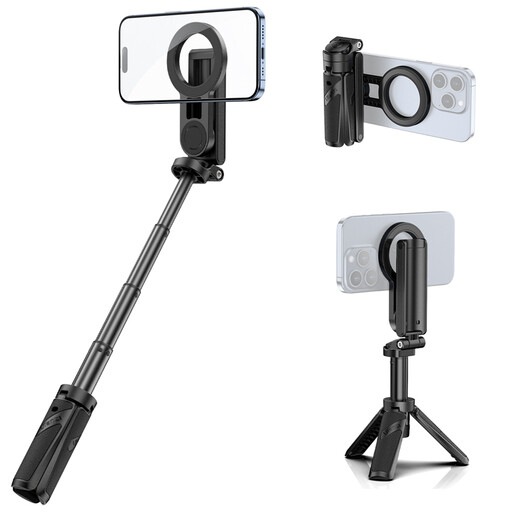
Ulanzi JJ03 3-in-1 magnetic desk tripod with remote control
An option for a fixed smartphone set-up when you want to release the shutter remotely.
The product title specifies a magnetic mount and a tripod that rotates 360°.
The product information warns that the strong magnets must be kept at least 15 cm away from pacemakers, defibrillators and other medical implants.
Joybuy
 No image available
Ulanzi JJ02 Bluetooth selfie stick with 3-in-1 phone tripod
This phone tripod set-up is designed for smartphone photography with remote control.
The product title specifies an extendable mini tripod, two cold shoe mounts and support for iPhone and Android.
Joybuy
 No image available
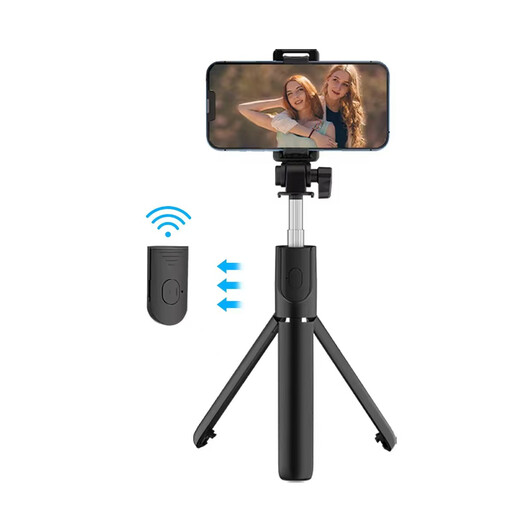
Verbex New K50 Black Bluetooth selfie stick with phone holder
An option for a smartphone set-up with a phone holder and remote control.
The product title specifies an extended length of 1.9 m, a floor stand and a fill light.
The product information specifies a maximum supported phone size of 6.0 inches.
Joybuy
Frequently asked questions
Does my camera need to be on a tripod to use a remote control?
No, but with a fixed set-up, a compatible shutter release lets you operate the shutter without touching the camera body. It won’t stop the soap from moving or the window light from changing.
How do I know if a shutter release is compatible with my camera?
Check the compatibility information for the exact combination of camera and shutter release. For a cable, check the connection type; for wireless control, check that your camera model is supported.
Which parts or power requirements should I check?
Check the packaging and power requirements for the exact version. For example, JJC says two AAA batteries are included with the TM-F2; this doesn’t tell you what’s included with other models or versions.
What rights apply to an online purchase in the Netherlands?
According to the Dutch government, for an eligible online purchase from a business, you generally have a 14-day cooling-off period; this rule for distance purchases does not apply to an online purchase from a private individual. You’re also entitled to a product that is fit for purpose. According to the Dutch government, the Netherlands has no fixed statutory warranty period; contact the seller if there’s a problem.


