
Vandaag of morgen in huis

Kwaliteit gegarandeerd

Welkomstaanbiedingen ontgrendelen: GRATIS bezorging | Tot 80% korting | Gratis 30 dagen JoyPlus-proefperiode
Download de app
A shower grab bar without drilling can be useful when you need extra support without permanently altering tiles or walls. This may apply to older people, those recovering from an injury, pregnant women, carers and tenants, for example. However, not every suction-cup shower grab bar is suitable for every bathroom or type of support.
Installation often looks straightforward, but the surface, intended use and way the grab bar is loaded determine whether a product is suitable for your situation. Below, you can find out which pitfalls to avoid and which specifications to check before buying.
A removable shower grab bar does not work on every type of tile or wall. Suction cups need a smooth, non-porous and airtight surface. According to the product descriptions, suitable surfaces include glass, metal, stainless steel, acrylic, marble and smooth tiles.
Unsuitable surfaces include:
Also check that the tiles are large enough. The TAILI grab bars mentioned specify a minimum tile size of 4 × 4 inches. Measure the area before ordering.
Many models are intended for balance assistance, not to support your entire body weight. According to TAILI's product information, each grab bar has a stated maximum load capacity of 240 lbs, but the safety instructions also say that you should not hang from it using your full body weight.
If you want to support someone when standing up, during a transfer or to help prevent a fall, first discuss with a physiotherapist, occupational therapist or another appropriate healthcare professional which type of wall grab bar is required. In these situations, a permanently screwed grab bar may be more suitable than a suction-cup shower grab bar.
An anti-slip shower grab bar should be comfortable to hold, but a ribbed surface alone is not enough. Also consider the shape, hand position, length and locking mechanism. A grab bar that is too short may not provide enough room to reposition your hand. A shape that is too smooth or uncomfortable may be less pleasant to use when your hands are wet.
Choose a model with clear installation instructions. The TAILI models use two suction cups with locking levers. According to the product description, these levers are pressed down to secure the suction cups. After installation, check that both levers are fully closed and that the grab bar does not move.
A bathroom grab bar without screws can be reused after removal, but only if the suction cups and surface are clean and undamaged. Remove grease from the wall and dry it before fitting the grab bar.
Pay attention to the following points:
TAILI's product descriptions mention an anti-slip strip and a wavy underside. These are verifiable design features; they do not guarantee that every user will experience the same level of grip.
Clean the grab bar with a damp cloth and mild soap. Check it before use and regularly thereafter for coming loose, wear or damage. According to the installation instructions, a suction cup with reduced adhesion can be washed with warm water and dried completely before being installed again.
Do not use a suction-cup grab bar as a permanent fixture, and do not place it in direct sunlight or extreme heat. For use at night, a glow-in-the-dark finish may improve visibility, but it does not replace good bathroom lighting.
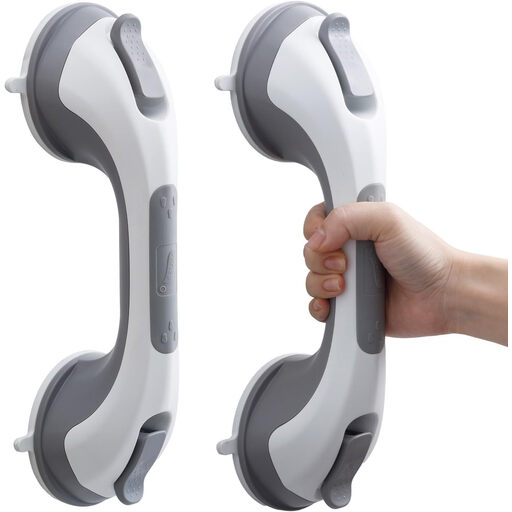
Why it suits this profile: A set of two compact grab bars offers flexibility in the shower or bath. According to the product description, installation requires no drilling, screws, adhesive or tools.
The product information clearly states that smooth, non-porous and airtight surfaces are required. This means you can find out in advance when this model is not suitable.
Two grab bars, plastic construction with TPE suction cups, an anti-slip strip and, according to the manufacturer, a stated load capacity of 240 lbs per grab bar.
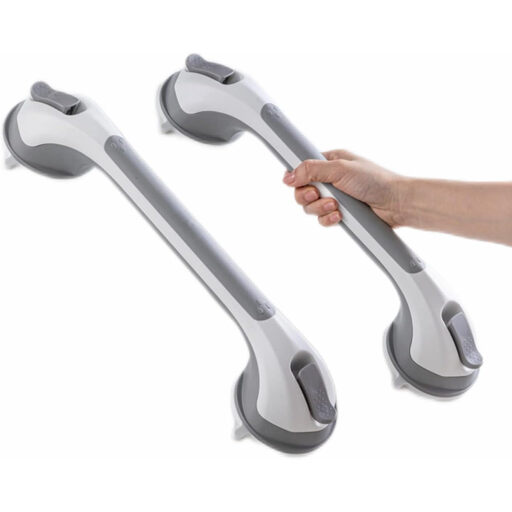
Why it suits this profile: This model has an ABS housing and is 16.8 inches long. It may suit users looking for a longer grab bar with a robust plastic construction.
The instructions limit use to suitable smooth surfaces and warn against supporting your full body weight. This helps prevent you from using a suction-cup grab bar as a permanent wall-mounted support.
ABS material, two lockable suction cups, a water-resistant product description and, according to the manufacturer, a stated load capacity of 240 lbs per grab bar.
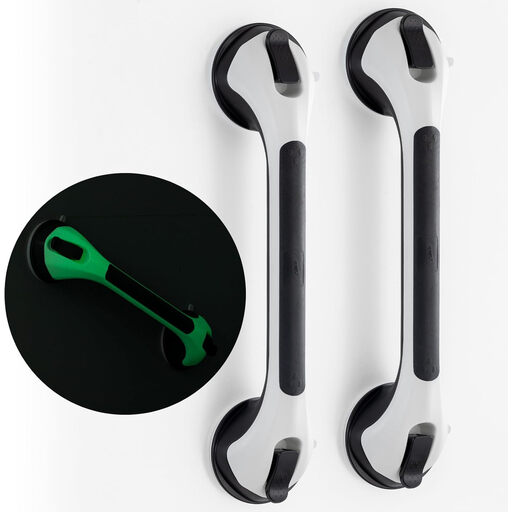
Why it suits this profile: For anyone who visits the bathroom at night, a glow-in-the-dark finish can make the grab bar easier to locate. The set is designed for showers and baths and can be removed.
The product description specifies both the suitable surface and the need to check the locking mechanism and adhesion regularly.
Glow-in-the-dark plastic finish, anti-slip strip, two TPE suction cups and, according to the manufacturer, a stated load capacity of 240 lbs per grab bar.
A bathroom towel rail can make the space more practical, but never use a storage rack as a support point. A wall-mounted rack with hooks is designed for towels, dressing gowns or accessories. The Ju7cer rack has four hooks and, according to the description, is not suitable for supporting body weight.
If you do not want to drill, an adhesive solution such as the Ochama × J.ZAO No Drill Towel Aluminum Bar is an option for smooth walls. The instructions state that the adhesive must cure for 48 to 72 hours before you use the rack. If you would rather not attach anything to the wall, a freestanding 5five Bamboo Towel Rail may be more practical. Place it on a level surface and distribute the weight evenly.
We have put together a complete, up-to-date list of products that fully meet these strict selection criteria and the applicable European safety regulations.
No. A suction-cup grab bar is generally intended for a smooth, non-porous and airtight surface. Rough tiles, deep grout lines, wallpaper and porous walls can reduce adhesion. Always check the product specifications and test the attachment before use.
This depends on the surface, cleaning, temperature and wear on the suction cups. There is no fixed usage period that applies to every bathroom. Check the grab bar regularly and reinstall it if you notice movement, leakage or detachment.
It can be suitable when light balance support is needed, provided the surface is suitable and the user does not put their full body weight on the grab bar. For more significant mobility issues or support during transfers, professional advice is recommended. A permanent wall-mounted grab bar may then be better suited to the intended use.
