
Vandaag of morgen in huis

Kwaliteit gegarandeerd

Welkomstaanbiedingen ontgrendelen: GRATIS bezorging | Tot 80% korting | Gratis 30 dagen JoyPlus-proefperiode
Download de app
Sneakers left scattered around, boots blocking the walkway and a rack that starts leaning after only a few weeks: a shoe rack may seem straightforward, but the wrong choice can quickly cost valuable space and money. Households, students and apartment dwellers in particular should consider dimensions, load capacity and stability before placing an order.
In this buying guide, the Joybuy Product Recommendation Officer outlines the key considerations and several popular choices for 2026. The recommendations are based on verifiable product information, including materials, dimensions, capacity and assembly method.
“Fits 18 pairs of shoes” does not always mean that 18 pairs of large sneakers or ankle boots will fit comfortably. The actual available space depends on the width of the shoes and the distance between tiers. Therefore, do not only check the stated number of pairs; also review the width, depth and height of each shelf.
A shoe rack for 18 pairs is a practical choice for a household with several pairs in daily rotation, but it may be less suitable if you need to store many tall shoes or wide hiking boots.
A narrow hallway shoe rack saves floor space, but a tall or shallow construction can be more susceptible to tipping. Place the rack on a level surface and check that all connections are securely fastened. For a tall model or a household with children, additional wall anchoring may be advisable if the option is provided.
Also consider the difference between a freestanding shoe rack and a shoe cabinet. An open rack offers easier access and better ventilation, while a shoe cabinet keeps footwear out of sight but generally requires more floor space and assembly.
A metal shoe rack may be made from sturdy steel profiles, but it may also consist of lightweight metal tubes with plastic connectors. This is not necessarily a drawback, provided the load capacity and intended use are clearly specified. Check the following:
According to JOYFURNOS product information, the three-tier model has a maximum static load of 10 kg per tier and 30 kg in total. This is a verifiable product specification, not a guarantee that every configuration will remain equally stable under all conditions.
Measure the available space at three points: width, depth and height. When choosing a shoe rack for a wardrobe, account for doors, skirting boards and sliding rails. In a hallway, depth is particularly important; a rack that protrudes just a few centimetres too far can obstruct the walkway.
A model approximately 30 cm deep will often fit a narrow corridor better than a deep shoe cabinet. For a niche, a shoe organiser with vertical compartments or a stackable shoe rack may make more efficient use of space than a single wide shelf.
Metal can generally be wiped clean with a slightly damp cloth. With MDF or wood-effect models, prolonged exposure to moisture should be avoided. Bamboo creates a warmer aesthetic, but check the maximum load and preferably place the rack indoors on a dry, level surface.
An open construction allows air to circulate around the shoes. This can be practical for footwear used every day, but it does not protect against dust as effectively as a closed shoe cabinet.
Tool-free assembly is convenient for students or tenants who do not want to drill holes. However, make sure that all connectors are fully pressed into place. Larger models may require suitable tools for assembly.
A stackable shoe rack is a smart option if your collection is likely to grow. Before stacking, confirm that the product has actually been designed for this purpose. Do not simply place one freestanding rack on top of another.
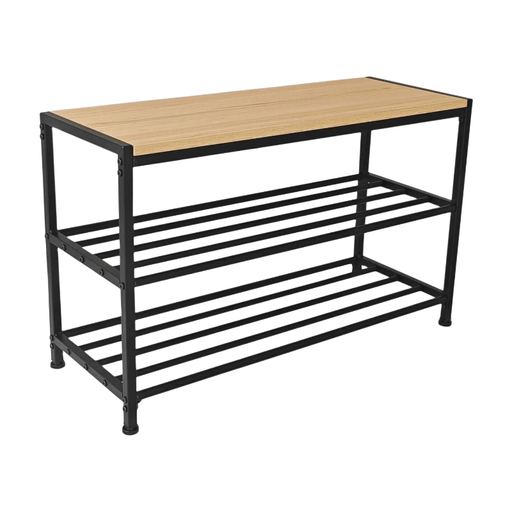
Why it works: A compact choice for a student room, small hallway or bedroom with around six pairs of shoes in daily rotation.
The capacity and dimensions are clearly specified, allowing you to match the rack to a smaller collection rather than relying on a broad marketing claim.
Black powder-coated metal, open construction, wooden top shelf and a freestanding footprint of 80 x 30 x 49.2 cm.
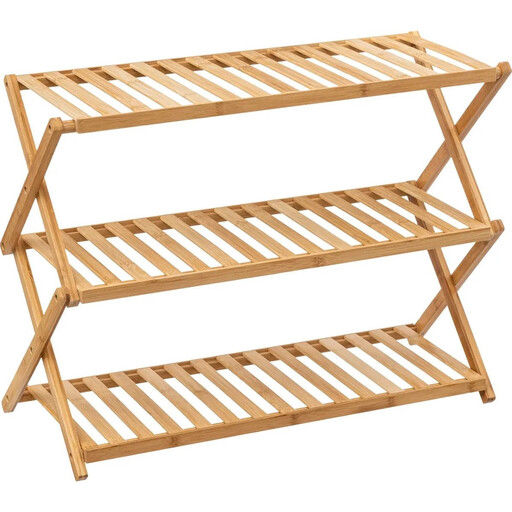
Why it works: Ideal for anyone seeking a natural look in a hallway, bedroom or dressing area, with the flexibility to store the rack away when needed.
The product specifications state that it has three tiers, a foldable design and a total maximum load of 15 kg. This makes it easier to assess whether it suits your intended use.
Bamboo frame and shelves, 70.5 x 28.5 x 52.5 cm, suitable for indoor use and easy to maintain with a damp cloth.

Why it works: A tall storage solution for a family or shared home where a large number of shoes need to be stored vertically.
The product information specifies a capacity of 30 pairs and a height of 138 cm. Check in advance that the height is suitable and place the rack on a level surface.
Freestanding metal model measuring 65.5 x 24.5 x 138 cm. Self-assembly is required; according to the product information, wall anchoring is recommended wherever there is a risk of tipping.
Explore a current selection of shoe racks and storage solutions designed for different spaces, capacities and materials.
That depends on the design. A three-tier model approximately 117 cm wide can accommodate multiple pairs side by side. For a narrow hallway, a slimmer or taller model may make more efficient use of space. Measure the shoes you actually intend to store; the stated capacity is an indicative figure based on the product information.
Yes, provided the depth leaves enough room to walk comfortably. An open metal rack approximately 28 to 30 cm deep takes up relatively little floor space. However, check its stability, especially with taller models. A low freestanding shoe rack may be more practical in a busy passageway.
Use the rack within its stated load capacity, periodically tighten the connections and place it on a level surface. Wipe metal parts with a soft, slightly damp cloth and dry them afterwards. With bamboo and MDF, it is best to avoid prolonged exposure to moisture. Also, never use a shoe rack as a bench, step or load-bearing structure.
