
Vandaag of morgen in huis

Kwaliteit gegarandeerd

Welkomstaanbiedingen ontgrendelen: GRATIS bezorging | Tot 80% korting | Gratis 30 dagen JoyPlus-proefperiode
Download de app
A shoe rack may seem like a simple piece of furniture, but the wrong size or construction can quickly become a source of frustration. A rack that looks spacious in the product photo may be too deep for your hallway in practice. Capacity figures may also be based on slim sneakers, while ankle boots or larger sizes leave considerably less room.
If you are looking for a shoe rack, shoe cabinet, or compact shoe organiser in the Netherlands, it is therefore wise to look beyond the number of pairs it can hold. Below, you will find the key points to check, common purchasing pitfalls, and several product options for different households.
A manufacturer may state that a rack holds 20 or 30 pairs of shoes, for example. That figure depends on the type of footwear and how you arrange it. High-top sneakers, walking shoes, and ankle boots take up more space than flat slip-ons.
Therefore, check:
A shoe rack for 20 pairs of shoes may be sufficient for a family that mainly owns low-profile footwear. For a household with many boots, a roomier model or shoe cabinet is more practical.
A slim shoe rack is convenient in a hallway or beside a wardrobe, but a tall, lightweight construction can be more prone to sliding or tipping. Pay attention to the rack’s weight, the shape of its feet, and the surface on which it will stand.
For tall models, it is advisable to follow the assembly instructions and check whether wall mounting is recommended. Always place a freestanding shoe rack on a level surface. Do not use it as a bench or step unless this is explicitly stated in the product information.
A metal shoe rack may be made from sturdy tubes, thin wire, or a combination of metal and plastic connectors. Therefore, do not look only at the material. Also consider:
The JOYFURNOS model, for example, specifies a maximum static load of 10 kg per tier and 30 kg for the rack as a whole. This is verifiable product information, but it does not guarantee that the rack will remain stable under every circumstance. Even weight distribution and correct assembly remain important.
Measure the available space in width, depth, and height. In a hallway, a difference of just a few centimetres can determine whether the walkway remains clear or becomes an annoying obstruction.
Also take skirting boards, doors, and power sockets into account. A shoe rack for a small space should not only be compact, but also remain easy to access. A 30 cm-deep model may fit perfectly inside a wardrobe, while a tall 67.2-inch model—approximately 171 cm—primarily makes use of vertical space.
Use the stated number of pairs as an indication. Also check the load capacity per shelf. Heavy boots place different demands on a shelf than lightweight children’s shoes.
A shoe rack for 30 pairs of shoes is an appealing option for larger households, but check whether the available compartment height suits your collection. With a model featuring multiple tiers, it is also important that the structure does not wobble when you regularly remove shoes from a lower compartment.
Some models can be assembled without tools, while others require suitable tools and additional care when securing the connections. Read the instructions before purchasing if the rack will be placed in a busy hallway.
Open metal racks are easy to wipe down with a soft, slightly damp cloth. Dry metal surfaces afterwards. For plastic or mesh, avoid using abrasive cleaning products. A shoe rack will remain useful for longer if wet shoes are allowed to dry before being stored.
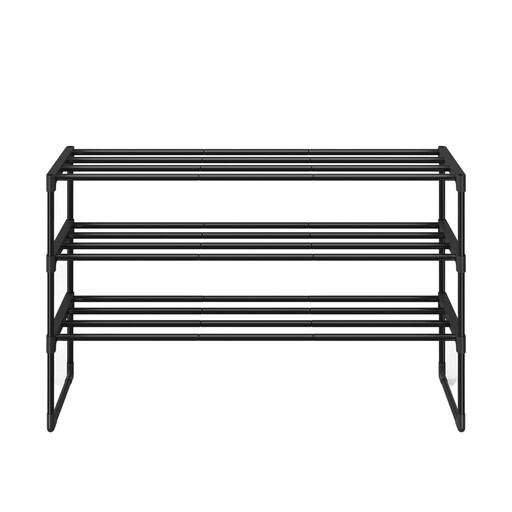
Why it fits: With a width of 92 cm and a depth of 30 cm, this is a practical choice for a hallway, bedroom, or wardrobe with limited floor space.
The product information specifies the dimensions and a maximum static load of 10 kg per tier. This allows you to compare the available space and load capacity in advance.
Metal tubes, plastic connectors, three tiers, and a stated total load capacity of 30 kg. According to the product description, it can be assembled without tools.
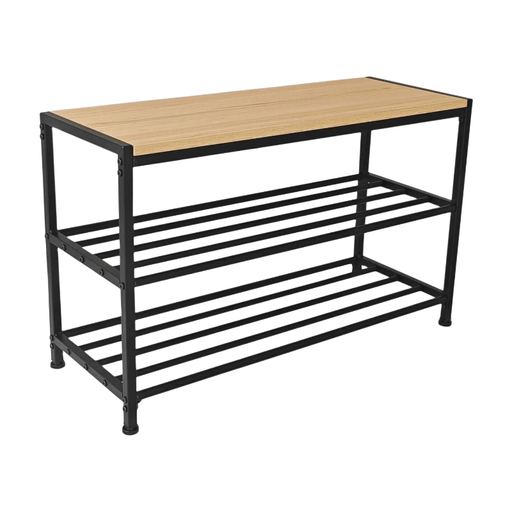
Why it fits: For anyone looking for a lower freestanding shoe rack that can also serve as a shelf for accessories, a bag, or decorative items.
At 49.2 cm high, it is clearly not a tall tower-style organiser. You know in advance that its capacity is six pairs of shoes.
A powder-coated metal frame, an engineered-wood top shelf, and a stated weight of 5.7 kg.

Why it fits: Suitable for larger households that want to store many pairs in one dedicated location, such as a spacious hallway or utility room.
The stated capacity of 30 pairs and dimensions of 65.5 x 24.5 x 138 cm make the choice clear. Wall mounting is recommended where there is a risk of tipping.
A tall, freestanding metal structure with room for a large number of shoes. According to the supplied product information, the product is covered by a minimum two-year statutory warranty.

Why it fits: An option for anyone who wants to keep the floor clear and make use of unused door or wardrobe space.
The product description specifies a metal frame, mesh pockets, and a height of approximately 170.7 cm. Before purchasing, check that your door, wardrobe, and door handle provide sufficient clearance.
Foldable design, tool-free assembly according to the product information, and 24 pockets for compact vertical storage.
Browse a current selection of shoe racks and shoe organisers, and compare capacity, dimensions, and materials for your space.
That depends on the model and the type of footwear. The compact Practo rack is specified for six pairs, while the 5five model is designed for 30 pairs of shoes. With wide shoes and boots, expect a lower practical capacity than the figure stated on the packaging.
Metal can be suitable for normal indoor use, but prolonged exposure to moisture may cause staining or corrosion, depending on the finish. Do not leave wet shoes on the rack for extended periods, and dry metal parts after cleaning. Always check the care instructions for the specific product.
A shoe rack for small spaces is usually shallow, stackable, or designed for vertical storage. A slim JOYFURNOS model, for example, fits in a space that is 30 cm deep. For a wardrobe, a plastic shoe stacker or hanging shoe organiser may be more convenient than a freestanding model. Measure the available space carefully first, and remember to allow for doors, skirting boards, and walking clearance.
