
Vandaag of morgen in huis

Kwaliteit gegarandeerd

Welkomstaanbiedingen ontgrendelen: GRATIS bezorging | Tot 80% korting | Gratis 30 dagen JoyPlus-proefperiode
Download de app
A shoe rack may seem like a simple purchase, until you get home with a model that wobbles, offers too little space or does not fit in the hallway. Every centimetre counts, especially in flats and busy households. The right shoe organiser should therefore not only look good, but also suit the number of shoes you own, the available space and how you use it every day.
A description such as “for 20 pairs of shoes” does not always explain how that capacity has been calculated. High-top trainers, children’s shoes and boots take up more space than low-cut women’s shoes. So check:
A shoe rack for 30 pairs of shoes can be practical for a large family, but it will often also take up more wall or floor space.
A shoe rack for the hallway should not block the walking space. Measure not only the area where the unit will stand, but also the space around doors, cupboards and radiators. Pay attention to the order of the measurements: width, depth and height may be displayed differently for different products.
For a narrow hallway, a model approximately 24 to 30 cm deep may be suitable. A tall shoe organiser makes use of vertical space, while a lower shoe rack with a bench offers extra convenience when putting on your shoes.
A metal shoe rack may be lightweight and easy to move, but the joints and plastic connectors also have a bearing on its stability. For a chipboard shoe cabinet, the back panel, hinges and wall-fixing system are important.
Check before buying:
The product description should be your guide here. Avoid making assumptions based on the photograph alone.
Count the shoes that will actually be kept in the hallway or wardrobe. For one person, a shoe rack for 6 pairs may be enough. Families will often benefit more from a shoe rack for 30 pairs of shoes, a tall organiser or a combination of two models.
Leave some space between pairs. This makes it easier to put shoes away and prevents larger styles from partly resting on an adjacent shelf.
A shoe rack for the bedroom or living room can be more prominent, while a shoe rack for the hallway should generally be compact and easy to access. An open rack keeps shoes visible and within easy reach. A shoe cabinet with doors creates a tidier look and offers extra protection from dust.
Consider the layout too:
A metal shoe rack can usually be wiped clean with a soft, slightly damp cloth. Allow metal surfaces to dry afterwards. With chipboard, it is best to avoid prolonged contact with moisture. An open shoe organiser allows air to circulate around your shoes thanks to its open construction, but provides less protection from dust than an enclosed shoe cabinet.
Also check whether a seating area is designed to be sat on and what load capacity is specified for it. Never use a shoe rack as a step stool unless the manufacturer expressly states that it is suitable for this purpose.
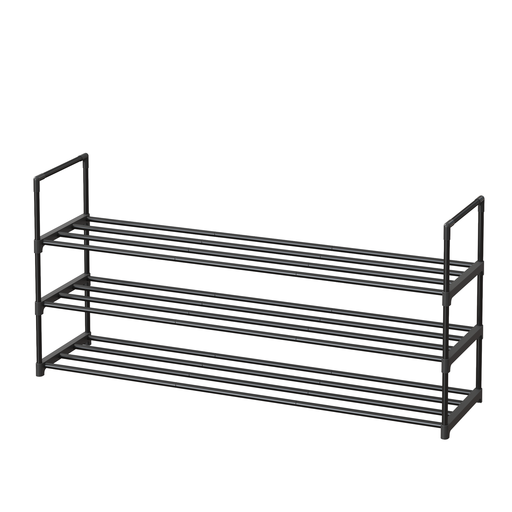
Why it suits this profile: This metal shoe rack has three tiers and is designed for use in the hallway, wardrobe or living room. According to the product information, it can be assembled without tools.
The dimensions of 30 x 117 x 55 cm and the stated load capacity of 10 kg per tier make it easier to compare with other models than relying on the photograph alone.
Metal tubes, plastic connectors, three tiers and a stackable design, according to the product description.
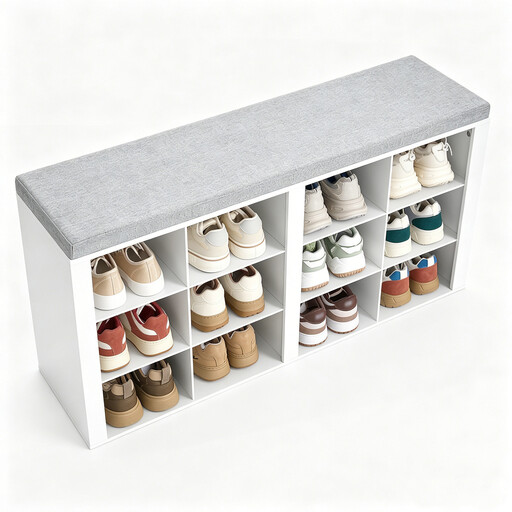
Why it suits this profile: A combination of shoe cabinet and shoe rack with a bench, for households that want to combine storage space with seating in the hallway.
According to the product information, the shelves are height-adjustable. This allows you to adapt the layout for trainers, heels or taller shoes.
Dimensions of 30.5 x 104.5 x 49.5 cm, 12 compartments, removable seat cushion covers and a stated load capacity of 150 kg.

Why it suits this profile: The tall freestanding design is aimed at households with lots of shoes that want to keep their floor space to a minimum.
The product information explicitly states a capacity of 30 pairs and a depth of 24.5 cm. However, check beforehand that you have enough available height for its 138 cm height.
Metal construction, space for 30 pairs of shoes and a narrow footprint. Assembly is required; wall mounting is recommended where there is a risk of tipping.
We have put together a complete, up-to-date list of products that fully meet these strict selection criteria and the applicable European safety regulations.
This depends on the number of shoes and the wall space available. First measure the clear width and depth. For a small hallway, a narrow shoe rack approximately 24 to 30 cm deep may be suitable. Also check that the shelves are wide enough for your shoe sizes.
An open shoe rack offers quick access and is usually easy to assemble. A shoe cabinet keeps shoes more out of sight and can create a tidier look in a living room or hallway. Choose adjustable shelves if you want to store different types of shoes.
Its lifespan depends on the material, assembly, load and maintenance. Follow the maximum load capacity, place the rack securely and check the fixings regularly. For metal models, removing moisture quickly can help; with chipboard, prolonged exposure to moisture should be avoided.
