
Vandaag of morgen in huis

Kwaliteit gegarandeerd

Welkomstaanbiedingen ontgrendelen: GRATIS bezorging | Tot 80% korting | Gratis 30 dagen JoyPlus-proefperiode
Download de app
Loose shoes in the hallway, pairs disappearing under the bed and a shoe rack that turns out to be too wide after all: these are familiar problems in Dutch households. Buying a shoe rack may seem straightforward, but the wrong size, unclear load capacity or impractical layout can make your purchase less useful.
Pay particular attention to these three pitfalls:
Before buying, measure the available width, depth and height. For a shoe rack in the hallway, take skirting boards, doors and walking space into account. In a wardrobe or under a bed, depth is usually the deciding factor.
Then consider the type of shoes you own:
A narrow shoe rack can work well in a flat, but a model with lots of tiers will become relatively tall. So also check that you have enough space above the rack to place and retrieve shoes safely.
A metal shoe rack is generally suitable for open storage and allows air to circulate between your shoes. Pay attention to the construction: some models combine metal tubes with plastic connectors. If so, check whether the maximum load per tier is clearly stated.
Closed shoe cabinets are often made from board materials such as chipboard. This gives them a different appearance and protects shoes from dust more effectively, but requires greater care around moisture. Do not place a cabinet directly against a damp wall, and dry shoes before storing them.
A specific example is the JOYFURNOS three-tier rack: its product specifications state 10 kg of static load per tier and 30 kg in total. This is verifiable information, but distribute the weight evenly and do not use the rack as a seat or step.
For a small household, a shoe rack for 6 pairs may be sufficient. If you are catering for several family members, you may need a shoe rack for 18 or 30 pairs instead. Bear in mind that capacity claims can depend on the type of footwear and how closely you place the pairs next to one another.
A shoe organiser for a wardrobe or bedroom does not need the same capacity as a hallway unit. Also consider how you plan to use it:
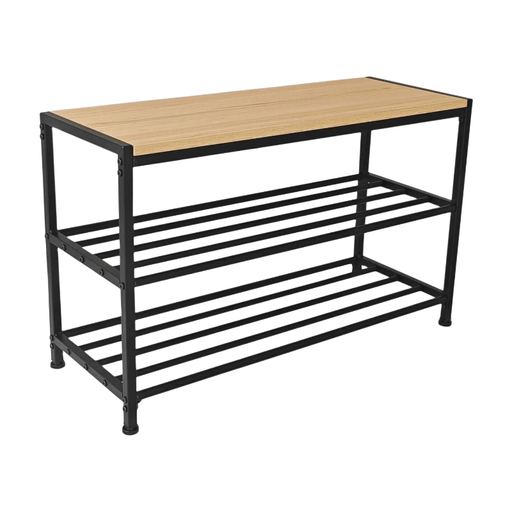
Why it suits this profile: This compact model holds 6 pairs and, measuring 80 x 30 x 49,2 cm, fits in a hallway, bedroom or corridor with limited space.
The capacity and external dimensions are clearly stated. This means you can assess in advance whether 6 pairs will be enough and whether the width will fit your space.
Black powder-coated metal frame, wooden top shelf and open construction for ventilation.

Why it suits this profile: A closed shoe cabinet is ideal if you want to keep shoes out of sight and value a furniture-style appearance in the hallway.
The cabinet has 6 shelves and a stated capacity of 18 pairs. Do check that you have enough height for this 119,5 cm model.
Flap doors, a drawer, FSC certification and a relatively shallow depth of 23,3 cm.

Why it suits this profile: This tall rack is designed for households with lots of shoes and, according to the product specifications, offers space for 30 pairs within a footprint of 65,5 x 24,5 cm.
The capacity, height of 138 cm and self-assembly requirements are stated clearly. Place it on a level surface and consider wall mounting if there is a risk of it toppling over.
Metal construction, a modern white finish and generous vertical storage for a narrow floor footprint.
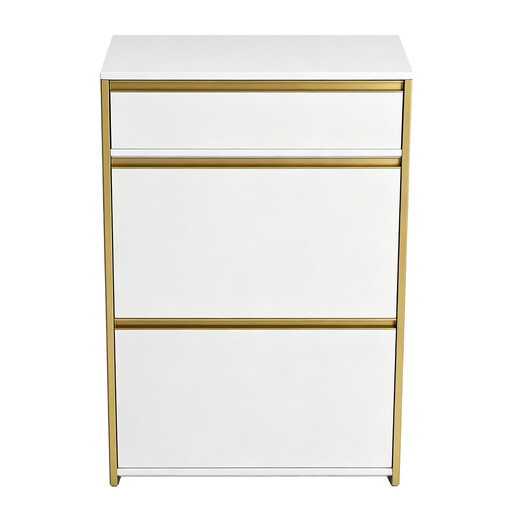
Why it suits this profile: Measuring 60 cm wide and 24 cm deep, this shoe cabinet is suitable for a hallway where you want to keep shoes and small items out of sight.
The adjustable, removable shelves allow you to customise the layout. The stated capacity is up to 12 pairs; check the compartment height for your shoes.
Two flap doors, a drawer, adjustable shelves and an anti-tip feature for securing the cabinet to the wall.
We have compiled a complete, up-to-date list of products that fully meet these strict selection criteria and the applicable European safety regulations.
Not every space needs a freestanding rack. For a wardrobe, a shoe organiser or plastic shoe stacker may be more practical. The 5five Plastic Shoe Rack Spacy measures 29,5 x 11,1 x 14 cm and, according to the product specifications, is suitable for up to 3 pairs. Only place this type of unit on a stable, level surface, and do not stack it higher than the manufacturer recommends.
If you prefer to keep your shoes visible, transparent boxes are practical. A set of 12 or 18 stackable shoe boxes allows you to organise pairs in separate compartments. Always measure the length of your shoes and compare it with the box’s internal dimensions. Ventilation holes may be present, but do not store damp shoes straight away.
Measure the space, including skirting boards and the doorway. Also leave a few extra centimetres so that you can retrieve your shoes easily. A level surface is important for a tall model; securing it to the wall may be advisable if there is a risk of it toppling over.
That depends on its construction and stated load capacity. Check the maximum weight per tier and distribute shoes evenly. Use a rack only for its intended purpose: not as a seat, ladder or step.
Its lifespan depends on the material, assembly, moisture and load. Tighten the connections of a self-assembly rack from time to time, check components for damage and clean metal surfaces with a soft, slightly damp cloth. A product with a statutory guarantee of at least two years under EU consumer law provides a formal basis for your purchase rights.
