
Vandaag of morgen in huis

Kwaliteit gegarandeerd

Welkomstaanbiedingen ontgrendelen: GRATIS bezorging | Tot 80% korting | Gratis 30 dagen JoyPlus-proefperiode
Download de app
A shoe rack may seem like a simple purchase, until it wobbles, does not fit in the hallway or holds fewer shoes than expected. Photos can be particularly misleading when ordering online. For example, a narrow shoe rack may be taller than anticipated, while a model with multiple tiers may offer little room for tall boots.
So watch out for these three common pitfalls:
Capacity is not explained in practical terms
“For 30 pairs” does not always tell you how large the shoes can be or what type of footwear will fit on the rack. Trainers take up less room than ankle boots. So check both the number of tiers and the overall width, depth and height.
Lightweight materials are mistaken for a stable construction
A metal shoe rack can be sturdy, but stability also depends on the connections, the floor surface and the height. For a tall, freestanding shoe rack, it is sensible to check whether wall mounting is recommended.
Assembly and finish are underestimated
Some models can be assembled quickly without tools, while others require more care and suitable equipment. Check in advance whether assembly materials are included and whether the rack needs to stand on a level surface.
For a hallway shoe rack, depth and width are particularly important. Take doors, skirting boards and the route through the space into account. A narrow shoe rack is useful in a flat or narrow hallway, but check that the shoes do not stick out.
For a wardrobe or small space, a low shoe organiser may be more practical. A stackable shoe rack makes use of vertical space, while a hanging model does not take up any floor space. With an over-door model, check that the door can still close properly and that the weight is suitable for the fixings.
A shoe rack for 30 pairs is useful for a large household or an extensive shoe collection. However, the layout needs to suit how you intend to use it. Open racks are easy to access and provide ventilation, but the shoes remain visible.
A compact model for six pairs is enough for everyday footwear in the hallway. For more pairs, you can choose several smaller racks or a taller model with multiple tiers. Also consider the gap between the shelves if you want to store high-top trainers or ankle boots.
A metal shoe rack generally has an open construction and is easy to wipe clean with a soft, slightly damp cloth. With models featuring plastic connectors, it is important to ensure that the tubes and joints are securely fitted.
A stated load capacity is a technical indication, not a guarantee that every configuration will feel equally stable. Distribute shoes evenly across the tiers and do not exceed the maximum weight. Do not use a shoe rack as a seat or step, unless the manufacturer explicitly states that it is suitable for this.
With a tall rack, a level surface is important. If there is a risk of it tipping over, follow the instructions for wall mounting. A product with a statutory guarantee of at least two years gives you rights in the event that it does not conform to the contract, but it is not a quality mark for the construction.
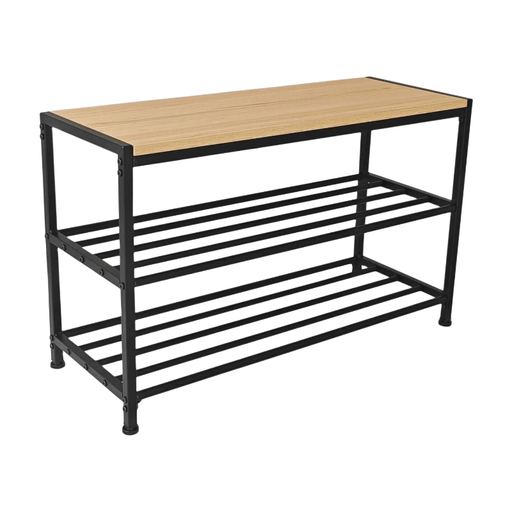
Why it suits this profile: This compact model holds six pairs, making it suitable for a small hallway, bedroom or first home. The wooden top shelf can be used for accessories or a bag.
The capacity is clearly stated and the dimensions are suitable for anyone who wants to start small. The open construction makes the available space immediately visible.
Room for 6 pairs; black powder-coated metal frame; wooden top shelf; dimensions of approximately 80 x 30 x 49,2 cm.

Why it suits this profile: If you want to store a large number of shoes neatly, this tall, freestanding shoe rack offers space for up to 30 pairs according to the product description. The white, modern design suits a range of interiors.
The stated capacity and dimensions make it easier to decide in advance whether the rack is suitable. Wall mounting is recommended where there is a risk of tipping.
Capacity for 30 pairs; metal construction; dimensions of 65,5 x 24,5 x 138 cm; self-assembly.
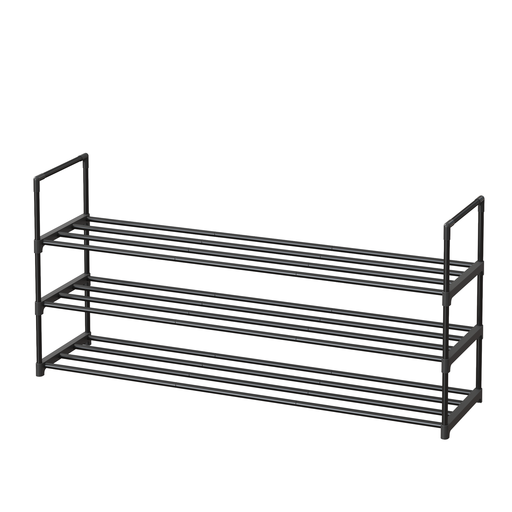
Why it suits this profile: This metal shoe rack is designed for hallways, wardrobes or living rooms and holds up to 18 pairs according to the product information. The sections can be used upright, upside down or stacked.
The product information states both the capacity and the maximum static load: 10 kg per tier and 30 kg in total. This allows you to distribute the load more effectively.
Room for up to 18 pairs; metal tubes with plastic connectors; approximately 117 x 30 x 55 cm; tool-free assembly according to the product description.
We have compiled a complete, up-to-date list of products that fully meet these strict selection criteria and the applicable European safety regulations.
Measure the available width, depth and height, leaving a few centimetres of clearance. Also check skirting boards, doors and power sockets. With a tall rack, a level floor is particularly important.
Not necessarily. Stability depends on the construction, connections, height, floor surface and weight distribution. Metal can form part of a sturdy construction, but always follow the stated load capacity and assembly instructions.
The lifespan varies depending on the material, use and load. Tighten the connections periodically, avoid overloading and keep metal surfaces dry. Regularly check plastic parts and shelves for cracks or deformation. Before buying, also consider the statutory guarantee of at least two years stated for the products mentioned.
