
Vandaag of morgen in huis

Kwaliteit gegarandeerd

Welkomstaanbiedingen ontgrendelen: GRATIS bezorging | Tot 80% korting | Gratis 30 dagen JoyPlus-proefperiode
Download de app
Loose shoes in the hallway can quickly create clutter. However, buying a shoe rack is not simply about choosing the one with the most compartments. A model may look spacious on paper, but be too deep in practice, wobble or provide insufficient room for high-top shoes.
Joybuy Product Recommendation Officer helps you assess the key differences. This allows you to compare a narrow shoe rack, metal rack, shoe cabinet or shoe organiser based on verifiable features rather than marketing claims.
A statement such as “for 18 pairs of shoes” is only a guideline. Chunky trainers, ankle boots and children’s shoes do not all require the same amount of space. So check whether the capacity is based on an open rack, shoe boxes or compact trainers.
Also consider the layout. A shoe rack for 18 pairs may be suitable for a family, while a narrow three-tier model is particularly useful for shoes worn every day.
For a hallway shoe rack, width and depth are particularly important. Measure the available space, including skirting boards, doors and walking clearance. A rack that is 30 cm deep may already stick out too far in a narrow hallway.
Also check the height. A stackable shoe rack or tall model makes good use of vertical space, but it must stand securely. Place a tall rack on a level surface and follow the assembly instructions. If there is a risk of tipping, wall fixing is a sensible safety measure when recommended for the product.
A metal shoe rack often consists of tubes, connectors and plastic joints. Its load-bearing capacity depends on all the components together. So check the stated weight per tier and the total capacity.
A chipboard shoe cabinet offers a different type of use from an open metal rack. A cabinet keeps shoes out of sight, but takes longer to assemble and may be heavier. Open racks generally provide better ventilation because the shoes are not completely enclosed, but this feature is no guarantee against odours or damp.
Start by making a simple inventory:
For a small collection, a compact shoe rack for six pairs may be enough. Families may be better off looking at models for 16 to 30 pairs, a shoe cabinet with several compartments or a set of transparent shoe boxes.
Compare the product dimensions with your measurements. A shoe rack for a small space is not automatically the narrowest model: a taller rack may take up less floor space, while a low model can fit beneath a clothes rail or bed.
For a wardrobe, individual shoe stackers or transparent shoe boxes are practical. When choosing boxes, always check the internal dimensions, not just the external measurements. According to the product information for the relevant storage boxes, you should compare the length of your shoes with the internal space before buying.
A metal shoe rack is often lightweight and easy to move. Check:
For plastic shoe organisers, the clip connections and ventilation openings are relevant considerations. A closed shoe cabinet creates a tidier visual effect, but it must fit the available space and provide the level of accessibility you want.
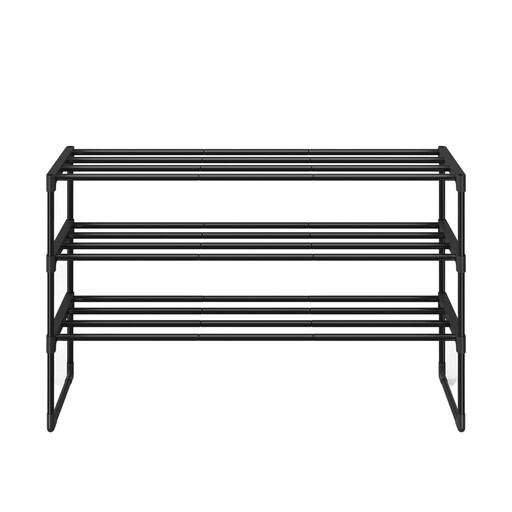
Why it suits this profile: This narrow metal shoe rack is suitable for anyone looking for a simple solution for the hallway, wardrobe or living room. It measures 30 x 92 x 55 cm and has a stated capacity of 16–20 pairs.
The product information states a maximum static load of 10 kg per tier and 30 kg in total. This allows you to compare the stated load capacity directly with your collection.
Metal tubes, plastic connectors, tool-free assembly according to the product description, and a design that can be placed upright, upside down or stacked.

Why it suits this profile: This closed shoe cabinet is designed for households that want to keep their shoes out of sight. The unit measures 60 x 23,3 x 119,5 cm and has six shelves with a stated capacity of 18 pairs.
The cabinet has a specific depth of 23,3 cm and a fixed number of shelves. This allows you to check in advance whether the layout suits your shoes and available wall space.
Chipboard shelves, doors and structure, six shelves, flaps and a drawer. Self-assembly is required; according to the product information, the stated statutory warranty is at least two years.
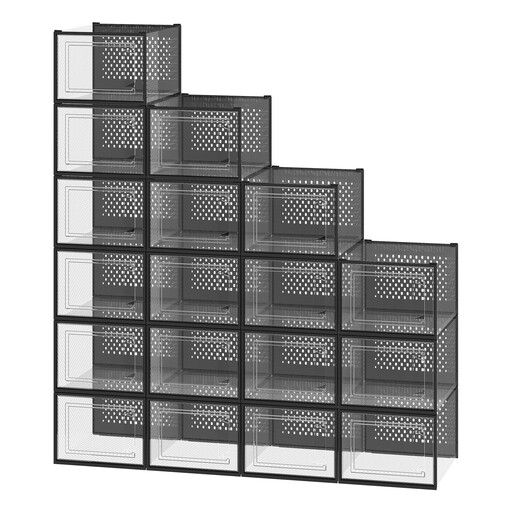
Why it suits this profile: This set is ideal for sneaker collectors who want to store pairs visibly and individually. Each box measures 25,2 x 35 x 19 cm and the set contains 18 boxes.
The transparent front makes the contents visible, but you should measure the shoe length beforehand. The product information also lists ventilation openings and stackability as design features.
PP plastic housing, PS door frame and 18 individual transparent boxes. Ideal for a wardrobe or wall arrangement where you want to identify a pair quickly.
We have put together a complete, up-to-date list of products that fully meet these strict selection criteria and the applicable European safety regulations.
Choose a shoe rack for a wardrobe if you want to keep your shoes compact and easy to access. A stackable model is useful if you may want to expand the arrangement later. For a busy household, a shoe cabinet with doors is more suitable if you want to keep the hallway looking tidy.
For an open rack, pay attention to the distance between the tiers. Low-top shoes will usually fit easily, but boots may need a separate compartment or a higher shelf. Only use a plastic shoe organiser under the bed in a dry, level place, and do not exceed the stated load capacity.
An over-the-door model can save floor space. However, check that the door still closes properly and that the weight is suitable for the hinges. Transparent shoe boxes keep individual pairs organised, but measure wide or high-top shoes before buying.
That varies by design. An open rack may be around 90 to 120 cm wide, while a shoe cabinet may be narrower but taller. As well as the width, measure the depth and keep sufficient walking space clear in the hallway.
That depends on the stated load capacity per tier. Compare the weight of your shoes with the product specifications and distribute heavy pairs evenly. Do not use the rack as a seat or step, unless the manufacturer expressly states that it is suitable for this.
Its lifespan depends on the material, moisture, assembly and load. Place a metal or wooden model indoors on a stable surface, clean it with a soft cloth and check the connections regularly. With plastic boxes, it is important to replace damaged panels or clip connections promptly.
