
Vandaag of morgen in huis

Kwaliteit gegarandeerd

Welkomstaanbiedingen ontgrendelen: GRATIS bezorging | Tot 80% korting | Gratis 30 dagen JoyPlus-proefperiode
Download de app
Shoes left lying around can quickly take over your hallway. But choosing a shoe rack is about more than just colour or the number of shelves. A model that looks as though it can hold plenty of shoes on paper might be too deep, unstable or unsuitable for boots in practice.
The most common pitfalls:
Measure not only the width, but also the depth and height. In a narrow hallway, a rack just a few centimetres too deep can get in the way when you open a door. For a shoe rack in a wardrobe or under a bed, compact plastic models are often more practical than a freestanding rack with several tiers.
Also check the clearance above the rack. A tall model, such as a 138 cm rack, makes good use of vertical space, but won’t fit under every coat stand or shelf.
The stated capacity is a guide. Trainers and low-cut shoes usually fit side by side more efficiently than ankle boots or high heels. So if you’re looking for a shoe rack for 30 pairs of shoes, don’t just look at the number of tiers: check the shelf width and clearance between shelves too.
A compact three-tier model, for example, may suit a smaller collection. According to the product description, the JOYFURNOS 3-Tier Shoe Rack holds up to 18 pairs of shoes. Its stated maximum static load is 10 kg per tier and 30 kg in total. So don’t automatically put heavy boxes on top of the rack.
A metal shoe rack can be a practical choice if you want to store several pairs. Check how the joints are made, though. Metal tubes with plastic connectors are lightweight and often easy to assemble without tools, but the rack needs to stand on a level surface.
A bamboo shoe rack works well in a natural-looking interior. The 5five Bamboo Shoe Rack Sicela has three tiers, folds away and has a stated maximum total load of 15 kg, according to the product information. Make sure the folding mechanisms are fully locked, and don’t use the rack as a bench.
A plastic shoe rack or shoe stacker is especially handy in a wardrobe, under the bed or against a wall. The 5five Plastic Shoe Rack Spacy fits shoes up to size 46 and has a maximum capacity of three pairs of shoes. That makes it an extra shoe storage option, rather than a solution for a large shoe collection.
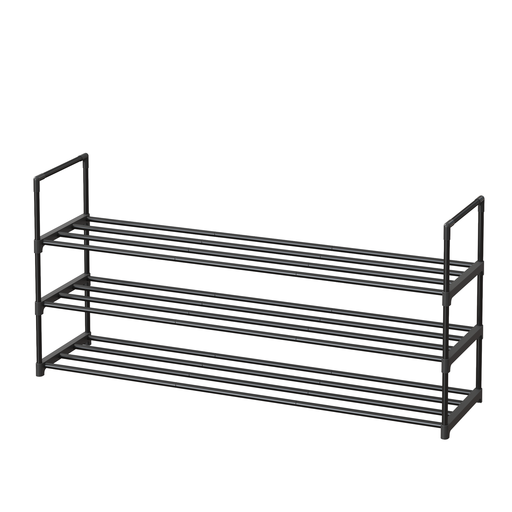
Why it suits this profile: This model is ideal if you’re looking for a simple rack for the hallway, wardrobe or living room. It can be used upright, upside down or stacked.
Its dimensions of 30 x 117 x 55 cm and stated load capacity of 10 kg per tier give you a clearer idea of the space required and the weight it can hold than a general capacity claim alone.
Metal tubes, plastic connectors, tool-free assembly and a stated total load capacity of 30 kg.
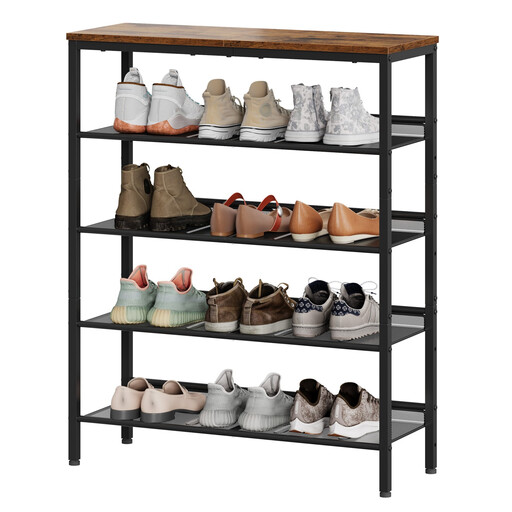
Why it suits this profile: This rack has five tiers, adjustable shelves and a spacious top surface. It’s a practical choice when you need to store shoes and accessories together by the entrance.
The stated load capacity is broken down by part: 27 kg for the top surface and 11 kg per metal shelf. The included anti-tip kit helps you secure the rack safely against the wall.
Dimensions of 28 x 75 x 93 cm, adjustable shelves, a steel frame and a top surface for bags or accessories.

Why it suits this profile: This tall freestanding rack is designed for households with lots of shoes. Measuring 65.5 x 24.5 x 138 cm, it makes good use of vertical space.
The product information gives the capacity of 30 pairs and the exact dimensions. As the rack is tall and lightweight, the manufacturer recommends considering extra wall fixings if there’s a risk of it tipping over.
Space for up to 30 pairs, according to the product description, a depth of 24.5 cm and a white metal design.
Always place a shoe rack on a level, stable surface. Tighten the joints securely after assembly and check them again after a while. If you have a tall model or young children at home, an anti-tip solution is a sensible precaution when recommended in the product information.
Don’t use a shoe rack as a seat unless it’s specifically designed for that purpose. Don’t leave wet shoes on a wooden or bamboo rack for long periods. Let them dry first, and wipe metal surfaces with a soft, damp cloth. Abrasive cleaning products can damage the finish.
Under EU consumer law, products covered by this product information come with a minimum two-year legal guarantee. This is separate from normal wear and tear, misuse or damage caused by incorrect assembly.
We’ve put together a complete, up-to-date list of products that meet these strict selection criteria and the applicable European safety regulations.
That depends on the type of shoes and how you want to arrange them. A tall model can save floor space, while a wide rack makes it easier to reach each pair. Measure the available width, depth and height, and allow extra room for boots or wide shoes.
A narrow shoe rack can be stable if it’s assembled correctly and placed on a level surface. Taller models are more at risk of tipping over. Spread heavy shoes across the tiers and use an anti-tip kit or wall fixings if the manufacturer recommends them.
Metal is suitable for a rack with several tiers and a larger collection. Bamboo complements a natural-looking interior and can be handy if you’d like a folding model. Plastic is especially practical as a compact shoe organiser in a wardrobe, under a bed or in another small space. Always check the stated load capacity and maximum capacity.
