
Vandaag of morgen in huis

Kwaliteit gegarandeerd

Welkomstaanbiedingen ontgrendelen: GRATIS bezorging | Tot 80% korting | Gratis 30 dagen JoyPlus-proefperiode
Download de app
A shoe rack seems like a simple purchase, until you find that shoes stick out, shelves sag or there’s barely any room left to walk in the hallway. A model that looks spacious in the product photo may not offer enough room in practice for boots, wide trainers or children’s shoes.
So don’t focus on looks alone. The dimensions, load capacity, layout and assembly all affect how well your shoe storage works over time. Read on to find out which common pitfalls are easy to overlook and which models suit different households.
A claim such as “holds 30 pairs of shoes” sounds clear, but it doesn’t always explain how that capacity has been calculated. A pair of low-cut shoes takes up less height than ankle boots. Wide trainers may also need more room side by side.
So check:
A shoe rack for 30 pairs of shoes is handy for a large household, but only if you have enough floor and wall space.
A shoe cabinet may look narrow on paper, but doors or tilt-out compartments need extra room to open. Measure the available space at several points, especially around skirting boards, door frames and radiators.
For a narrow hallway, an open metal shoe rack is often more practical than a deep shoe cabinet. For a wardrobe or the space under a bed, a compact shoe storage system may be a better fit.
A shoe rack with a bench is handy when you want to sit down to put on your shoes. Even so, check the stated maximum load and make sure the bench is stable. An open rack without a seat isn’t designed for sitting on.
Also consider the upholstery. A removable cushion is easier to clean than a fixed seat, especially in a hallway where dirt and moisture are more likely to get in.
Before you buy, note the maximum width, depth and height. Leave enough room to move around the unit. In a small hallway, a narrow shoe cabinet with tilt-out doors can save a lot of floor space, while an open rack makes shoes quicker to reach.
Low models are practical in a bedroom or wardrobe. A stackable shoe organiser or plastic shoe rack makes use of vertical space without adding a large piece of furniture.
A metal shoe rack is usually lightweight and easy to move. Check that the joints are securely fastened and that the rack is standing on a level surface. For tall, narrow models, wall fixing may be advisable if there’s a risk of them tipping over.
Chipboard is often used for shoe cabinets and benches. Check the edging and avoid prolonged contact with moisture. For everyday use, a surface that can be wiped with a slightly damp cloth is practical.
A shoe rack with adjustable shelves gives you more flexibility for trainers, heels and boots. Check how many height settings are available and whether the shelves can be removed. A fixed layout may work well for one type of shoe, but be less suitable for a mixed collection.
For self-assembly, clear instructions, numbered parts and the fixings included are useful. After assembly, check regularly that the joints are still secure.
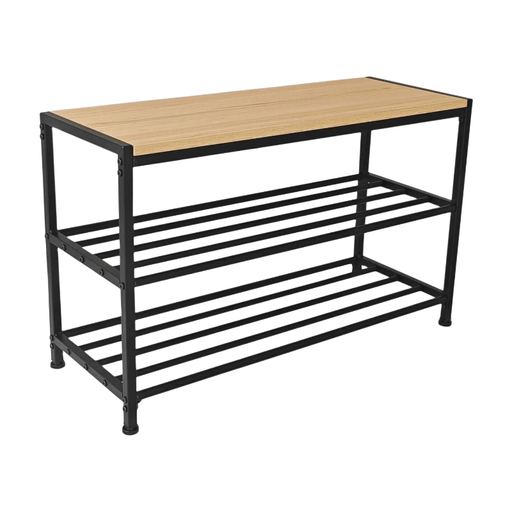
Why it suits this need: This compact model is ideal for a small hallway, bedroom or corridor where you want to keep a few everyday pairs neatly stored. The wooden top shelf gives you extra space for accessories or a bag.
Its capacity is clearly stated as 6 pairs, and its dimensions are 80 x 30 x 49,2 cm. That means you won’t end up buying a large unit for a small collection.
Powder-coated metal frame, wooden top shelf and open design. Assembly required; clean with a dry or slightly damp cloth.
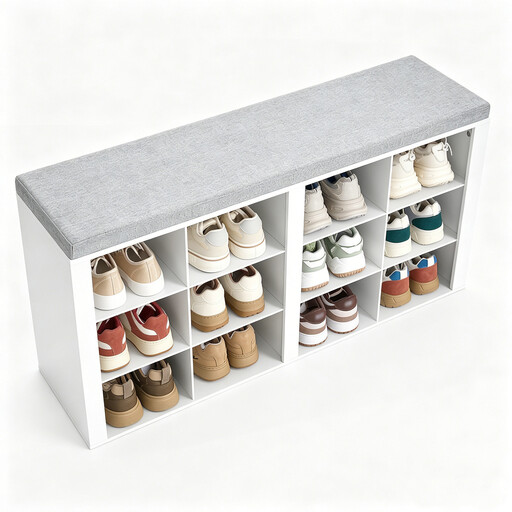
Why it suits this need: This combination of shoe cabinet and bench is a good fit for households looking to combine hallway storage with a place to sit. It measures 30,5 x 104,5 x 49,5 cm.
The shelves are height-adjustable to suit different types of shoes. The seat cushion is removable, so you can clean it separately.
12 compartments, adjustable shelves and a maximum load of 150 kg, as stated in the product description. Materials: chipboard, sponge, cotton and linen.

Why it suits this need: This tall freestanding rack is designed for a large shoe collection. Measuring 65,5 x 24,5 x 138 cm, it makes good use of vertical space while keeping its depth to a minimum.
The product information explicitly states that it holds 30 pairs and that the rack isn’t suitable for sitting on. This helps prevent misuse.
Metal construction, tall layout and capacity for up to 30 pairs according to the product description. Self-assembly required; place the rack on a level, stable surface.
For a shoe rack for the hallway, easy access and room to move are important. An open model works well for shoes you wear every day. To keep loose items out of sight, choose a shoe cabinet with tilt-out doors or a drawer.
In the bedroom or wardrobe, you can make use of the space beneath a hanging rail. According to the product information, the 5five Plastic Shoe Rack Spacy is suitable for shoes up to size 46 and has a maximum capacity of 3 pairs per unit. Only place this type of rack on a stable, level surface and follow the safety instructions.
Families with lots of shoes could also consider a tall cabinet or several lightweight racks. If so, check whether your chosen storage solution needs to be fixed to the wall. A narrow shoe cabinet with adjustable shelves can also be used for shoes and small accessories.
We’ve put together a complete, up-to-date list of products that meet these strict selection criteria and the applicable European safety requirements.
Measure the spot where you plan to put the rack, and allow for doors, drawers and walkways. With an open rack, depth is the main consideration. If you’re choosing a shoe cabinet with tilt-out doors, leave space in front of the unit so they can open.
Metal is easy to wipe clean, but not every finish is equally resistant to prolonged moisture. Don’t leave wet shoes on the rack for long, and dry metal parts after cleaning. Also check the joints and look for any damage to the finish regularly.
Its lifespan depends on the load, assembly, moisture and how often it’s used. Don’t exceed the stated load capacity, only use a bench for its intended purpose, and check the screws and connectors from time to time. This will reduce the risk of wobbling or damage.
