
Vandaag of morgen in huis

Kwaliteit gegarandeerd

Welkomstaanbiedingen ontgrendelen: GRATIS bezorging | Tot 80% korting | Gratis 30 dagen JoyPlus-proefperiode
Download de app
A tidy entrance often starts with a practical shoe organiser. However, a shoe rack does not always work well in practice. A model may appear to hold plenty of pairs on paper, but still be unsuitable for your hallway because it is too deep, has awkward compartments or lacks stability.
Pay particular attention to these three common pitfalls:
A shoe cabinet with flap doors often looks neat and tidy, while an open metal shoe rack keeps shoes easily accessible and provides ventilation. The right choice therefore depends on your home, household and everyday needs.
For a hallway shoe rack, depth is particularly important. A difference of just a few centimetres can be noticeable in a narrow entrance. Therefore, check:
A narrow shoe rack is not automatically practical. A model measuring 24 cm deep may fit well, but check that shoes do not protrude. With a shoe cabinet featuring flap doors, the flap must also be able to open fully without hitting a door or blocking a passageway.
A shoe rack for 6 to 20 pairs of shoes may be suitable for different households, but the stated capacity is only a guideline. Take the type of footwear into account:
A shoe rack for 6 pairs is practical for a one-person household or as an additional organiser in a bedroom. For a family, a shoe rack with storage space or a taller shoe cabinet may offer a tidier solution.
A metal shoe rack often consists of tubes and connectors. This makes it relatively lightweight and suitable for flexible use. However, check the maximum load per shelf and for the furniture unit as a whole.
An MDF or chipboard shoe cabinet generally offers a closed appearance and a top surface for accessories. Pay attention to the finish and care instructions. Water, mud and prolonged exposure to moisture can damage wood-based panels, even when the surface is described as water- or scratch-resistant.
For tall or narrow furniture, anti-tip protection is important. Use the supplied wall fixing in accordance with the instructions. Preferably place heavier shoes at the bottom, and do not let children climb on open shelves.
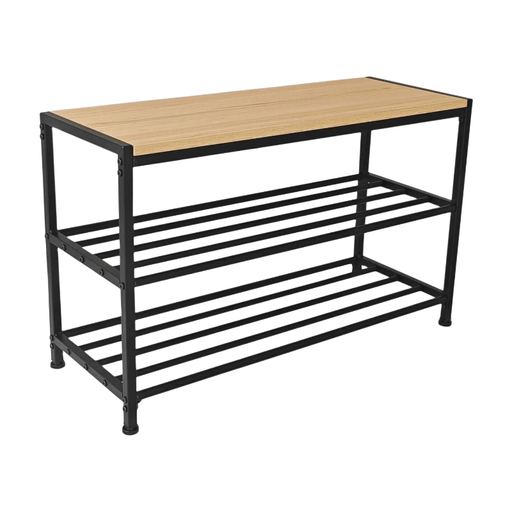
Why it suits this profile: Measuring approximately 80 × 30 × 49.2 cm, its compact dimensions suit a small entrance, bedroom or hallway. The stated capacity is 6 pairs of shoes.
The open design makes the capacity clear, so you do not have to guess whether your shoes will fit in closed compartments.
Metal frame, wooden top, open ventilation and dimensions suitable for smaller spaces.
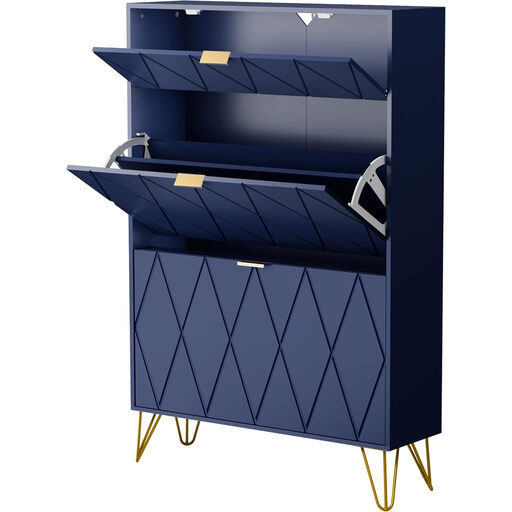
Why it suits this profile: This tall, narrow shoe cabinet is 24 cm deep and has two flap compartments for up to 16 pairs, plus a drawer and top storage space.
The stated dimensions and layout give you a clear idea of the available storage space. Use the anti-tip feature to secure the tall unit to the wall.
MDF panels, metal legs, two flaps, a drawer and a top surface; maximum load according to the product information: 10 kg.
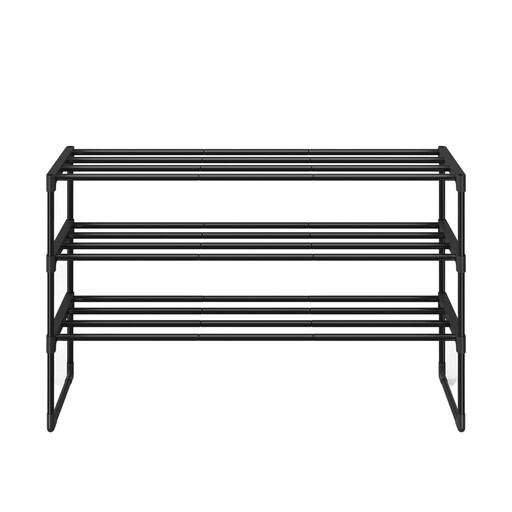
Why it suits this profile: According to the product information, this 30 × 92 × 55 cm metal shoe rack can be placed upright, upside down or stacked. The stated capacity is 16 to 20 pairs.
The flexible configuration is useful when your layout changes. When stacking and loading the rack, always check its stability and the stated load capacity.
Metal tubes, tool-free assembly, a maximum of 10 kg per level and 30 kg in total according to the product information.
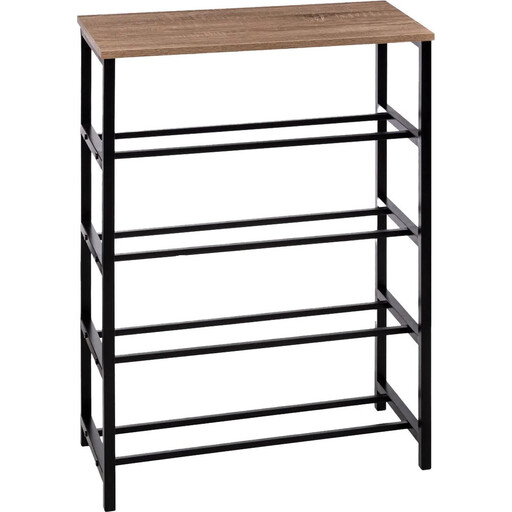
Why it suits this profile: The two open tiers provide room for up to 12 pairs of shoes. The top surface offers extra space for keys, bags or decorative items.
The open compartments make different shoe sizes immediately visible. Secure the unit to the wall, as stated in the safety information.
Steel frame, chipboard shelves, FSC mentioned in the product information and a width of 63 cm.
We have compiled a complete, up-to-date list of products that fully meet these strict selection criteria and the applicable European safety regulations.
Choose an open shoe rack when you wear your shoes every day and good air circulation is important to you. This type is often lightweight, easy to move and suitable for a wardrobe, bedroom or living room.
A shoe cabinet is a better choice when you want to keep your shoes out of sight. A model with flap doors makes efficient use of vertical space and gives the hallway a calmer appearance. However, check that the flaps open far enough and that your favourite shoes fit in the compartments.
For households with changing needs, a space-saving shoe organiser with stackable or adjustable components can be useful. Also consider maintenance: remove mud straight away and avoid using excessive water on MDF or chipboard.
It depends on the width, number of levels and type of footwear. Compact models may offer space for 6 pairs, while taller shoe cabinets or wide metal racks can accommodate 12, 16 or 20 pairs according to their product information. Allow for less capacity when storing boots and wide trainers.
Place the shoe rack on a level surface, put heavier shoes at the bottom and use the supplied anti-tip protection. A tall model should be secured to the wall whenever this is specified in the instructions. After assembly, check that all connections are firmly tightened.
An open shoe rack provides quick access and ventilation. A closed shoe cabinet with flap doors keeps shoes out of sight and can make the hallway look tidier. With a closed model, measure the opening space particularly carefully and check the compartment height against your shoe collection.
