
Vandaag of morgen in huis

Kwaliteit gegarandeerd

Welkomstaanbiedingen ontgrendelen: GRATIS bezorging | Tot 80% korting | Gratis 30 dagen JoyPlus-proefperiode
Download de app
A shoe rack may seem like a simple purchase, until you find that the model wobbles, does not fit in the hallway or holds fewer shoes than expected. Especially in homes with a narrow entrance, limited cupboard space or a large household, the dimensions and stability matter more than an attractive product photo.
When comparing shoe racks, do not just look at the number of tiers. Also check the actual width, depth, height, load capacity and assembly method. This will help you avoid buying a model that proves awkward to use after just a few weeks.
A description such as “for 30 pairs of shoes” sounds clear, but the space available depends on the type of footwear. Low-top trainers take up less room than ankle boots or wide sports shoes. So check whether the stated capacity suits your collection.
A shoe rack for 30 pairs is particularly practical if you have lots of low shoes and can make good use of the available height. For a smaller household, a compact shoe rack with several tiers may be enough.
A rack may have a limited width but still be relatively deep. So do not just measure the wall. Also take doors, skirting boards and the walking space in the hallway into account.
For a hallway shoe rack, a depth of around 25 to 30 cm is usually convenient, but the right size depends on the location. A shoe rack for a wardrobe or clothing cupboard with smaller compartments may be a better fit.
A lightweight metal shoe rack is easy to move, but it can become unstable when the shoes are distributed unevenly. Check that the surface is level, the connections are firmly secured and that the rack can be stacked safely according to the product instructions.
For a tall model, it is worth checking whether it needs to be secured to the wall. Also, do not use a shoe rack as a seat or step unless the manufacturer explicitly states that it is suitable for this purpose.
Before ordering, note down the available width, depth and height. For example, a 117 cm-wide model will not fit every entrance, while a 92 cm rack may be better suited to a narrow wall.
Also look at:
A stackable shoe rack can be useful if you want to expand your storage later. However, check that the construction is actually designed for stacking multiple units. A standalone shoe organiser for under the bed or inside a cupboard is not automatically suitable for stacking.
A metal shoe rack often consists of metal tubes with plastic connectors. This can provide a lightweight and flexible solution. Do not just consider the material; also check the stated maximum static load for each tier and for the rack as a whole.
An open metal rack provides ventilation and keeps shoes clearly visible. A shoe cabinet, on the other hand, offers better protection against dust and gives the hallway a tidier appearance. For damp shoes, it is important to let them dry first before placing them in a closed cabinet.
Tool-free assembly is practical for students, tenants and anyone who wants to move the rack regularly. Larger models may require assembly with tools. After assembly, check all the connections and place the rack on a stable, level surface.
For most metal and plastic models, a soft, slightly damp cloth is all you need for cleaning. Dry metal surfaces afterwards, particularly if the rack is kept in an area where wet shoes are stored.
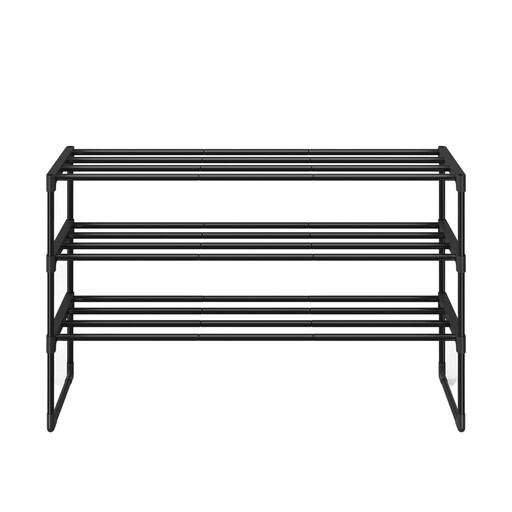
Why it suits this profile: This black metal shoe rack is 92 cm wide and 30 cm deep. This makes it suitable for a smaller hallway, cupboard or living room where wall space is limited. According to the product description, it holds 16–20 pairs of shoes.
The width and depth are clearly stated, allowing you to measure beforehand. The manufacturer also specifies a maximum static load of 10 kg per tier and 30 kg in total.
Three tiers, a black finish, metal tubes and tool-free assembly according to the product information.
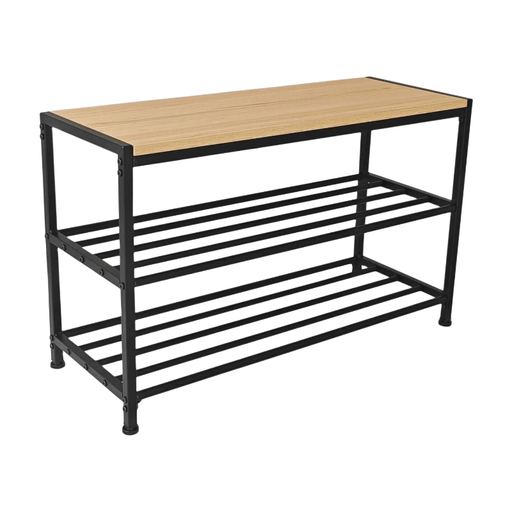
Why it suits this profile: This model combines a black powder-coated metal frame with a wooden top shelf. It is ideal if you are looking for a hallway shoe rack that also provides space for a bag, keys or decorations.
The stated dimensions of 80 x 30 x 49,2 cm make it easy to check how much space you need. The capacity is specified as 6 pairs, so you do not have to rely on a vague storage claim.
Space for 6 pairs of shoes, an additional top shelf and an open design according to the product description.

Why it suits this profile: This tall model is designed for households with a larger shoe collection. The product details state that it holds 30 pairs of shoes and measures 65,5 x 24,5 x 138 cm.
The vertical design makes use of height rather than just floor space. As the rack is 138 cm tall, check beforehand that it will not clash with a shelf, door or ceiling.
Stated capacity of 30 pairs, a metal construction and a narrow dimension of 24,5 cm in one direction.
We have put together a complete, up-to-date list of products that fully meet these strict selection criteria and the applicable European safety regulations.
Not every home has room for a freestanding rack. A wardrobe shoe rack or plastic shoe organiser may be suitable for a few pairs that you wear less often. According to the product information, the 5five Plastic Shoe Rack Spacy measures 29,5 x 11,1 x 14 cm and is designed to hold up to 3 pairs of shoes. Place the model on a level surface and do not exceed the stated capacity.
For doors and unused vertical space, a hanging organiser is another option. According to the product description, the ANQI organiser has a metal frame, mesh pockets and a height of 67,2 inches. With a door, check that the weight and construction will not interfere with opening and closing it.
Measure the space at three points: width, depth and height. Leave extra room for skirting boards, doors and taking shoes out. With a narrow shoe rack, depth is particularly important, as a model that is too deep can restrict the passageway in the hallway.
An open metal rack allows air to circulate, but let wet shoes drain and dry first. Dry the metal parts if they have been in prolonged contact with moisture. This makes the surface easier to maintain.
Its lifespan depends on the material, load, assembly and use. Distribute shoes evenly, do not exceed the stated load capacity and check the connections regularly. With plastic components, it is especially important to spot cracks or deformation promptly.
A shoe rack keeps shoes immediately visible and is often easier to access. A shoe cabinet creates a tidier appearance and offers better protection against dust. Choose based on the available space, ventilation and how often you wear the shoes.
