
Vandaag of morgen in huis

Kwaliteit gegarandeerd

Welkomstaanbiedingen ontgrendelen: GRATIS bezorging | Tot 80% korting | Gratis 30 dagen JoyPlus-proefperiode
Download de app
A shoe rack may seem like a simple purchase, until you discover that it does not fit in the hallway, wobbles or holds fewer shoes than expected. The right size is particularly important in Dutch homes with a narrow corridor or limited storage space. The difference between an open shoe organiser, shoe cabinet and shoe bench also determines how practical the solution is for everyday use.
A description such as “shoe rack for 30 pairs” sounds generous, but the actual capacity depends on the type of shoes. Low-top trainers take up less space than boots, high-top shoes or children’s shoes. So do not just check the stated number of pairs; also check the height and depth of each compartment.
Product pages do not always list dimensions in the same order. Check whether the measurements are given as width × depth × height. A narrow shoe rack that is 24.5 cm deep may be suitable for a hallway, whereas a 35 cm-deep model takes up more walking space.
Also measure skirting boards, doors and passageways. When choosing a shoe rack for the hallway, leave enough room to open doors and walk comfortably past the unit.
A tall rack is more likely to tip over if the weight is distributed unevenly. A shoe cabinet or tall shoe organiser should therefore be placed on a level surface. Some models recommend or include wall fixing. Use this feature when the product information says it is necessary, particularly in a household with children.
Also pay attention to the assembly method. “Easy to assemble” does not mean you will not need to set aside time to tighten the connections properly. After assembly, regularly check that the joints are still secure.
Choose the location first, then the size. For a small hallway, models measuring around 24 to 30 cm deep are often more practical. A low shoe rack can be placed under a coat rack or against a low wall. A tall model makes use of vertical space, but must be positioned securely.
Consider your everyday needs when assessing capacity:
A metal shoe rack is generally easy to wipe clean and has an open layout. Steel or metal tubes are often combined with plastic connectors. With these models, check whether the maximum load per shelf is clearly stated.
A wooden shoe rack or shoe bench works well in a warm, inviting interior. Bamboo and composite board do require careful maintenance, however: remove moisture and mud quickly and do not use harsh cleaning products. An open design allows air to circulate around the shoes, while a closed shoe cabinet keeps the shoes out of sight.
Pay attention to the difference between a shelf’s load capacity and that of a seating area. For a shoe bench, the maximum load for sitting is relevant; for a rack, it is the static load per shelf or the total load of the unit.
Place heavier shoes at the bottom. This generally helps a tall shoe organiser remain more stable. Also, do not use a shoe bench as a seat unless the product information states that it is suitable for this purpose.
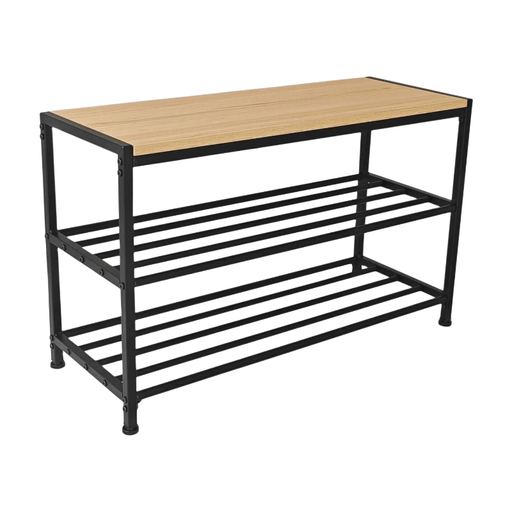
Why it suits this profile: The compact dimensions of 80 × 30 × 49.2 cm fit in a small hallway, bedroom or corridor. The model offers space for 6 pairs of shoes and has an additional wooden top shelf.
The dimensions and capacity are clearly stated. This means you can check in advance whether 6 pairs will be enough and whether the rack will fit in the available space.
Powder-coated metal frame, wooden top shelf, open design and compact width.

Why it suits this profile: This shoe bench combines storage with a seat. Measuring 90 cm long and with a maximum load of 110 kg, it is designed for use while putting on your shoes.
The product information states both the material and the maximum load. This prevents confusion between a decorative rack and a piece of furniture you can sit on.
Bamboo frame and shelves, seating function, space for shoes, slippers and clogs, FSC certification.

Why it suits this profile: According to the product description, the vertical layout provides space for 30 pairs of shoes. At 24.5 cm deep, this is a space-saving shoe rack for a relatively narrow corridor.
The stated dimensions and storage capacity make it easier to assess the required vertical space in advance. Place the rack on a level surface and check the connections after assembly.
Suitable for 30 pairs according to the product information, metal construction, white finish and shallow depth.
We have put together a complete, up-to-date list of products that fully meet these strict selection criteria and the applicable European safety regulations.
An open shoe rack is convenient when you want to grab your shoes quickly and ventilation is important. A shoe cabinet keeps shoes and loose items more out of sight. With a narrow model featuring doors, check the internal dimensions: flaps and adjustable shelves can affect the space available for each pair.
A shoe bench is suitable for a hallway where you want to put your shoes on while seated. Models with a seat cushion require extra attention to the maximum load and the surface they are placed on. If you want to store coats, bags and shoes in one unit, a hallway unit with hooks, a shelf and a bench may be more practical, but this type of solution takes up more vertical space.
For a narrow corridor, a depth of around 24 to 30 cm is often convenient. Measure your largest shoe and check that the toe does not protrude beyond the shelf. Boots may require greater depth or an adjustable layout.
Place the rack on a level floor, distribute heavier shoes across the bottom shelves and follow the assembly instructions. Use the supplied anti-tip feature or wall fixing when the product information recommends it. Check screws and connections regularly.
Its lifespan depends on the material, load, moisture and assembly. Stay within the maximum load, remove mud and moisture promptly and use the unit only for its intended purpose. Products with a statutory guarantee in the EU are covered by the applicable statutory conformity rules for at least the required period; check the terms for each product.
